
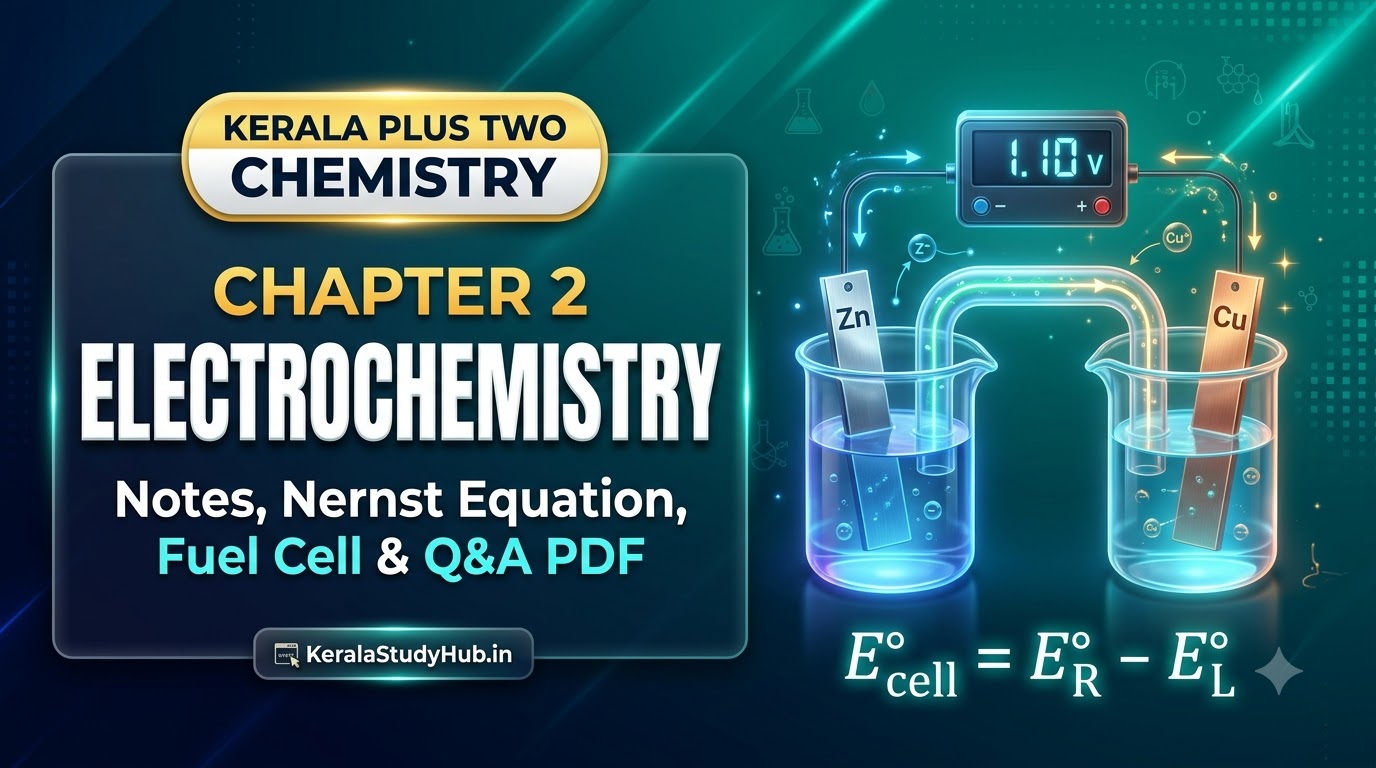
After studying liquid solutions in Kerala Plus Two Chemistry Chapter 1 (Solutions) and electric circuits in Plus Two Physics Chapter 3 (Current Electricity), we now bring Chemistry and Electricity together in Kerala Plus Two Chemistry Chapter 2 — Electrochemistry (വൈദ്യുതരസതന്ത്രം)! Electrochemistry is the branch of chemistry that deals with the conversion of chemical energy into electrical energy (in batteries and fuel cells) and electrical energy into chemical energy (in electrolysis).
- Plus Two Chemistry Chapter 2 (Electrochemistry) Overview & Weightage (പാഠഭാഗത്തിന്റെ സംഗ്രഹം)
- Easy Revision Notes: Electrochemistry (പ്രധാന ആശയങ്ങൾ ലളിതമായി പഠിക്കാം)
- 1. Galvanic (Voltaic) Cell & Daniell Cell (ഗാൽവാനിക് സെല്ലും ഡാനിയൽ സെല്ലും)
- 2. Standard Hydrogen Electrode (SHE) & Nernst Equation (നേൺസ്റ്റ് സമവാക്യം)
- 3. Conductance, Molar Conductivity (Λ_m) & Kohlrausch’s Law (കോൾറാഷ് നിയമം)
- 4. Faraday’s Two Laws of Electrolysis (ഫാരഡെയുടെ വൈദ്യുതവിശ്ലേഷണ നിയമങ്ങൾ)
- 5. Commercial Cells (Batteries), Fuel Cells & Corrosion (ബാറ്ററികളും ഇന്ധന സെല്ലും തുരുമ്പിക്കലും)
- 1 Mark, 2 Mark & 3 Mark Questions — DHSE Board Pattern (ചോദ്യോത്തരങ്ങൾ)
- Frequently Asked Questions (FAQ) — Kerala Plus Two Chemistry Chapter 2
- 1. What are the two main advantages of a Fuel Cell over ordinary thermal power plants?
- 2. Where can I study Plus Two Chemistry Chapter 1 and Plus Two Physics notes?
In the DHSE Kerala Class 12 Chemistry Public Exam for 2026–27, Chapter 2 (Electrochemistry) carries the highest marks weightage in the entire syllabus (9 to 10 Marks). If you learn the Daniell Cell, Standard Hydrogen Electrode (SHE), Nernst Equation numericals, Molar Conductivity & Kohlrausch’s Law, Lead Storage Battery, H₂–O₂ Fuel Cell, and the Electrochemical Theory of Rusting of Iron, you will score full marks effortlessly. Here is the complete English and Malayalam Medium (മലയാളം മീഡിയം) revision guide by Kerala Study Hub (KeralaStudyHub.in).
Plus Two Chemistry Chapter 2 (Electrochemistry) Overview & Weightage (പാഠഭാഗത്തിന്റെ സംഗ്രഹം)
| Exam Feature | Details for 2026–27 DHSE Kerala Plus Two Chemistry Syllabus |
|---|---|
| Board & Class | DHSE & SCERT Kerala — Plus Two (Class 12) |
| Subject | Chemistry (രസതന്ത്രം) |
| Chapter Number & Title | Chapter 2: Electrochemistry (വൈദ്യുതരസതന്ത്രം) |
| Medium Covered | English Medium (EM) & Malayalam Medium (MM) |
| Expected Marks Weightage | 9 to 10 Marks (Highest Weightage Chapter in Plus Two Chemistry!) |
| Sure-Shot Exam Topics | Daniell Cell & Salt Bridge, Nernst Equation, Kohlrausch’s Law, H₂–O₂ Fuel Cell, Lead Storage Battery, Rusting of Iron |
Easy Revision Notes: Electrochemistry (പ്രധാന ആശയങ്ങൾ ലളിതമായി പഠിക്കാം)
1. Galvanic (Voltaic) Cell & Daniell Cell (ഗാൽവാനിക് സെല്ലും ഡാനിയൽ സെല്ലും)
A device that converts chemical energy of a spontaneous redox reaction into electrical energy is called a Galvanic Cell (or Voltaic Cell — ഗാൽവാനിക് സെൽ). The most famous example is the Daniell Cell (ഡാനിയൽ സെൽ), which uses Zinc (Zn) and Copper (Cu) electrodes:
- Memory Trick “LOAN” for Galvanic Cells:
Left electrode = Oxidation = Anode = Negative terminal! - Reactions in a Daniell Cell:
• At Anode (Left, Negative — Oxidation): Zn(s) → Zn²⁺(aq) + 2e⁻ (E° = −0.76 V)
• At Cathode (Right, Positive — Reduction): Cu²⁺(aq) + 2e⁻ → Cu(s) (E° = +0.34 V)
• Net Cell Reaction: Zn(s) + Cu²⁺(aq) → Zn²⁺(aq) + Cu(s) - Cell Representation (IUPAC Notation):
Zn(s) | Zn²⁺(aq, 1 M) || Cu²⁺(aq, 1 M) | Cu(s)
*(Here, the double vertical line || represents the Salt Bridge!)* - Standard EMF of Daniell Cell (E°_cell):
E°_cell = E°_cathode − E°_anode = E°_right − E°_left
E°_cell = (+0.34 V) − (−0.76 V) = +1.10 V! - What is a Salt Bridge and what are its 2 functions? (സാൾട്ട് ബ്രിഡ്ജ് — 2-Mark Repeated Question):
A Salt Bridge is an inverted U-tube filled with an inert electrolyte like KCl, KNO₃, or NH₄NO₃ mixed with agar-agar gel.
• Function 1: It completes the inner electrical circuit by allowing the movement of ions.
• Function 2: It maintains electrical neutrality (വൈദ്യുത നിഷ്പക്ഷത) of the solutions in both half-cells!
2. Standard Hydrogen Electrode (SHE) & Nernst Equation (നേൺസ്റ്റ് സമവാക്യം)
- Standard Hydrogen Electrode (SHE — സ്റ്റാൻഡേർഡ് ഹൈഡ്രജൻ ഇലക്ട്രോഡ്): Used as the primary reference electrode to measure the standard electrode potential of other metals. Its potential is assigned as exactly Zero (E° = 0.00 V) at all temperatures! It consists of a platinum foil coated with finely divided platinum black dipped in 1 M H⁺ (HCl) solution through which pure H₂ gas at 1 bar pressure is bubbled.
- Nernst Equation at 298 K (25 °C) [Guaranteed 3-Mark Numerical Topic!]:
For a general cell reaction aA + bB → cC + dD involving transfer of n moles of electrons:
E_cell = E°_cell − (0.0591 / n) × log₁₀ ( [Products] / [Reactants] )
• Nernst Equation for a Daniell Cell at 298 K (where n = 2):
E_cell = E°_cell − (0.0591 / 2) × log₁₀ ( [Zn²⁺] / [Cu²⁺] ) - Relation Between E°_cell, Equilibrium Constant (K_c), and Gibbs Energy (ΔG°):
• At equilibrium, E_cell = 0 ⇒ E°_cell = (0.0591 / n) log₁₀ K_c
• Δ_r G° = − n F E°_cell = − 2.303 R T log₁₀ K_c (where 1 Faraday F = 96,487 C mol⁻¹ ≈ 96,500 C mol⁻¹).
3. Conductance, Molar Conductivity (Λ_m) & Kohlrausch’s Law (കോൾറാഷ് നിയമം)
| Conductivity Term & Symbol | Formula (Clean Unicode Format) | SI / Common Unit & Effect of Dilution (നേർപ്പിക്കുമ്പോൾ) |
|---|---|---|
| 1. Conductivity / Specific Conductance (κ — കാപ്പ) | κ = (1 / R) × (l / A) = G × G* *(where G* = l / A is Cell Constant)* |
Unit: S cm⁻¹ or S m⁻¹ • DECREASES on dilution! *(Because number of ions per unit volume (1 cm³) decreases on adding water!)* |
| 2. Molar Conductivity (Λ_m — മോളാർ ചാലകത) | Λ_m = (κ × 1000) / M *(where M is Molarity)* |
Unit: S cm² mol⁻¹ • INCREASES on dilution! *(Because total volume V containing 1 mole of electrolyte increases!).* |
| 3. Debye–Hückel–Onsager Equation (Strong Electrolytes) | Λ_m = Λ°_m − A √C | Graph of Λ_m vs √C is a straight line with negative slope (−A) for strong electrolytes (like KCl, NaCl). |
💡 Kohlrausch’s Law of Independent Migration of Ions (കോൾറാഷ് നിയമം — 3-Mark Sure Question!):
- Statement: The limiting molar conductivity of an electrolyte at infinite dilution (Λ°_m) can be represented as the sum of the individual contributions of the anion and cation of the electrolyte.
• For NaCl: Λ°_m (NaCl) = λ°(Na⁺) + λ°(Cl⁻)
• For CaCl₂: Λ°_m (CaCl₂) = λ°(Ca²⁺) + 2 λ°(Cl⁻) - Main Applications of Kohlrausch’s Law:
1. To calculate Λ°_m of weak electrolytes (like Acetic acid CH₃COOH, whose Λ°_m cannot be found by graphical extrapolation):
Λ°_m(CH₃COOH) = Λ°_m(CH₃COONa) + Λ°_m(HCl) − Λ°_m(NaCl)
2. To calculate the Degree of Dissociation (α = Λ_m / Λ°_m) and Dissociation Constant [K_a = C α² / (1 − α)] of a weak electrolyte.
4. Faraday’s Two Laws of Electrolysis (ഫാരഡെയുടെ വൈദ്യുതവിശ്ലേഷണ നിയമങ്ങൾ)
- Faraday’s First Law: The amount (mass w) of any substance deposited or liberated at any electrode during electrolysis is directly proportional to the quantity of electricity (charge Q = I × t) passed through the electrolyte:
w = Z × Q = Z × I × t = (E × I × t) / 96500 - Faraday’s Second Law: When the same quantity of electricity is passed through different electrolytes connected in series, the masses of different substances liberated at the electrodes are directly proportional to their chemical equivalent weights (w₁ / E₁ = w₂ / E₂).
• Quick 1-Mark Exam Counts:
1. Al³⁺ + 3e⁻ → Al requires 3 Faradays (3 × 96500 C) per mole of Al.
2. Cu²⁺ + 2e⁻ → Cu requires 2 Faradays per mole of Cu.
3. Oxidation of 1 mole of H₂O to O₂ requires 2 Faradays; 1 mole of MnO₄⁻ to Mn²⁺ requires 5 Faradays!
5. Commercial Cells (Batteries), Fuel Cells & Corrosion (ബാറ്ററികളും ഇന്ധന സെല്ലും തുരുമ്പിക്കലും)
| Cell Type & Name | Anode & Cathode | Electrolyte & Key Exam Feature |
|---|---|---|
| 1. Dry Cell (Leclanché Cell) (Primary / Non-rechargeable) |
• Anode: Zinc container • Cathode: Carbon (Graphite) rod surrounded by MnO₂ + C |
Moist paste of NH₄Cl and ZnCl₂. Cell potential = 1.5 V. |
| 2. Mercury Cell (Button Cell) (Primary — used in watches & hearing aids) |
• Anode: Zn–Hg amalgam • Cathode: Paste of HgO and Carbon |
Paste of KOH and ZnO. Gives a constant voltage of 1.35 V throughout its life because no ions in solution are involved in the net reaction! |
| 3. Lead Storage Battery (Secondary / Rechargeable — used in cars & inverters) |
• Anode: Lead (Pb) • Cathode: Grid of lead packed with Lead Dioxide (PbO₂) |
38% Sulphuric Acid (H₂SO₄) solution. • Net Discharging Reaction: Pb(s) + PbO₂(s) + 2 H₂SO₄(aq) → 2 PbSO₄(s) + 2 H₂O(l) |
| 4. H₂–O₂ Fuel Cell (ഇന്ധന സെൽ — used in Apollo space programme!) |
Porous Carbon electrodes containing Pt/Pd catalysts with H₂ (Anode) and O₂ (Cathode) | Concentrated aqueous NaOH / KOH. • Net Reaction: 2 H₂(g) + O₂(g) → 2 H₂O(l) • Advantages: Pollution-free (produces drinking water!) and high efficiency (~70%). |
💡 Electrochemical Theory of Rusting of Iron (ഇരുമ്പിന്റെ തുരുമ്പിക്കൽ — 3-Mark Question):
Rusting of iron is an electrochemical phenomenon where a tiny water droplet containing dissolved CO₂ and O₂ on the iron surface acts as a miniature electrochemical cell:
- At Anode (Pure Iron spot): 2 Fe(s) → 2 Fe²⁺ + 4e⁻
- At Cathode: O₂(g) + 4 H⁺(aq) + 4e⁻ → 2 H₂O(l)
- The Fe²⁺ ions are further oxidised by atmospheric oxygen to Hydrated Ferric Oxide [Fe₂O₃ · xH₂O — Rust (തുരുമ്പ്)]!
- Prevention of Rusting: Painting/greasing, Galvanisation (coating iron with Zinc), and Sacrificial / Cathodic Protection (connecting iron pipes to more reactive metals like Mg or Zn).
1 Mark, 2 Mark & 3 Mark Questions — DHSE Board Pattern (ചോദ്യോത്തരങ്ങൾ)
Q1. Why does the voltage of a Mercury Cell remain constant (1.35 V) throughout its entire life?
Answer:
Because the overall cell reaction [Zn(Hg) + HgO(s) → ZnO(s) + Hg(l)] does NOT involve any ion in solution whose concentration can change during its lifetime.
Q2. Why does the conductivity (κ) of a solution decrease with dilution, whereas molar conductivity (Λ_m) increases with dilution?
Answer:
• Conductivity (κ) decreases on dilution because the number of ions per unit volume (1 cm³) that carry the current decreases on adding water.
• Molar conductivity (Λ_m = κ × V) increases on dilution because the total volume V of solution containing 1 mole of electrolyte increases sharply (and for weak electrolytes, degree of dissociation α also increases).
Q3. Calculate the EMF of the following cell at 298 K:
Mg(s) | Mg²⁺ (0.001 M) || Cu²⁺ (0.0001 M) | Cu(s)
Given: E°(Mg²⁺/Mg) = −2.37 V and E°(Cu²⁺/Cu) = +0.34 V.
Answer:
1. Standard Cell Potential (E°_cell):
E°_cell = E°_cathode − E°_anode = (+0.34) − (−2.37) = +2.71 V.
2. Applying Nernst Equation at 298 K (here n = 2):
• E_cell = E°_cell − (0.0591 / 2) × log₁₀ ( [Mg²⁺] / [Cu²⁺] )
• E_cell = 2.71 − 0.02955 × log₁₀ ( 0.001 / 0.0001 )
• Since 0.001 / 0.0001 = 10¹ and log₁₀(10) = 1:
• E_cell = 2.71 − (0.02955 × 1) = 2.6805 V (or 2.68 V).
Q4. Values of Λ°_m for NaCl, HCl, and CH₃COONa are 126.4, 425.9, and 91.0 S cm² mol⁻¹ respectively. Calculate Λ°_m for CH₃COOH (Acetic acid).
Answer:
By Kohlrausch’s Law:
• Λ°_m(CH₃COOH) = Λ°_m(CH₃COONa) + Λ°_m(HCl) − Λ°_m(NaCl)
• Λ°_m(CH₃COOH) = 91.0 + 425.9 − 126.4 = 516.9 − 126.4 = 390.5 S cm² mol⁻¹.
Frequently Asked Questions (FAQ) — Kerala Plus Two Chemistry Chapter 2
1. What are the two main advantages of a Fuel Cell over ordinary thermal power plants?
(1) Fuel cells are 100% pollution-free (the only by-product in an H₂–O₂ fuel cell is pure water), and (2) They have a much higher efficiency (~70%) compared to thermal plants (~40%).
2. Where can I study Plus Two Chemistry Chapter 1 and Plus Two Physics notes?
Explore our Class 12 study guides here:
• Plus Two Chemistry Chapter 1: Solutions Notes & Q&A
• Plus Two Physics Chapter 3: Current Electricity Notes & Q&A