
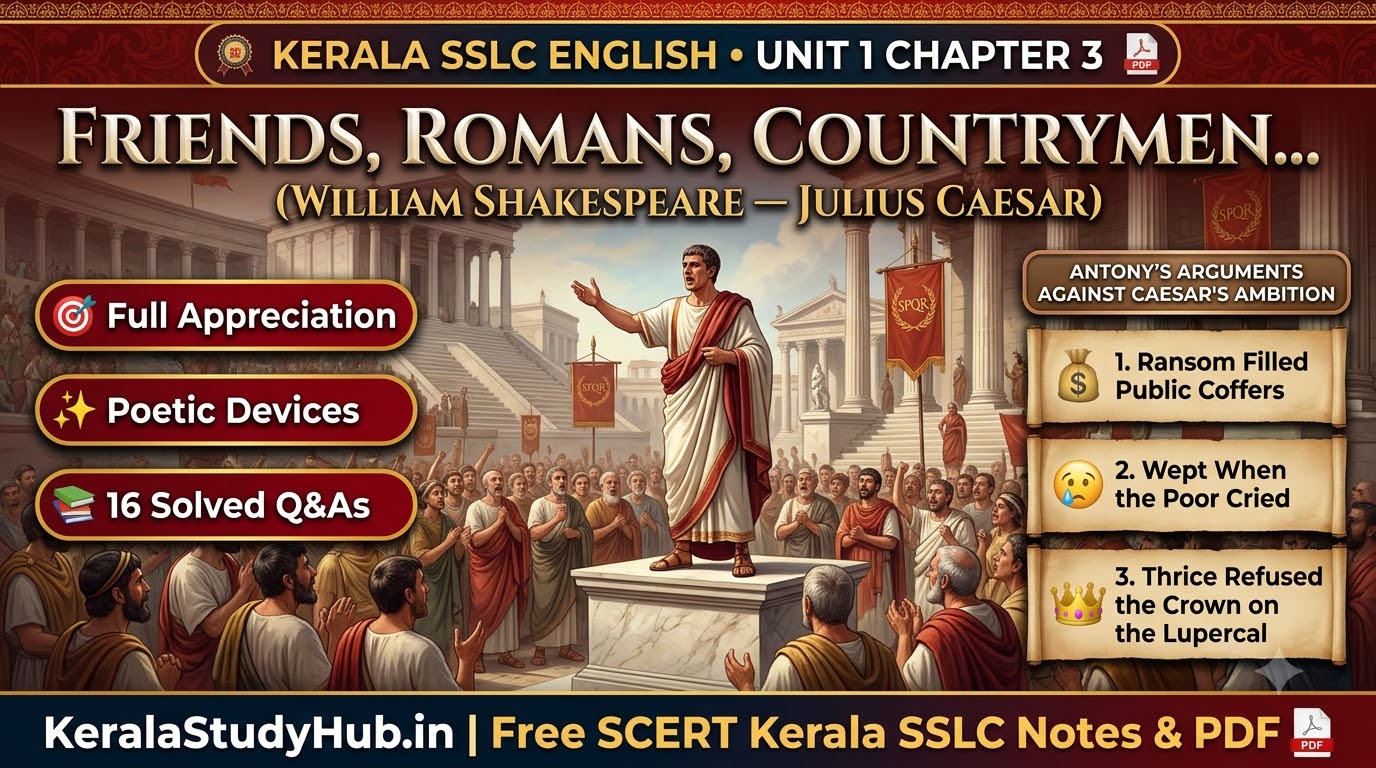
Kerala SSLC English Chapter 3 Notes on “Friends, Romans, Countrymen…” by William Shakespeare welcome you to the third and concluding lesson of Unit I (Trials and Triumphs) in the newly revised Class 10 (Std 10) Kerala Reader English textbook published by the State Council of Educational Research and Training (SCERT Kerala). In my classroom, when we perform this iconic dramatic speech from Act III, Scene II of Shakespeare’s tragedy Julius Caesar, I ask my students: “How does Mark Antony step up to a pulpit facing a hostile Roman crowd that has just cheered Brutus for assassinating Julius Caesar, obey the strict condition that he must not blame the conspirators, and yet—within thirtyfive lines of brilliant verbal irony—turn the entire Roman public against Brutus and his fellow assassins?”
- 1. Section-by-Section Summary & Line-by-Line Classroom Analysis
- 2. Complete Critical Appreciation of “Friends, Romans, Countrymen…” (6-Mark SSLC Question)
- 3. Character Sketch of Mark Antony & Solved Discourses
- Character Sketch of Mark Antony (6 Marks)
- Discourse: Diary Entry of a Roman Citizen After Listening to Mark Antony’s Speech (5 Marks)
- 4. Complete Textbook Solutions & Extra Exam Questions (16 Fully Solved Q&As)
Prepared strictly for the Kerala Pareeksha Bhavan SSLC Public Examination, this complete classroom guide covers the Line-by-Line Paraphrase & Explanation, Malayalam Summary, Full 6-Mark Critical Appreciation of the Speech/Poem, Poetic & Rhetorical Devices (Verbal Irony, Refrain, Metonymy, Metaphor, Rhetorical Questions & Blank Verse), Character Sketch of Mark Antony, and 16 Solved Textbook & Exam Questions and Answers.
Quick SSLC English Navigation: SSLC English All 15 Chapters Master Hub | Previous: Chapter 1: A Very Old Man with Enormous Wings & Chapter 2: In the Attic | Next: Chapter 4: Breaking Barriers, I Will Fly (Srikanth Bolla).
CHAPTER 3 AT A GLANCE: “FRIENDS, ROMANS, COUNTRYMEN…” (LITERARY & EXAM BLUEPRINT)
- Title, Playwright & Source: “Friends, Romans, Countrymen…” (Mark Antony’s Funeral Oration) by William Shakespeare (1564–1616), the Bard of Avon; extracted from Act III, Scene II of the tragedy Julius Caesar.
- Speaker & Context: Delivered by Mark Antony (Caesar’s loyal friend and general) at Caesar’s funeral in the Roman Forum, immediately after Marcus Brutus justified the assassination by claiming that “Caesar was ambitious.”
- Antony’s 3 Counter-Arguments Against “Ambition”: (1) Caesar brought many captives home to Rome whose ransoms filled the public coffers (treasury), (2) When the poor cried, Caesar wept, and (3) On the feast of the Lupercal, Antony thrice offered him a kingly crown, which Caesar thrice refused!
- Verse Form & Key Literary Devices: Written in Blank Verse (unrhymed iambic pentameter). Uses Verbal Irony & Refrain (“Yet Brutus says he was ambitious, / And Brutus is an honourable man”), Metonymy (“lend me your ears”), Rhetorical Questions, and Personification/Hyperbole (“My heart is in the coffin there with Caesar”).
1. Section-by-Section Summary & Line-by-Line Classroom Analysis
| Key Lines from Shakespeare’s Text | Meaning, Rhetorical Strategy & Literary Devices |
|---|---|
| 1. “Friends, Romans, countrymen, lend me your ears; / I come to bury Caesar, not to praise him. / The evil that men do lives after them; / The good is oft interred with their bones…” | Antony wins the hostile crowd’s trust by addressing them first as “Friends” (equals) before “Romans” and “countrymen”. “Lend me your ears” is a classic example of Metonymy (asking for their close attention). He pretends neutrality by saying he has come only to bury Caesar, not to praise him, and remarks philosophically that men’s faults are remembered long after they die, while their good deeds are buried with their bones. |
| 2. “The noble Brutus / Hath told you Caesar was ambitious: / If it were so, it was a grievous fault, / And grievously hath Caesar answer’d it.” | Antony introduces conditional doubt with the words “If it were so”! He agrees that if Caesar really was ambitious, it was a serious fault, and Caesar has already paid a terrible price (“grievously hath Caesar answer’d it”) with his life. He politely acknowledges that he speaks by the permission of Brutus and the rest, calling them all “honourable men”. |
| 3. “He was my friend, faithful and just to me… / He hath brought many captives home to Rome / Whose ransoms did the general coffers fill: / Did this in Caesar seem ambitious?” | Evidence 1 Against Ambition: Antony testifies that Caesar was a faithful and just friend, and reminds the citizens that Caesar brought home many prisoners of war whose ransom money went into the public treasury (general coffers) for the welfare of Rome, not into Caesar’s private pocket! He follows this with a sharp Rhetorical Question: “Did this in Caesar seem ambitious?” |
| 4. “When that the poor have cried, Caesar hath wept: / Ambition should be made of sterner stuff: / Yet Brutus says he was ambitious; / And Brutus is an honourable man.” | Evidence 2 Against Ambition: Caesar was deeply compassionate and wept whenever the poor suffered, whereas true ruthless ambition is made of harder, crueler material (“sterner stuff”; notice the Alliteration in sterner stuff). Repeating the refrain “And Brutus is an honourable man” turns the compliment into biting Verbal Irony! |
| 5. “You all did see that on the Lupercal / I thrice presented him a kingly crown, / Which he did thrice refuse: was this ambition?” | Evidence 3 Against Ambition (The Climax): Antony appeals to what the citizens saw with their own eyes during the festival of the Lupercal: Antony offered Caesar a royal crown three times, and three times Caesar refused it! If Caesar wanted to be a tyrant king, why did he refuse the crown three times? |
| 6. “O judgment! thou art fled to brutish beasts, / And men have lost their reason. Bear with me; / My heart is in the coffin there with Caesar, / And I must pause till it come back to me.” | Antony reminds the citizens that they once loved Caesar dearly and asks why they now refuse to mourn for him. Using Apostrophe & Alliteration (“brutish beasts”—a subtle pun on Brutus!), he laments that human reason has fled to wild animals. He then makes a masterstroke dramatic pause, claiming he is too choked with grief to continue because his heart lies inside Caesar’s coffin—giving the crowd time to let his words sink in and turn against the conspirators! |
മലയാളം സംഗ്രഹം (Malayalam Summary — “Friends, Romans, Countrymen…” by William Shakespeare):
വില്യം ഷേക്സ്പിയറിന്റെ (William Shakespeare) ‘ജൂലിയസ് സീസർ’ (Julius Caesar) എന്ന വിഖ്യാത ദുരന്തനാടകത്തിലെ മൂന്നാം അങ്കത്തിൽ (Act III, Scene II) സീസറുടെ മൃതദേഹത്തിന് മുന്നിൽ വെച്ച് ഉറ്റസുഹൃത്തായ മാർക്ക് ആന്റണി (Mark Antony) നടത്തുന്ന ലോകപ്രശസ്തമായ പ്രസംഗമാണ് “Friends, Romans, Countrymen…”. സീസർ അമിതമായ അധികാരമോഹിയായിരുന്നു (Ambitious) എന്ന കാരണത്താലാണ് തങ്ങൾ അദ്ദേഹത്തെ വധിച്ചതെന്ന് ബ്രൂട്ടസ് (Brutus) ജനങ്ങളെ പറഞ്ഞു വിശ്വസിപ്പിച്ചിരുന്നു. ഗൂഢാലോചനക്കാരെ കുറ്റപ്പെടുത്തരുത് എന്ന നിബന്ധനയോടെ പ്രസംഗിക്കാൻ കയറിയ മാർക്ക് ആന്റണി, അത്യന്തം ബുദ്ധിപരമായ പരിഹാസത്തിലൂടെയും (Verbal Irony) മൂന്ന് തെളിവുകളിലൂടെയും ബ്രൂട്ടസിന്റെ വാദങ്ങളെ പൊളിച്ചടുക്കുന്നു: (1) യുദ്ധത്തടവുകാരുടെ മോചനദ്രവ്യം സീസർ പൊതുഖജനാവിലേക്കാണ് (Public coffers) നൽകിയത്, (2) പാവപ്പെട്ടവർ കരഞ്ഞപ്പോൾ സീസറും അവർക്കൊപ്പം കരഞ്ഞു, (3) ലൂപ്പർക്കൽ (Lupercal) ഉത്സവത്തിൽ താൻ മൂന്ന് തവണ കിരീടം വെച്ചുനീട്ടിയിട്ടും സീസർ അത് മൂന്ന് തവണയും നിരസിച്ചു! “എന്നിട്ടും ബ്രൂട്ടസ് പറയുന്നു സീസർ അധികാരമോഹിയായിരുന്നു എന്ന്; ബ്രൂട്ടസ് ഒരു മാന്യനായ മനുഷ്യനാണ് (And Brutus is an honourable man)” എന്ന് ആവർത്തിച്ചു പറഞ്ഞുകൊണ്ട് റോമൻ ജനതയുടെ വികാരം സീസർക്കനുകൂലമായി മാറ്റാൻ മാർക്ക് ആന്റണിക്ക് കഴിയുന്നു.

2. Complete Critical Appreciation of “Friends, Romans, Countrymen…” (6-Mark SSLC Question)
Introduction: The dramatic verse passage “Friends, Romans, Countrymen…” is the opening part of Mark Antony’s immortal funeral oration from Act III, Scene II of William Shakespeare’s celebrated Roman tragedy Julius Caesar. Spoken over the assassinated body of Julius Caesar in the Roman Forum, it stands as one of the finest masterpieces of persuasive rhetoric and psychological mastery in world literature.
Theme and Context: Just before Antony speaks, Marcus Brutus had convinced the Roman citizens that Caesar had to be killed because he was “ambitious” and would have enslaved Rome. Permitted to speak on the strict condition that he must not blame the conspirators, Antony uses facts, emotional appeal (pathos), and biting verbal irony to dismantle Brutus’s claim of Caesar’s ambition and awaken grief and outrage in the hearts of the Roman public.
Rhetorical Mastery & Evidence: Antony begins modestly, addressing the crowd as “Friends, Romans, countrymen” and claiming he has come “to bury Caesar, not to praise him.” Without ever directly calling Brutus a liar, he presents three undeniable facts: first, Caesar filled Rome’s public coffers with the ransoms of captives; second, Caesar wept whenever the poor cried; and third, on the feast of the Lupercal, Caesar thrice refused a kingly crown offered by Antony himself.
Poetic Craft & Literary Devices: Composed in dignified Blank Verse (unrhymed iambic pentameter), the speech is rich in figures of speech. The repeated refrain—“Yet Brutus says he was ambitious; / And Brutus is an honourable man”—is a textbook example of Verbal Irony, where each repetition hollows out Brutus’s honour until the crowd realizes the conspirators are traitors. Shakespeare employs Metonymy in “lend me your ears”, Alliteration in “faithful and just”, “sterner stuff”, and “brutish beasts”, Rhetorical Questions (“Did this in Caesar seem ambitious?”, “Was this ambition?”), Apostrophe (“O judgment! thou art fled to brutish beasts”), and Hyperbole / Metaphor in the closing lines (“My heart is in the coffin there with Caesar”).
Conclusion: Through its rhythmic cadence, emotional sincerity, and razor-sharp irony, Mark Antony’s speech demonstrates the immense power of language to sway public opinion and expose political hypocrisy.
3. Character Sketch of Mark Antony & Solved Discourses
Character Sketch of Mark Antony (6 Marks)
Mark Antony is Julius Caesar’s devoted friend, general, and one of the most brilliant orators in Shakespearean drama. When Caesar is brutally assassinated by Brutus, Cassius, and the other conspirators, Antony combines deep personal grief with extraordinary political intelligence and self-control. Knowing that the Roman mob has just been won over by Brutus’s speech, Antony does not attack the conspirators directly. Instead, he displays remarkable psychological insight into crowd behaviour. Addressing the citizens warmly as “Friends, Romans, countrymen,” he adopts a humble, respectful tone while systematically disproving Brutus’s accusation that Caesar was ambitious. By citing Caesar’s generosity in filling the public treasury, his tears for the poor, and his thrice-repeated refusal of the royal crown at the Lupercal, Antony lets the facts speak for themselves. His mastery of verbal irony, rhetorical questions, and dramatic pauses—pausing in tears as he says his heart lies in the coffin with Caesar—reveals him as a fiercely loyal friend, a master strategist, and a supreme orator.
Discourse: Diary Entry of a Roman Citizen After Listening to Mark Antony’s Speech (5 Marks)
Ides of March (15 March, 44 BC)
9:30 PM
How blind and foolish we Romans were this morning, and how deeply Mark Antony’s words have opened our eyes tonight! When Brutus spoke to us from the pulpit, we believed his claim that Julius Caesar was ambitious and deserved to die. But then Mark Antony stepped up beside Caesar’s bleeding body and reminded us of the truth we had so easily forgotten. Did Caesar keep the ransom of captives for himself? No—he filled the public treasury for us! Did he not weep whenever the poor of Rome cried? And did we not see with our own eyes on the feast of the Lupercal how he refused the kingly crown three times? Truly, as Antony said, our judgment had fled to brutish beasts! The “honourable” men who stabbed our noble Caesar are not saviours, but ungrateful traitors.
4. Complete Textbook Solutions & Extra Exam Questions (16 Fully Solved Q&As)
Q1: Who is the speaker of “Friends, Romans, Countrymen…”, and on what occasion is the speech delivered?
Answer: The speaker is Mark Antony, a loyal friend and general of Julius Caesar. He delivers this funeral oration in the Roman Forum over the assassinated body of Julius Caesar, immediately after Brutus has addressed the Roman citizens to justify Caesar’s murder.
Q2: Why does Mark Antony begin his speech with “Friends, Romans, countrymen, lend me your ears”? Identify the figure of speech.
Answer: Because the crowd is initially hostile to Caesar and supportive of Brutus, Antony addresses them first as “Friends” to establish an emotional bond of equality and warmth before appealing to their civic pride as “Romans” and “countrymen”. The phrase “lend me your ears” is an example of Metonymy, where “ears” stands for the crowd’s patient attention.
Q3: Explain the meaning of the lines: “The evil that men do lives after them; / The good is oft interred with their bones.”
Answer: Antony observes that the mistakes or evil deeds committed by people are remembered long after their death, whereas the noble and good deeds they performed during their lifetime are often forgotten and buried along with their bones in the grave.
Q4: What accusation had Brutus made against Caesar to justify his assassination? How does Antony cast doubt on it in the opening lines?
Answer: Brutus had accused Caesar of being ambitious (seeking to become a tyrant king over Rome). Antony casts doubt on this accusation by using the conditional clause “If it were so, it was a grievous fault,” subtly suggesting to the listeners that Caesar’s ambition is merely Brutus’s claim, not a proven fact.
Q5: What are the three specific pieces of evidence Mark Antony presents to prove that Caesar was NOT ambitious?
Answer:
1. Caesar brought many war captives home to Rome, and their ransom money filled the public coffers (state treasury) rather than enriching Caesar personally.
2. Whenever the poor cried, Caesar wept with empathy, showing he was tender-hearted rather than made of the “sterner stuff” of ruthless ambition.
3. On the feast of the Lupercal, Antony thrice offered Caesar a kingly crown in front of everyone, and Caesar thrice refused it.
Q6: Why does Mark Antony repeatedly call Brutus and the conspirators “honourable men”? What literary device is used here?
Answer: Antony had promised Brutus that he would not speak ill of the conspirators in his funeral speech. By repeating the refrain “And Brutus is an honourable man” immediately after presenting hard evidence that contradicts Brutus’s claim, Antony uses Verbal Irony—saying the exact opposite of what he means—so the crowd itself realizes that Brutus is neither truthful nor honourable.
Q7: What does Antony mean by “Ambition should be made of sterner stuff”?
Answer: Antony means that an ambitious person who craves absolute power is usually hard-hearted, selfish, and unfeeling toward the suffering of ordinary people. Since Caesar wept whenever the poor cried, he possessed a compassionate heart, not the harsh (“sterner”) nature of an ambitious tyrant.
Q8: What is the significance of the rhetorical questions “Did this in Caesar seem ambitious?” and “Was this ambition?”
Answer: A rhetorical question does not require an answer because the answer (“No!”) is obvious. Instead of telling the citizens what to think, Antony asks these questions so that the citizens themselves actively conclude in their own minds that Caesar was not ambitious.
Q9: How does Antony remind the Roman citizens of their past love for Caesar?
Answer: Antony says, “You all did love him once, not without cause: / What cause withholds you then, to mourn for him?” He reminds them that they had good reasons to love Caesar in the past, making them feel guilty for abandoning their loyalty so quickly after his murder.
Q10: Explain the exclamation: “O judgment! thou art fled to brutish beasts, / And men have lost their reason.”
Answer: Addressing “Judgment” directly (Apostrophe / Personification), Antony laments that sound judgment and common sense have abandoned human beings and fled to wild animals (“brutish beasts”—which also echoes the name Brutus), leaving the men of Rome irrational for celebrating the murder of their benefactor.
Q11: Why does Antony pause at the end of this passage, saying “My heart is in the coffin there with Caesar, / And I must pause till it come back to me”?
Answer: On an emotional level, Antony shows the crowd his overwhelming grief by saying his heart lies buried in the coffin with Caesar. On a strategic level, pausing allows the crowd to see his tears, discuss his arguments among themselves, and turn their anger against Brutus and the conspirators.
Q12: What is “Blank Verse”, and why does Shakespeare use it for Mark Antony’s speech?
Answer: Blank Verse is unrhymed verse written in iambic pentameter (lines of ten syllables with five unstressed-stressed beats). Shakespeare uses blank verse for Mark Antony’s speech (whereas Brutus spoke in prose) to give Antony’s oration a musical rhythm, emotional elevation, and dramatic power.
Q13: Pick out three instances of Alliteration from the speech.
Answer:
1. “He was my friend, faithful and just to me” (repetition of /f/ sound)
2. “Ambition should be made of sterner stuff” (repetition of /s/ sound)
3. “O judgment! thou art fled to brutish beasts” (repetition of /b/ sound).
Q14: What was the Feast of the Lupercal?
Answer: The Lupercal (Lupercalia) was an ancient Roman pastoral festival celebrated annually on February 15 to purify the city and promote health and fertility. During this public festival, Mark Antony had thrice offered a royal crown to Julius Caesar.
Q15: How does Mark Antony avoid breaking the condition imposed by Brutus while still achieving his goal?
Answer: Antony strictly obeys the letter of Brutus’s condition by never uttering a single direct insult against Brutus or the conspirators—instead calling them “honourable men” four times—while juxtaposing that praise with undeniable facts of Caesar’s selflessness so the crowd draws the conclusion that Caesar was murdered unjustly.
Q16: Give the modern English meanings of the archaic Shakespearean words used in the speech: (i) oft, (ii) interred, (iii) hath, (iv) coffers, (v) thrice, (vi) withholds.
Answer:
• (i) Oft: Often
• (ii) Interred: Buried in a grave/tomb
• (iii) Hath: Has
• (iv) Coffers: Treasury / strongboxes for holding public money
• (v) Thrice: Three times
• (vi) Withholds: Holds back / prevents.
Teacher’s Classroom Note & Student Discussion Question:
In your SSLC English exam, when a 5-mark or 6-mark Appreciation question gives lines from “Friends, Romans, Countrymen…”, be sure to highlight the three terms Blank Verse, Verbal Irony, and Rhetorical Questions—examiners look specifically for these three literary terms!
Quick Challenge for You (Drop Your Answer in the Comments Below!): How many times did Mark Antony offer the kingly crown to Julius Caesar on the feast of the Lupercal, and how many times did Caesar refuse it? Comment below!



Latest SCERT & DHSE Kerala Study Notes
- Kerala Class 9 Physics Chapter 2 Notes: Equations of Motion (ചലനസമവാക്യങ്ങൾ) Std 9 Let Us Assess Questions and Answers PDF
- Kerala SSLC Christmas Exam Question Paper 2025-27: All Subjects Second Term & Model Question Papers with Solved Answer Keys PDF (New SCERT Syllabus)
- Kerala SSLC English Christmas Exam Question Paper 2025-27: Second Term & Model Solved 80-Mark Answer Key, Discourses & Grammar PDF
- Kerala SSLC Social Science Christmas Exam Question Paper 2025-27: Second Term & Model Solved 80-Mark Answer Key, Weightage & Map Study PDF
- Kerala SSLC Maths Christmas Exam Question Paper 2025-27: Second Term & Model Solved Answer Key, Weightage & Formula Sheet PDF (New SCERT Syllabus)
- Kerala SSLC Biology Christmas Exam Question Paper 2025-27: Second Term & Model Solved Answer Key, Weightage & Flowcharts PDF (New SCERT Syllabus)
- Kerala SSLC Chemistry Christmas Exam Question Paper 2025-27: Second Term & Model Solved Answer Key, Weightage & Sure A+ Questions PDF (New SCERT Syllabus)
- Kerala SSLC Physics Christmas Exam Question Paper 2025-27: Second Term & Model Solved Answer Key, Weightage & Formula Sheet PDF (New SCERT Syllabus)