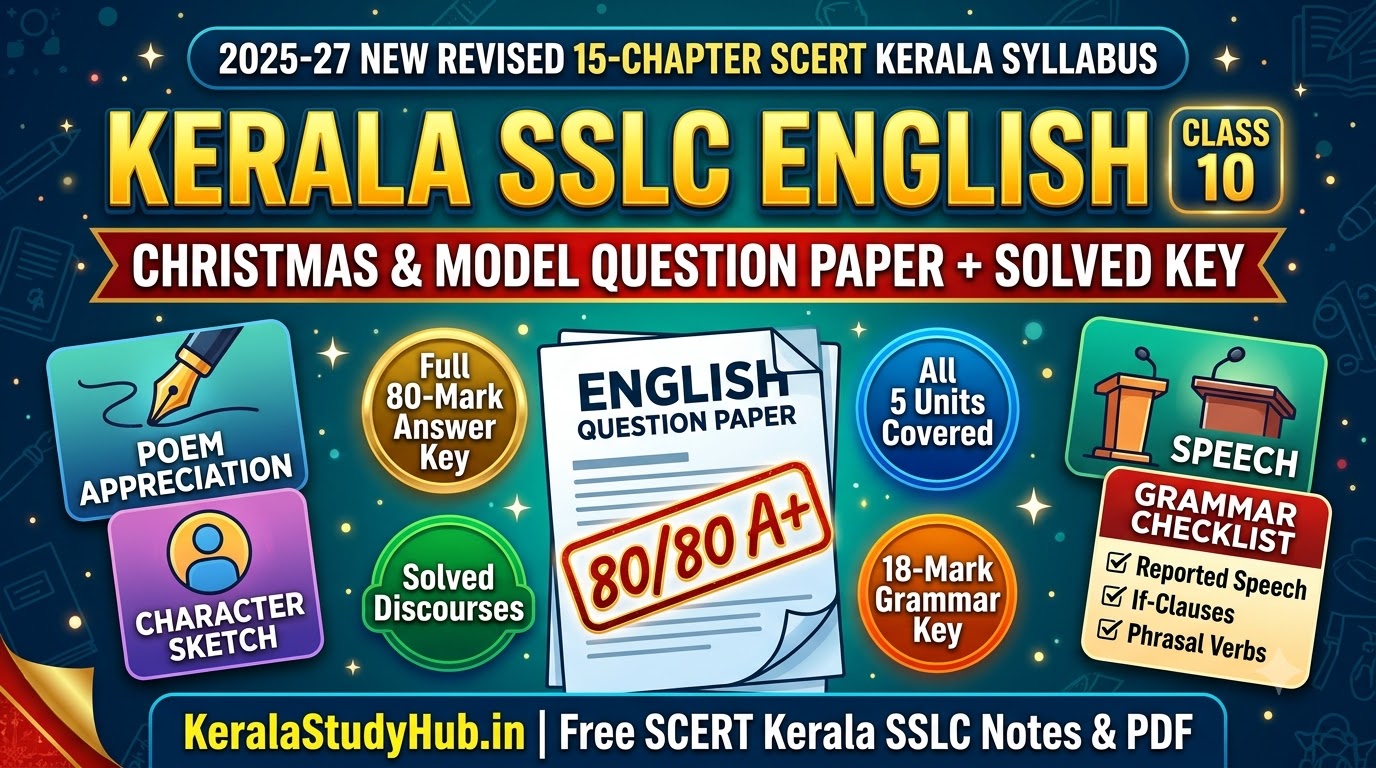
Kerala SSLC English Christmas Exam Question Paper and complete 80-Mark Solved Answer Key (2025–27 New Revised 15-Chapter SCERT Syllabus) give Class 10 students a full-length, board-pattern practice question paper for the December Second Term (Christmas) Examination, the February Model Examination, and the March Public Examination conducted by the Kerala Pareeksha Bhavan. Because the State Council of Educational Research and Training (SCERT Kerala) introduced an entirely new 15-chapter Class 10 English Reader across 5 units (Trials and Triumphs, Paths to Progress, The Trumpets of Change, Woodland Whispers, and Songs of the Self), practising with this updated 2025–27 question paper is the fastest way to secure an A+ Grade (72+ out of 80)!
- 1. Full 80-Mark Solved SSLC English Second Term & Model Question Paper (With Model Answers)
- PART I: Reading Comprehension & Poem Appreciation (Questions 1–11)
- PART II: Solved Minor & Major Discourses (Character Sketch, Diary, Letter, Profile & Speech)
- PART III: Solved Grammar & Language Elements (18 Marks — Exact Board Pattern)
In my English classroom, I train my students on the exact 4-part structure of the 80-Mark SSLC English Question Paper: (1) Reading Comprehension — Prose, Poem & Unseen Passage (22 Marks), (2) Critical Poem Appreciation (6 Marks), (3) Minor & Major Discourses — Character Sketch, Speech, Letter, Diary, Conversation, Notice & Profile (34 Marks), and (4) Grammar & Language Elements — Editing, Conversation Completion, Reported Speech, Phrasal Verbs & Word Pyramid (18 Marks).
Quick SSLC Exam Navigation: SSLC English All 15 Chapters Master Hub | Previous: SSLC Social Science Question Paper | All-Subjects SSLC Question Paper Master Hub.
SSLC ENGLISH EXAM AT A GLANCE: 80-MARK QUESTION PAPER BLUEPRINT (2025–27)
- Questions 1–15 (Reading Comprehension — 22 Marks): Prose excerpt (6 Marks), Poem stanza excerpt (4 Marks), Poem Appreciation (6 Marks), and Unseen/Supplementary passage (6 Marks).
- Questions 16–21 (5-Mark Minor Discourses — Answer Any 4 out of 6 = 20 Marks): Character Sketch, Diary Entry, Informal/Formal Letter, Notice, Conversation, or Thoughts.
- Questions 22–25 (7-Mark & 6-Mark Major Discourses = 20 Marks): Biographical Profile (6 Marks, compulsory) + Speech / Narrative / News Report / Write-up (Answer Any 2 out of 3 = 14 Marks).
- Questions 26–32 (Grammar & Language Elements = 18 Marks): Information Transfer (4M), Editing (4M), Conversation Completion — Question Tags & Conditionals (4M), Reported Speech (2M), Phrasal Verbs (2M), and Word Pyramid / Cohesive Devices (2M).
1. Full 80-Mark Solved SSLC English Second Term & Model Question Paper (With Model Answers)
PART I: Reading Comprehension & Poem Appreciation (Questions 1–11)
Read the excerpt from Chapter 8: “War” by Luigi Pirandello and answer Questions 1 to 4 (6 Marks):
“Then… is your son really dead?” Everybody stared at her. The old man, too, turned to look at her, fixing his great, bulging, horribly watery light grey eyes, deep in their sockets, directly on her face. For some little time he tried to answer, but words failed him. Then suddenly, as if only at that moment he had realized that his son was really dead—gone forever—he broke into harrowing, heart-rending, uncontrollable sobs.
• Q1 (1 Mark): Who asked the question “Then… is your son really dead?”
Answer: The grieving mother (the woman in mourning whose only son had just been sent to the war front).
• Q2 (1 Mark): What was the old man preaching to his fellow passengers just before this question?
Answer: He was preaching that parents should not weep when their sons die for King and Country, claiming his own son had sent a message saying he died happy.
• Q3 (2 Marks): Why did words fail the old man when the woman asked her simple question?
Answer: Until that moment, the old man had been hiding his unbearable grief behind high-sounding patriotic speeches. Her innocent, literal question pierced his intellectual denial and forced him to confront the finality of his son’s death.
• Q4 (2 Marks): Pick out the phrase from the passage that describes the old man’s eyes and explain what it reveals about his inner state.
Answer: “great, bulging, horribly watery light grey eyes, deep in their sockets” — it reveals his suppressed agony, sleeplessness, and emotional exhaustion.
Read the lines from Chapter 12: “The Wild Swans at Coole” by W.B. Yeats and answer Questions 5 to 8 (4 Marks):
The nineteenth autumn has come upon me / Since I first made my count; / I saw, before I had well finished, / All suddenly mount / And scatter wheeling in great broken rings / Upon their clamorous wings.
• Q5 (1 Mark): How many years have passed since the poet first counted the swans?
Answer: Nineteen years (nineteen autumns).
• Q6 (1 Mark): What did the swans suddenly do before the poet finished counting them?
Answer: They suddenly mounted into the air and scattered wheeling in great broken rings.
• Q7 (1 Mark): Identify one visual image and one auditory image from the stanza.
Answer: Visual image: “wheeling in great broken rings”; Auditory image: “clamorous wings”.
• Q8 (1 Mark): What is the rhyme scheme of this six-line stanza?
Answer: ABCBDD (count/mount and rings/wings).
Q9 (6 Marks — Compulsory Poem Appreciation): Prepare a critical appreciation of Sylvia Plath’s poem “Mirror” (Chapter 15) focusing on its theme, speaker, tone, poetic devices, and imagery.
Answer (6-Mark Model Appreciation):
Introduction: “Mirror” is a famous confessional poem written in two nine-line stanzas of free verse by Pulitzer Prize-winning American poet Sylvia Plath. Narrated by a personified mirror, the poem explores the themes of objective truth, human vanity, and the painful reality of ageing.
Theme & Content: In Stanza 1, the mirror describes itself as “silver and exact” with “no preconceptions”. Unclouded by love or dislike, it reflects whatever stands before it truthfully, calling itself “The eye of a little god, four-cornered.” In Stanza 2, the mirror becomes a deep lake (“Now I am a lake”). A woman bends over it every morning searching for her lost youth. Shocked by her ageing face, she turns to “those liars, the candles or the moon”, whose dim light hides her wrinkles, yet she returns to the truthful mirror with tears. Over the years, a young girl has drowned in the mirror, and an old woman rises toward her daily “like a terrible fish”.
Poetic Devices & Conclusion: Plath uses sustained Personification (the mirror speaking as “I”), striking Metaphors (“eye of a little god”, “Now I am a lake”, “those liars”), a haunting closing Simile (“like a terrible fish”), and vivid Visual Imagery (silver, pink with speckles, candles, moon) to remind us that time and truth cannot be escaped.
PART II: Solved Minor & Major Discourses (Character Sketch, Diary, Letter, Profile & Speech)
Q10 (5 Marks — Character Sketch): Prepare a character sketch of Teresa in Maxim Gorky’s short story “Beloved Boles” (Chapter 13).
Answer: Teresa is the deeply moving protagonist of Maxim Gorky’s Beloved Boles. A tall, muscular Polish woman living in a Moscow tenement opposite the student narrator, she has bushy black eyebrows, a coarse pockmarked face, and a deep bass voice. Because of her rough appearance, society judges her as a “fallen” woman. Yet beneath her tough exterior beats a gentle, lonely heart starving for human affection. Being illiterate and completely alone in the world, she invents an imaginary lover named Boleslav Kashput (“Boles”) so that others will read letters aloud to her and she can feel loved. Her tearful plea—“Am I not a human being like the rest?”—transforms the proud student and teaches us never to judge people by their outward appearance.
Q11 (5 Marks — Diary Entry): Imagine you are Wladyslaw Szpilman (Chapter 2: “In the Attic”). Write a Diary Entry on the night the German officer Captain Wilm Hosenfeld listened to you play Chopin on the piano and promised to bring you food.
Answer:
18 November 1944 | Night, Warsaw Attic
A miracle has happened tonight in this freezing ruin! When the German officer discovered me hiding in the pantry, I thought my final hour had come. Weak, unshaven, and starving, I told him I was a pianist. When he led me to the piano in the next room and asked me to play, my stiff, trembling fingers touched the keys for the first time in years, playing Chopin’s Nocturne in C-sharp minor. Instead of arresting me, the officer listened in silence, learned where my hiding loft was, and promised to bring me bread and food! Even in the darkest pit of war, music and humanity have saved my life tonight.
Q12 (6 Marks — Compulsory Biographical Profile): Prepare a short biographical profile of Dr. Salim Ali (Chapter 11) using the hints given below:
Birth: 12 November 1896, Mumbai — Known as: “Birdman of India” — Profession: Pioneering Ornithologist & Naturalist — Famous Books: The Book of Indian Birds (1941), Handbook of the Birds of India and Pakistan, The Fall of a Sparrow (Autobiography) — Awards: Padma Bhushan (1958), Padma Vibhushan (1976) — Demise: 20 June 1987.
Answer:
DR. SALIM ALI — THE BIRDMAN OF INDIA
Dr. Salim Moizuddin Abdul Ali, fondly remembered across the world as the “Birdman of India”, was born on 12 November 1896 in Mumbai. He was India’s greatest pioneering ornithologist and wildlife conservationist, who conducted the first systematic bird surveys across the Indian subcontinent. His landmark publications include The Book of Indian Birds (1941), the ten-volume Handbook of the Birds of India and Pakistan (co-authored with S. Dillon Ripley), and his celebrated autobiography The Fall of a Sparrow. In recognition of his monumental contributions to ornithology and nature conservation, the Government of India honoured him with the Padma Bhushan in 1958 and the Padma Vibhushan in 1976. This legendary naturalist passed away on 20 June 1987, leaving behind an immortal legacy in environmental science.
Q13 (7 Marks — Speech): In the light of Chapter 4: “Breaking Barriers, I Will Fly” (Srikanth Bolla), prepare a motivational speech to be delivered at your school assembly on the topic “Turning Obstacles into Stepping Stones”.
Answer:
Respected Principal, beloved teachers, and my dear friends,
A warm good morning to one and all! Today, I stand before you to share an inspiring message from the life of Srikanth Bolla in our lesson “Breaking Barriers, I Will Fly”: True vision comes not from the eyes, but from the mind and determination!
When Srikanth was born blind into a poor farming family, neighbours advised his parents to abandon him. Schools pushed him to the back bench, and the State education board denied him permission to study Science after Class 10. Did Srikanth give up? No! He fought a six-month legal battle in the High Court, scored 98% in Class 12, became the first international blind student at the Massachusetts Institute of Technology (MIT, USA), and returned to India to build Bollant Industries, giving dignified employment to hundreds of differently-abled individuals. Friends, whenever life places a wall in front of you, remember Srikanth Bolla’s words—do not let the world define your limits; spread your wings and fly! Thank you!
PART III: Solved Grammar & Language Elements (18 Marks — Exact Board Pattern)
Q14 (4 Marks — Editing): Edit the errors underlined in the following passage from “A Piece of String”:
Maître Hauchecorne was walking (a) slowly towards the public square when he see (b) a little piece of string on (c) the ground. He bent down painful (d) because he suffered from rheumatism.
Answer: (a) was walking (Correct — if were walking was given, change to was walking) | (b) saw | (c) on (if in the ground was given, change to on) | (d) painfully.
Q15 (4 Marks — Conversation Completion: Question Tag, If-Clause & Framing Questions):
Teresa: Good evening, sir. You are a university student, (a) __________?
Student: Yes, I am. (b) ____________________?
Teresa: I came here to ask you a small favour.
Student: If you tell me what you want, (c) ____________________.
Teresa: You had better (d) __________ (write / wrote) a short letter to my hometown.
Answer:
• (a) aren’t you?
• (b) Why did you come here? (or What can I do for you?)
• (c) I will help you (Type-1 Conditional).
• (d) write (had better is always followed by the bare infinitive V1).
Q16 (2 Marks — Reported Speech): Report the following dialogue:
Ascetic: “O King, do not shoot this tender deer of the hermitage.”
King Dushyanta: “I have withdrawn my arrow immediately.”
Answer:
• The ascetic requested (or forbade) the King not to shoot that tender deer of the hermitage.
• King Dushyanta replied that he had withdrawn his arrow immediately.
Q17 (2 Marks — Phrasal Verbs): Replace the underlined words with suitable phrasal verbs from the box:
[ put up with, give up, set out, call on ]
Dr. Salim Ali started his journey (a) early in the morning to observe birds, and he never abandoned (b) his passion despite hardships.
Answer: (a) set out | (b) gave up.
Teacher’s Classroom Note & Student Discussion Question:
In the 18-Mark Grammar section of SSLC English, remember the three golden rules of If-Clauses (Conditionals): (1) If + Simple Present (V1) → will/can + V1, (2) If + Simple Past (V2) → would/could + V1, and (3) If + Past Perfect (had + V3) → would have + V3!
Quick Challenge for You (Drop Your Answer in the Comments Below!): Complete this sentence with the correct Question Tag: “Let us help the poor woman, __________?” Comment your answer below!


Latest SCERT & DHSE Kerala Study Notes
- Kerala Class 9 Physics Chapter 2 Notes: Equations of Motion (ചലനസമവാക്യങ്ങൾ) Std 9 Let Us Assess Questions and Answers PDF
- Kerala SSLC Christmas Exam Question Paper 2025-27: All Subjects Second Term & Model Question Papers with Solved Answer Keys PDF (New SCERT Syllabus)
- Kerala SSLC Social Science Christmas Exam Question Paper 2025-27: Second Term & Model Solved 80-Mark Answer Key, Weightage & Map Study PDF
- Kerala SSLC Maths Christmas Exam Question Paper 2025-27: Second Term & Model Solved Answer Key, Weightage & Formula Sheet PDF (New SCERT Syllabus)
- Kerala SSLC Biology Christmas Exam Question Paper 2025-27: Second Term & Model Solved Answer Key, Weightage & Flowcharts PDF (New SCERT Syllabus)
- Kerala SSLC Chemistry Christmas Exam Question Paper 2025-27: Second Term & Model Solved Answer Key, Weightage & Sure A+ Questions PDF (New SCERT Syllabus)
- Kerala SSLC Physics Christmas Exam Question Paper 2025-27: Second Term & Model Solved Answer Key, Weightage & Formula Sheet PDF (New SCERT Syllabus)
- Kerala SSLC English Notes: All 15 Chapters New SCERT Textbook Solutions, Appreciations, Character Sketches & Discourses PDF (2025-27)