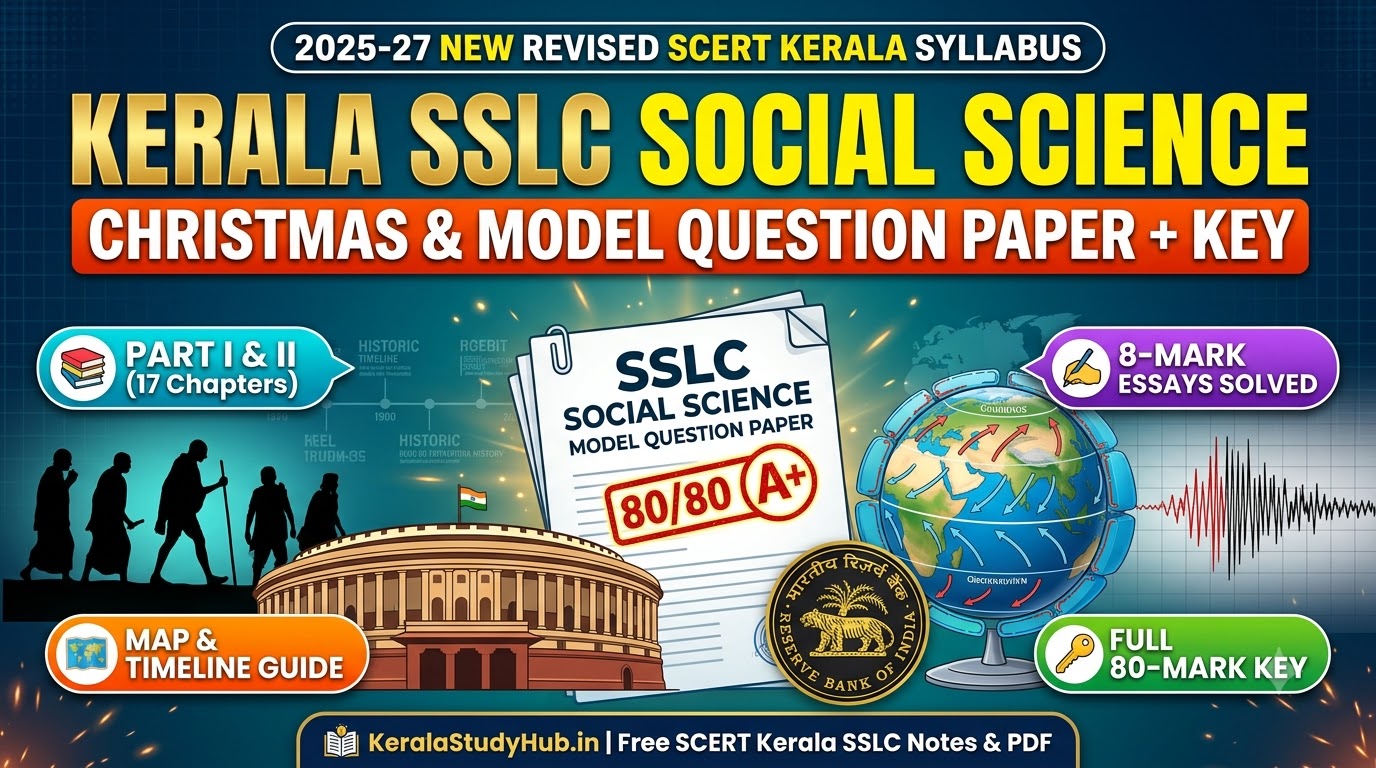
Kerala SSLC Social Science Christmas Exam Question Paper and complete 80-Mark Solved Answer Key (2025–27 New Revised SCERT Syllabus) have been compiled for Class 10 students preparing for the December Second Term (Christmas) Examination, the February Model Examination, and the March Public Examination conducted by the Kerala Pareeksha Bhavan. Because the State Council of Educational Research and Training (SCERT Kerala) introduced brand-new textbooks for both Social Science I (History, Political Science & Sociology — 9 Chapters) and Social Science II (Geography & Economics — 8 Chapters)—starting Part I with Humanism (മാനവികത) and Liberty, Equality, Fraternity and Part II with Weather and Climate and Climatic Regions—old question papers before 2025 no longer match your syllabus!
In my Social Science classroom, I guide my students to secure an effortless A+ (72+ out of 80) by mastering four high-scoring components: (1) Part A (40 Marks — All Compulsory Questions including the 4-Mark Map Question), (2) Part B (40 Marks — Choice-based Questions in Pairs), (3) World & Indian History Chronological Timelines, and (4) 8-Mark Essay Questions on the French Revolution / Indian National Movement and Planetary Winds / Geomorphic Processes.
Quick SSLC Exam Navigation: Social Science I Master Hub (9 Chapters) | Social Science II Master Hub (8 Chapters) | Next Paper: SSLC English Christmas & Model Question Paper.
SSLC SOCIAL SCIENCE EXAM AT A GLANCE: 80-MARK BLUEPRINT (PART I + PART II)
- Total Marks & Duration: 80 Marks Written Exam (40 Marks from Social Science I + 40 Marks from Social Science II) + 20 Marks CE = 100 Marks | Time: 2 Hours 30 Minutes + 15 Minutes Cool-off Time.
- Part A (40 Marks — Compulsory Section): Contains 1-Mark Objective MCQs, 3-Mark Short Notes, 4-Mark Analytical Questions, and the compulsory 4-Mark Outline Map Identification/Marking Question.
- Part B (40 Marks — Internal Choice Section): Every question number has an (A) or (B) internal choice from paired chapters across 3-Mark, 4-Mark, 5-Mark, and 8-Mark Essay Questions.
- Total Chapters Covered: 17 Chapters (9 Chapters in Social Science I + 8 Chapters in Social Science II).
1. All 17 Chapters Weightage & Study Notes Directory (Social Science I & II)
| Part & Chapter | English & Malayalam Title | High-Yield Exam Topics | Study Notes Link |
|---|---|---|---|
| SS-I Ch 1 | Humanism (മാനവികത) | Italian Renaissance, Petrarch, Da Vinci, Gutenberg, Martin Luther (5 Marks) | SS-I Ch 1 → |
| SS-I Ch 2 | Liberty, Equality, Fraternity (സ്വാതന്ത്ര്യം സമത്വം സാഹോദര്യം) | Three Estates, Voltaire/Rousseau/Montesquieu, Tennis Court Oath, Napoleon (6 Marks) | SS-I Ch 2 → |
| SS-I Ch 3 | Social Analysis: Sociological Imagination | Commonsense Knowledge vs Sociological Imagination (C. Wright Mills) (3 Marks) | SS-I Ch 3 → |
| SS-I Ch 4 | Wealth and the World (സമ്പത്തും ലോകവും) | Mercantilism, Industrial Revolution, WWI (Triple Alliance/Entente), Fascism, WWII (6 Marks) | SS-I Ch 4 → |
| SS-I Ch 5 | Public Opinion in Democracy | Characteristics & Agencies of Public Opinion, Media & Digital Literacy (3 Marks) | SS-I Ch 5 → |
| SS-I Ch 6 | Mass Movement for Freedom | Champaran/Kheda/Ahmedabad, Non-Cooperation, Civil Disobedience, Quit India, INA (8 Marks) | SS-I Ch 6 → |
| SS-I Ch 7 | The Glimpses of Free India | Integration of Princely States (Patel & V.P. Menon), 1956 States Reorganization, Panchsheel (4 Marks) | SS-I Ch 7 → |
| SS-I Ch 8 | Democracy: An Indian Experience | First General Election (1951–52), 1975 Emergency, Mandal Commission, RTI Act 2005 (3 Marks) | SS-I Ch 8 → |
| SS-I Ch 9 | Know the Indian Social System | Herbert Spencer, Diversity vs Pluralism, Rural-Urban Continuum, Tribal Society (3 Marks) | SS-I Ch 9 → |
| SS-II Ch 1 | Weather and Climate (ദിനാന്തരീക്ഷസ്ഥിതിയും കാലാവസ്ഥയും) | Heat Budget, 7 Global Pressure Belts, Planetary Winds (Trade, Westerlies), Ferrel’s Law (8 Marks) | SS-II Ch 1 → |
| SS-II Ch 2 | Climatic Regions and Climate Change | Mediterranean, Taiga, Savanna, Temperate Grasslands (Steppes/Prairies), Kyoto/Paris (5 Marks) | SS-II Ch 2 → |
| SS-II Ch 3 | From the Rainy Forests to the Land of Permafrost | Equatorial Selvas (4 O’clock Rain, Pygmies) vs Arctic Tundra (Inuit, Igloos, Permafrost) (4 Marks) | SS-II Ch 3 → |
| SS-II Ch 4 | Consumer: Rights and Protection | Law of Diminishing Marginal Utility, Consumer Protection Act 2019, 3-Tier Courts, ISI/AGMARK (4 Marks) | SS-II Ch 4 → |
| SS-II Ch 5 | Money and Economy (പണവും സമ്പദ്വ്യവസ്ഥയും) | Functions of RBI, Quantitative Credit Control (Repo, Reverse Repo, CRR, SLR), Inflation (5 Marks) | SS-II Ch 5 → |
| SS-II Ch 6 | The Changing Earth (മാറുന്ന ഭൂമി) | Endogenic (Diastrophism, Volcanism, Seismic Waves P, S, L) vs Exogenic (Weathering) (5 Marks) | SS-II Ch 6 → |
| SS-II Ch 7 | Indian Economy: Growth and Transformation | GDP vs Per Capita Income, HDI & PQLI, NITI Aayog (2015), 1991 LPG Reforms, Kerala Model (5 Marks) | SS-II Ch 7 → |
| SS-II Ch 8 | Towards Sustainability (സുസ്ഥിരതയിലേക്ക്) | Stocks vs Reserves, Ferrous vs Non-Ferrous Minerals, Non-Conventional Energy, SDGs (4 Marks) | SS-II Ch 8 → |
2. Full Solved SSLC Social Science Second Term & Model Question Paper (Part A & Part B — 16 High-Yield Exam Questions & Essays Solved)
Q1 (3 Marks — SS-I Ch 1 Humanism): Match the Renaissance thinkers and artists with their famous works:
(i) Dante Alighieri | (ii) Niccolò Machiavelli | (iii) Leonardo da Vinci | (iv) Michelangelo | (v) Thomas More | (vi) Erasmus.
Answer:
• (i) Dante Alighieri: The Divine Comedy | (ii) Niccolò Machiavelli: The Prince | (iii) Leonardo da Vinci: Mona Lisa & The Last Supper | (iv) Michelangelo: Pietà, David & The Last Judgment | (v) Thomas More: Utopia | (vi) Erasmus: In Praise of Folly.
Q2 (4 Marks — SS-I Ch 2 French Revolution): Describe the social inequality of the Three Estates in pre-revolutionary France and explain the contributions of Voltaire, Rousseau, and Montesquieu.
Answer:
• First Estate (Clergy) & Second Estate (Nobility): Owned vast lands, held high state offices, were exempted from paying taxes, and collected feudal dues (Tithe by the Church).
• Third Estate (Middle Class/Bourgeoisie, Peasants & Artisans): Comprised 98% of the population, had no political rights, and bore the entire tax burden (Taille to the State and Tithe to the Church).
• Thinkers: Voltaire ridiculed clergy exploitation; Rousseau declared in The Social Contract that “Man is born free, and everywhere he is in chains” (popular sovereignty); Montesquieu proposed the Separation of Powers (Legislature, Executive, Judiciary) in The Spirit of the Laws.
Q3 (3 Marks — SS-I Ch 3 Sociological Imagination): How does Sociological Imagination (C. Wright Mills) differ from Commonsense Knowledge when analysing a social problem like unemployment or poverty?
Answer: Commonsense knowledge is based on personal assumptions, stereotypes, and surface experience, blaming the individual’s laziness or fate for poverty/unemployment. In contrast, Sociological Imagination (introduced by C. Wright Mills in 1959) connects personal troubles with broader public structural issues (economic recession, lack of industrial policy, or social inequality) through scientific enquiry.
Q4 (4 Marks — SS-I Ch 4 Wealth and the World): Compare the military alliances of the First World War (1914–1918) and the Second World War (1939–1945) and explain how Imperialism led to global conflict.
Answer:
• First World War (1914–1918): Triple Alliance (Germany, Austria-Hungary, Italy) vs Triple Entente (Britain, France, Russia). Immediate cause: Assassination of Archduke Franz Ferdinand at Sarajevo.
• Second World War (1939–1945): Axis Powers (Germany, Italy, Japan) vs Allied Powers (Britain, France, USSR, USA, China).
• Role of Imperialism: Industrialized capitalist nations competed fiercely for raw materials and export markets in Asia and Africa, triggering aggressive nationalism, militarism, and secret alliances.
Q5 (4 Marks — SS-I Ch 7 Glimpses of Free India): Explain how Sardar Vallabhbhai Patel and V.P. Menon integrated the 565 Princely States into the Indian Union. Which three states initially refused to sign the Instrument of Accession, and how were they integrated?
Answer:
• Through the States Department led by Sardar Vallabhbhai Patel and its Secretary V.P. Menon, rulers were persuaded to sign the Instrument of Accession and Standstill Agreement.
• The three states that refused initially were:
1. Junagadh: Integrated through a popular Referendum (Plebiscite).
2. Hyderabad: Integrated through police/military action (Operation Polo in 1948).
3. Jammu & Kashmir: Maharaja Hari Singh signed the Instrument of Accession in October 1947 following Pakistani tribal invasion.
Q6 (8 Marks Essay — SS-I Ch 6 Mass Movement for Freedom): Explain the major mass movements led by Mahatma Gandhi in India’s struggle for freedom based on the following hints:
(i) Early Satyagraha Experiments (Champaran, Ahmedabad, Kheda) | (ii) Non-Cooperation Movement & Chauri Chaura (1920–22) | (iii) Civil Disobedience Movement & Dandi Salt March (1930) | (iv) Quit India Movement (1942).
Answer:
• (i) Early Struggles (1917–18): After returning from South Africa in 1915, Gandhiji led the Champaran Satyagraha (1917) in Bihar against indigo planters (Tinkathia system), the Ahmedabad Mill Strike (1918) for plague bonus (using hunger strike), and the Kheda Satyagraha (1918) in Gujarat demanding tax remission after crop failure.
• (ii) Non-Cooperation Movement (1920–22): Launched alongside the Khilafat Movement against the Rowlatt Act and Jallianwala Bagh Massacre (13 April 1919). Included boycott of foreign cloth, British courts, titles, and schools, and promotion of Khadi and national schools (Jamia Millia Islamia, Kashi Vidyapith). Suspended in February 1922 after the Chauri Chaura incident in Uttar Pradesh.
• (iii) Civil Disobedience Movement (1930): Following the 1929 Lahore Congress (Purna Swaraj), Gandhiji marched from Sabarmati Ashram to Dandi (12 March to 6 April 1930) with 78 followers to break the British Salt Law (in Kerala, K. Kelappan led the Payyannur Salt Satyagraha).
• (iv) Quit India Movement (August 1942): Launched in Bombay with the call “Do or Die” (Karo ya Maro) demanding immediate British withdrawal, uniting youth, peasants, and underground leaders like Jayaprakash Narayan and Aruna Asaf Ali.
Q7 (4 Marks — SS-II Ch 2 & 3 World Climatic Regions Map & Comparison): Compare the climatic conditions, natural vegetation, and human life of the Equatorial Climatic Region and the Tundra Region.
Answer:
• Equatorial Region (0°–10° N & S — Amazon Basin, Congo Basin, Indonesia): High temperature and heavy convectional 4 O’clock rainfall throughout the year; dense evergreen rainforests (Selvas in Amazon with mahogany, ebony, rosewood); inhabited by indigenous tribes such as Pygmies (Congo), Semang (Malaysia), and Yanomami (Amazon).
• Tundra Region (North of 60°–65° N — Alaska, Northern Canada, Greenland, Siberia): Long freezing winters with Permafrost (permanently frozen subsoil) and brief summers; treeless vegetation of mosses and lichens; inhabited by Inuit (Eskimos), Lapps, and Yakuts living in snow houses (Igloos) in winter and using sledges and kayaks.
Q8 (4 Marks — SS-II Ch 4 Consumer Rights & Protection): State the monetary jurisdiction limits of the Three-Tier Consumer Disputes Redressal Commissions under the Consumer Protection Act, 2019 (revised rules) and list four major rights of a consumer.
Answer:
• Three-Tier Consumer Commissions:
1. District Commission: Complaints where value of goods/services paid does not exceed Rs. 1 Crore (or up to Rs. 50 Lakhs under amended notified slab).
2. State Commission: Complaints between Rs. 1 Crore and Rs. 10 Crore (or Rs. 50 Lakhs to Rs. 2 Crore).
3. National Commission: Complaints exceeding Rs. 10 Crore (or above Rs. 2 Crore).
• Consumer Rights: Right to Safety, Right to be Informed, Right to Choose, Right to be Heard, Right to Seek Redressal, and Right to Consumer Education.
Q9 (5 Marks — SS-II Ch 5 Money and Economy): What are the major functions of the Reserve Bank of India (RBI)? How does the RBI control inflation using Repo Rate, Reverse Repo Rate, CRR, and SLR?
Answer:
• Functions of RBI (established 1 April 1935; nationalised 1949): Monopoly of currency note issue (except Rs. 1 note and coins), Banker to the Government, Bankers’ Bank, Controller of Credit, and Custodian of Foreign Exchange Reserves.
• Controlling Inflation (Quantitative Tools): During inflation, there is excess money supply in the economy. The RBI increases the Repo Rate (rate at which RBI lends to commercial banks), Reverse Repo Rate, Cash Reserve Ratio (CRR), and Statutory Liquidity Ratio (SLR). This reduces the lending capacity of commercial banks, makes loans costlier, and brings down inflation.
Q10 (5 Marks — SS-II Ch 6 The Changing Earth): Distinguish between Endogenic and Exogenic Earth Movements, and compare the characteristics of Primary (P), Secondary (S), and Surface (L) Seismic Waves.
Answer:
• Endogenic vs Exogenic Processes: Endogenic processes originate inside the Earth’s interior (Diastrophic/Orogenic & Epeirogenic movements, Earthquakes, and Volcanism); Exogenic processes operate on the Earth’s surface (Physical, Chemical & Biological Weathering, Erosion, and Mass Wasting).
• Seismic Waves:
– Primary Waves (P-waves): Fastest longitudinal waves; reach the seismograph first; can travel through solid, liquid, and gaseous media.
– Secondary Waves (S-waves): Transverse waves; can travel only through solid media (helping scientists deduce that Earth’s outer core is liquid).
– Surface Waves (L-waves): Travel along the Earth’s crust with high amplitude and cause the maximum destruction to buildings.
Q11 (8 Marks Essay — SS-II Ch 1 Weather and Climate): Explain the Global Pressure Belts and Planetary Winds with the help of a neat diagram based on the following hints:
(i) Equatorial Low, Sub-Tropical High, Sub-Polar Low & Polar High Pressure Belts | (ii) Trade Winds, Westerlies & Polar Easterlies | (iii) Ferrel’s Law & Coriolis Force.
Answer:
• (i) 7 Global Pressure Belts: (1) Equatorial Low Pressure Belt (Doldrums, 5°N–5°S): Thermally induced low pressure due to vertical sun rays; (2) Sub-Tropical High Pressure Belts (Horse Latitudes, 30°–35° N & S): Dynamically induced subsidence of air; (3) Sub-Polar Low Pressure Belts (60°–65° N & S): Dynamic uplift due to Earth’s rotation; (4) Polar High Pressure Belts (90° N & S): Extreme cold.
• (ii) Ferrel’s Law: Due to the Coriolis Force caused by Earth’s rotation, winds are deflected to their right in the Northern Hemisphere and to their left in the Southern Hemisphere.
• (iii) Three Planetary Winds:
1. Trade Winds (വാണിജ്യവാതങ്ങൾ): Blow from Sub-Tropical Highs to Equatorial Low (North-East Trade Winds in N.H. and South-East Trade Winds in S.H., converging at the ITCZ).
2. Westerlies (പശ്ചിമവാതങ്ങൾ): Blow from Sub-Tropical Highs to Sub-Polar Lows; very strong in the Southern Hemisphere (Roaring Forties at 40°S, Furious Fifties at 50°S, Shrieking Sixties at 60°S).
3. Polar Easterlies (ധ്രുവീയ പൂർവ്വവാതങ്ങൾ): Cold winds blowing from Polar Highs toward Sub-Polar Lows.
Teacher’s Classroom Note & Student Discussion Question:
In your SSLC Social Science examination, always write 8-Mark Essay answers using clear sub-headings and bullet points (as shown above) and draw a quick schematic diagram of the 7 Pressure Belts and Planetary Winds whenever the Weather & Climate essay appears!
Quick Challenge for You (Drop Your Answer in the Comments Below!): Who led the Salt Satyagraha at Payyannur in Kerala during the 1930 Civil Disobedience Movement? Comment the leader’s name below!


Latest SCERT & DHSE Kerala Study Notes
- Kerala Class 9 Physics Chapter 2 Notes: Equations of Motion (ചലനസമവാക്യങ്ങൾ) Std 9 Let Us Assess Questions and Answers PDF
- Kerala SSLC Christmas Exam Question Paper 2025-27: All Subjects Second Term & Model Question Papers with Solved Answer Keys PDF (New SCERT Syllabus)
- Kerala SSLC English Christmas Exam Question Paper 2025-27: Second Term & Model Solved 80-Mark Answer Key, Discourses & Grammar PDF
- Kerala SSLC Maths Christmas Exam Question Paper 2025-27: Second Term & Model Solved Answer Key, Weightage & Formula Sheet PDF (New SCERT Syllabus)
- Kerala SSLC Biology Christmas Exam Question Paper 2025-27: Second Term & Model Solved Answer Key, Weightage & Flowcharts PDF (New SCERT Syllabus)
- Kerala SSLC Chemistry Christmas Exam Question Paper 2025-27: Second Term & Model Solved Answer Key, Weightage & Sure A+ Questions PDF (New SCERT Syllabus)
- Kerala SSLC Physics Christmas Exam Question Paper 2025-27: Second Term & Model Solved Answer Key, Weightage & Formula Sheet PDF (New SCERT Syllabus)
- Kerala SSLC English Notes: All 15 Chapters New SCERT Textbook Solutions, Appreciations, Character Sketches & Discourses PDF (2025-27)
