
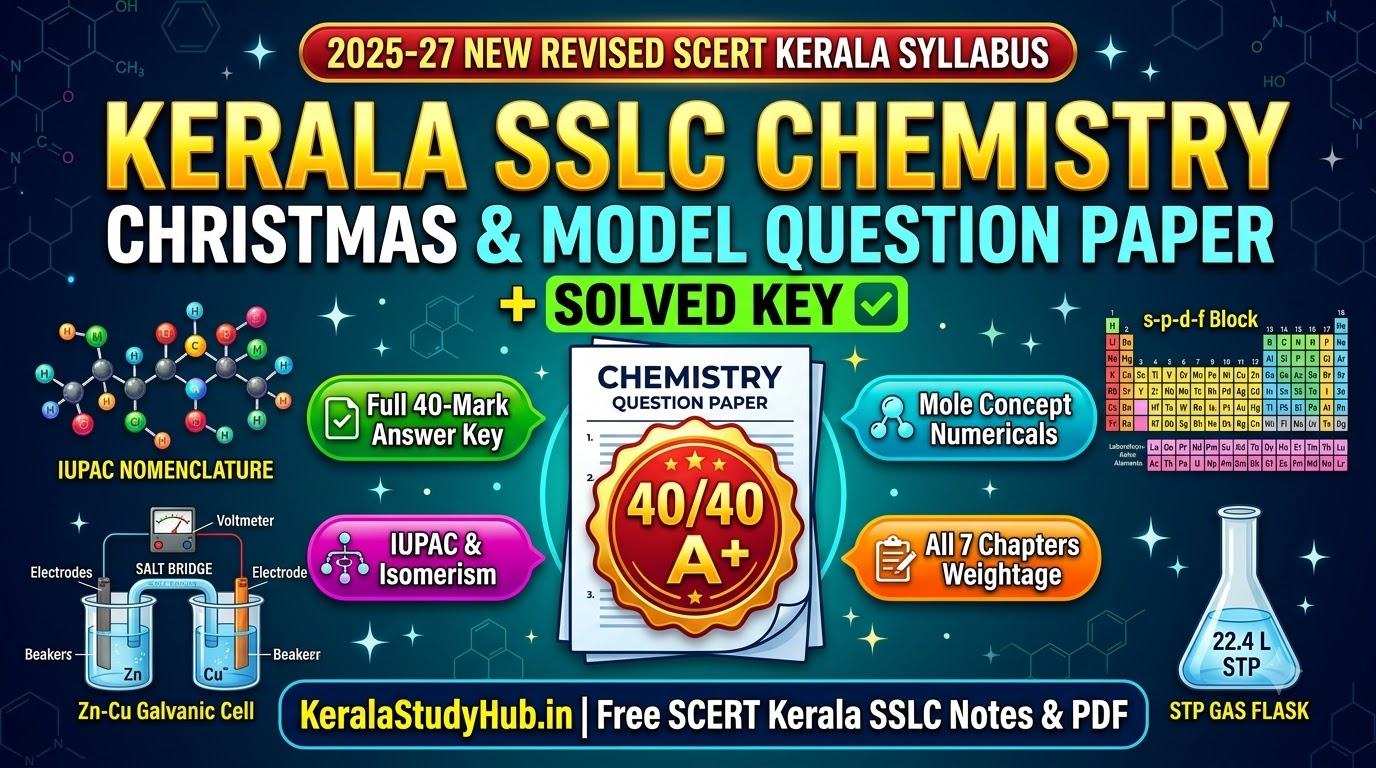
Kerala SSLC Chemistry Christmas Exam Question Paper and complete 40-Mark Solved Answer Key (2025–27 New Revised SCERT Syllabus) give Class 10 students a complete exam-ready practice paper and quick revision blueprint for the December Second Term (Christmas) Examination, the February Model Examination, and the March Public Examination conducted by the Kerala Pareeksha Bhavan. Because the State Council of Educational Research and Training (SCERT Kerala) restructured the new Class 10 Chemistry textbook—moving Chapter 1: Nomenclature of Organic Compounds and Isomerism and Chapter 2: Chemical Reactions of Organic Compounds to the very beginning of Part 1—relying on old pre-2025 question papers will leave you unprepared for the new Organic Chemistry and Periodic Table weightage!
- 1. Chapter-wise Marks Weightage & Direct Study Links (New SCERT Textbook)
- 2. SSLC Chemistry Rapid Revision Cheat Sheet (Formulas, Functional Groups & Processes)
- 3. Full 40-Mark Solved SSLC Chemistry Second Term & Model Question Paper (With Answer Key)
- SECTION A: Answer Any 4 Questions from Q1 to Q5 (Each Carries 1 Score — 4 × 1 = 4 Marks)
- SECTION B: Answer Any 4 Questions from Q6 to Q10 (Each Carries 2 Scores — 4 × 2 = 8 Marks)
- SECTION C: Answer Any 4 Questions from Q11 to Q15 (Each Carries 3 Scores — 4 × 3 = 12 Marks)
- SECTION D: Answer Any 4 Questions from Q16 to Q18 (Each Carries 4 Scores — Detailed Structured Questions)
In my Chemistry classroom, I tell my students that Chemistry is the easiest science paper to score a full 40 out of 40 (A+) once you master four sure-shot question areas: (1) IUPAC Naming & Isomerism, (2) Subshell Electronic Configuration (including Cr and Cu exceptions), (3) Gas Laws & GMM/STP Mole Numericals (22.4 L), and (4) Galvanic vs Electrolytic Cells & Metallurgy (Hall-Héroult / Blast Furnace / Contact & Haber Processes). Below is the complete Chapter Weightage Table, Revision Cheat Sheet, and a Full 40-Mark Solved Question Paper.
Quick SSLC Exam Navigation: SSLC Chemistry All 7 Chapters Master Hub | Previous Paper: SSLC Physics Christmas & Model Question Paper | SSLC Biology Master Hub.
SSLC CHEMISTRY EXAM AT A GLANCE: 40-MARK QUESTION PAPER BLUEPRINT (2025–27)
- Total Marks & Time Allowed: 40 Marks Theory + 10 Marks CE = 50 Marks | Time: 1 Hour 30 Minutes + 15 Minutes Cool-off Time.
- Section A (1 Mark Questions): Answer any 4 out of 5 questions (
4 × 1 = 4 Marks) — Functional groups, ores, subshell capacity, and gas law identification. - Section B (2 Marks Questions): Answer any 4 out of 5 questions (
4 × 2 = 8 Marks) — Isomer pairs, organic reactions, block/period finding, and electroplating. - Section C (3 Marks Questions): Answer any 4 out of 5 questions (
4 × 3 = 12 Marks) — Mole concept numericals, Le Chatelier’s principle (Haber/Contact process), and metallurgy steps. - Section D (4 Marks Questions): Answer any 4 out of 5 questions (
4 × 4 = 16 Marks) — Multi-step IUPAC naming, Galvanic cell diagram (`Zn-Cu` Daniel cell), blast furnace reactions, and organic conversions.
1. Chapter-wise Marks Weightage & Direct Study Links (New SCERT Textbook)
| Chapter & Malayalam Title | High-Yield Exam Topics | Public Exam Marks | Chapter Study Notes |
|---|---|---|---|
| Ch 1: Nomenclature of Organic Compounds and Isomerism (ഓർഗാനിക് സംയുക്തങ്ങളുടെ നാമകരണവും ഐസോമെറിസവും) | IUPAC Naming of Branched Alkanes, Functional Groups (-OH, -CHO, -CO-, -COOH), Chain/Position/Functional Isomerism |
8 Marks | Ch 1 Notes → |
| Ch 2: Chemical Reactions of Organic Compounds (ഓർഗാനിക് സംയുക്തങ്ങളുടെ രാസപ്രവർത്തനങ്ങൾ) | Substitution, Addition, Polymerisation (PVC, Teflon), Combustion, Esterification, Ethanol, Ethanoic Acid & Soaps | 6 Marks | Ch 2 Notes → |
| Ch 3: Periodic Table and Electronic Configuration (പീരിയോഡിക് ടേബിളും ഇലക്ട്രോൺ വിന്യാസവും) | Subshells (s, p, d, f), Finding Period/Block/Group, ₂₄Cr & ₂₉Cu Stability, d-Block Variable Oxidation States |
7 Marks | Ch 3 Notes → |
| Ch 4: Gas Laws and Mole Concept (വാതകനിയമങ്ങളും മോൾ സങ്കൽപ്പനവും) | Boyle’s Law (PV = k), Charles’s Law (V/T = k), Avogadro’s Law, Avogadro Number (6.022×10²³), Molar Volume at STP (22.4 L) |
7 Marks | Ch 4 Notes → |
| Ch 5: Reactivity Series and Electrochemistry (ക്രിയാശീല ശ്രേണിയും വൈദ്യുതരസതന്ത്രവും) | Displacement Reactions, Galvanic Cell (`Zn-Cu` Cell, Salt Bridge), Electrolysis of Molten vs Aqueous NaCl, Electroplating |
7 Marks | Ch 5 Notes → |
| Ch 6: Production of Metals (ലോഹനിർമ്മാണം) | Ores (Bauxite, Haematite, Calamine), Froth Floatation, Calcination vs Roasting, Blast Furnace (Iron), Hall-Héroult (Aluminium) | 6 Marks | Ch 6 Notes → |
| Ch 7: Compounds of Non-Metals (അലോഹസംയുക്തങ്ങൾ) | Ammonia (Haber Process), Chemical Equilibrium & Le Chatelier’s Principle, Sulphuric Acid (Contact Process, Oleum) | 6 Marks | Ch 7 Notes → |
2. SSLC Chemistry Rapid Revision Cheat Sheet (Formulas, Functional Groups & Processes)
| Concept / Chapter | Must-Know Exam Rule / Equation |
|---|---|
| 1. Organic Functional Groups & IUPAC Suffixes (Ch 1) | Alcohol (-OH): -ol | Aldehyde (-CHO): -al | Ketone (-CO-): -one | Carboxylic Acid (-COOH): -oic acid | Alkoxy / Ether (-O-R): Alkoxyalkane | Halo (-F, -Cl, -Br, -I): Haloalkane |
| 2. Finding Group Number from Subshell Configuration (Ch 3) | • s-block: Group = No. of electrons in outermost s subshell (1 or 2).• p-block: Group = No. of electrons in outermost p subshell + 12 (or valence s + p electrons + 10).• d-block: Group = Sum of electrons in outermost s and penultimate (n−1)d subshells.• Exceptions: Chromium ( ₂₄Cr): [Ar] 3d⁵ 4s¹ | Copper (₂₉Cu): [Ar] 3d¹⁰ 4s¹. |
| 3. Gas Laws & Mole Triangle Formulas (Ch 4) | No. of Moles (n) = Given Mass (g) / GMM = No. of Molecules / (6.022 × 10²³) = Volume at STP (L) / 22.4 L.• Boyle’s Law: P₁V₁ = P₂V₂ (Constant T, n) | Charles’s Law: V₁/T₁ = V₂/T₂ (Constant P, n; T(K) = t(°C) + 273). |
| 4. Galvanic Cell vs Electrolytic Cell Polarity (Ch 5) | In BOTH cells, Oxidation occurs at Anode and Reduction occurs at Cathode (AN OX, RED CAT). • Galvanic Cell: Anode is Negative ( −), Cathode is Positive (+).• Electrolytic Cell: Anode is Positive ( +), Cathode is Negative (−). |
| 5. Major Industrial Processes & Catalysts (Ch 6 & 7) | • Aluminium Extraction: Hall-Héroult Process (Purified Alumina Al₂O₃ dissolved in molten Cryolite Na₃AlF₆ to lower melting point).• Haber Process ( NH₃): N₂ + 3H₂ ⇌ 2NH₃ + Heat | Temp: 450°C, Pressure: 150–300 atm, Catalyst: Spongy Iron (Fe).• Contact Process ( H₂SO₄): 2SO₂ + O₂ ⇌ 2SO₃ | Temp: 450°C, Pressure: 2 atm, Catalyst: Vanadium Pentoxide (V₂O₅). |
3. Full 40-Mark Solved SSLC Chemistry Second Term & Model Question Paper (With Answer Key)
SECTION A: Answer Any 4 Questions from Q1 to Q5 (Each Carries 1 Score — 4 × 1 = 4 Marks)
Q1 (1 Mark): Identify the functional group present in the organic compound CH₃–CH₂–CHO and write its IUPAC name.
Answer: Functional Group: Aldehyde (–CHO) | IUPAC Name: Propanal.
Q2 (1 Mark): What is the maximum number of electrons that can be accommodated in the d subshell and the f subshell?
Answer: d subshell = 10 electrons; f subshell = 14 electrons (s = 2, p = 6, d = 10, f = 14).
Q3 (1 Mark): Weather balloons inflate in size as they rise higher into the atmosphere. Which gas law explains this observation?
Answer: Boyle’s Law (ബോയിൽ നിയമം) — as atmospheric pressure decreases with altitude, the volume of gas inside the balloon increases (V ∝ 1/P).
Q4 (1 Mark): Name the principal ore of Aluminium and write its chemical formula.
Answer: Bauxite (ബോക്സൈറ്റ്) — Chemical formula: Al₂O₃·2H₂O.
Q5 (1 Mark): Which substance is used as the drying agent to remove moisture from Ammonia (NH₃) gas in the laboratory?
Answer: Quicklime / Calcium Oxide (CaO) (since ammonia is basic, acidic drying agents like conc. H₂SO₄ would react with it).
SECTION B: Answer Any 4 Questions from Q6 to Q10 (Each Carries 2 Scores — 4 × 2 = 8 Marks)
Q6 (2 Marks): Examine the pair of compounds given below:
(i) CH₃–CH₂–OH and (ii) CH₃–O–CH₃
Write their IUPAC names and identify the type of isomerism exhibited by this pair.
Answer:
• IUPAC Names: (i) Ethanol and (ii) Methoxymethane (Molecular formula of both is C₂H₆O).
• Type of Isomerism: Functional Isomerism (ഫങ്ഷണൽ ഐസോമെറിസം), because they have the same molecular formula but different functional groups (Alcohol –OH and Ether/Alkoxy –O–).
Q7 (2 Marks): Complete the following organic chemical equations and name the type of reaction in each case:
(a) CH₂=CH₂ + H₂ —(Ni / Heat)→ __________
(b) CH₃COOH + CH₃CH₂OH —(Conc. H₂SO₄)→ __________ + H₂O
Answer:
• (a) Product: CH₃–CH₃ (Ethane) | Reaction Type: Addition Reaction (സങ്കലന രാസപ്രവർത്തനം).
• (b) Product: CH₃COOCH₂CH₃ (Ethyl ethanoate) | Reaction Type: Esterification (എസ്റ്ററിഫിക്കേഷൻ).
Q8 (2 Marks): The atomic number of Chromium (Cr) is 24. Write its correct subshell electronic configuration and explain why it differs from the expected 3d⁴ 4s² configuration.
Answer:
• Subshell Configuration of ₂₄Cr: 1s² 2s² 2p⁶ 3s² 3p⁶ 3d⁵ 4s¹ (or [Ar] 3d⁵ 4s¹).
• Reason: A half-filled (d⁵) or completely filled (d¹⁰) d subshell possesses extra symmetry and exchange energy, giving the atom extra stability. Hence one electron shifts from 4s to 3d.
Q9 (2 Marks): You are asked to electroplate a copper ring onto an iron bangle.
(a) Which metal should be connected to the positive terminal (anode) and negative terminal (cathode) of the battery?
(b) Name the electrolyte used in this process.
Answer:
• (a) Positive terminal (Anode): Pure Copper plate (Cu) | Negative terminal (Cathode): Iron bangle (the object to be plated).
• (b) Electrolyte: Aqueous Copper Sulphate (CuSO₄) solution acidified with a few drops of dilute H₂SO₄.
Q10 (2 Marks): Differentiate between Calcination and Roasting in metallurgy with one example for each.
Answer:
• Calcination (കാൽസിനേഷൻ): Heating the concentrated ore below its melting point in the absence (or limited supply) of air. Used for carbonate and hydroxide ores (e.g., ZnCO₃ → ZnO + CO₂).
• Roasting (റോസ്റ്റിങ്): Heating the concentrated ore below its melting point in a regular current of air (oxygen). Used for sulphide ores (e.g., 2ZnS + 3O₂ → 2ZnO + 2SO₂).
SECTION C: Answer Any 4 Questions from Q11 to Q15 (Each Carries 3 Scores — 4 × 3 = 12 Marks)
Q11 (3 Marks): 88 g of Carbon dioxide (CO₂) gas is kept in a cylinder at STP. (Given: Atomic masses C = 12, O = 16).
(a) Find the Gram Molecular Mass (GMM) of CO₂.
(b) Calculate the number of moles (n) and number of molecules in 88 g of CO₂.
(c) Find the volume occupied by this gas at STP.
Answer:
• (a) GMM of CO₂: 12 + (2 × 16) = 12 + 32 = 44 g.
• (b) Number of Moles: n = Given Mass / GMM = 88 / 44 = 2 moles.
Number of Molecules = 2 × N_A = 2 × 6.022 × 10²³ molecules (1.2044 × 10²⁴).
• (c) Volume at STP: V = n × 22.4 L = 2 × 22.4 L = 44.8 Litres.
Q12 (3 Marks): An element X has atomic number 26 (Iron, Fe).
(a) Write its subshell electronic configuration.
(b) Find its Period number, Block, and Group number in the Periodic Table.
(c) Write the subshell electronic configuration of the Fe²⁺ ion.
Answer:
• (a) Configuration of ₂₆X: 1s² 2s² 2p⁶ 3s² 3p⁶ 3d⁶ 4s².
• (b) Position: Highest shell n = 4 ⇒ Period = 4; Last electron enters 3d ⇒ Block = d-block; Group = electrons in 4s + 3d = 2 + 6 = Group 8.
• (c) Configuration of Fe²⁺: Two electrons are lost from the outermost 4s subshell: 1s² 2s² 2p⁶ 3s² 3p⁶ 3d⁶.
Q13 (3 Marks): Consider the reversible reaction used in the industrial manufacture of Ammonia (Haber Process):
N₂(g) + 3H₂(g) ⇌ 2NH₃(g) + Heat (ΔH = −92 kJ/mol)
Based on Le Chatelier’s Principle, how do the following changes affect the yield of Ammonia?
(a) Increasing the pressure | (b) Increasing the temperature continuously | (c) Removing NH₃ as it is formed.
Answer:
• (a) Increasing Pressure: Reactants have 4 moles of gas (1 N₂ + 3 H₂) while product has 2 moles (2 NH₃). Increasing pressure favours the forward reaction (fewer moles), so yield of Ammonia increases.
• (b) Increasing Temperature Continuously: Since the forward reaction is exothermic, very high temperature favours the endothermic backward reaction, so yield of Ammonia decreases (hence an optimum temperature of 450°C is used).
• (c) Removing NH₃: Removing product shifts equilibrium to the right (forward direction), so more Ammonia is produced.
Q14 (3 Marks): Compare the products formed at the anode and cathode during the electrolysis of (a) Molten Sodium Chloride (NaCl) and (b) Aqueous Sodium Chloride solution.
Answer:
• (a) Molten NaCl: At Anode (+): Chlorine gas (Cl₂) (`2Cl− → Cl₂ + 2e−`) | At Cathode (−): Sodium metal (Na) (`Na⁺ + e− → Na`).
• (b) Aqueous NaCl: At Anode (+): Chlorine gas (Cl₂) | At Cathode (−): Water is reduced more easily than Na⁺ ions, releasing Hydrogen gas (H₂) while NaOH remains in solution.
Q15 (3 Marks): How is Concentrated Sulphuric Acid (H₂SO₄) manufactured by the Contact Process? Why is Sulphur trioxide (SO₃) dissolved in concentrated H₂SO₄ instead of water?
Answer:
• Steps of Contact Process: (1) S + O₂ → SO₂, (2) Catalytic oxidation: 2SO₂ + O₂ ⇌ 2SO₃ in presence of V₂O₅ at 450°C and 2 atm, (3) Absorption of SO₃ in conc. H₂SO₄ to form Oleum (H₂S₂O₇): SO₃ + H₂SO₄ → H₂S₂O₇, and (4) Dilution of Oleum with water: H₂S₂O₇ + H₂O → 2H₂SO₄.
• Reason: Dissolving SO₃ directly in water is highly exothermic and forms a dense acid fog (mist) of droplets that does not condense easily.
SECTION D: Answer Any 4 Questions from Q16 to Q18 (Each Carries 4 Scores — Detailed Structured Questions)
Q16 (4 Marks): Write the IUPAC names of the following two organic compounds and draw the structural formulas of the next two:
(a) CH₃–CH(CH₃)–CH₂–CH(CH₃)–CH₂–CH₃
(b) CH₃–CH₂–CO–CH₂–CH₃
(c) Draw the structure of 2,2-Dimethylbutane.
(d) Draw the structure of But-2-ene.
Answer:
• (a) Longest chain = 6 carbons (Hexane); numbering from left gives methyl groups at C2 and C4 (2,4 vs 3,5 from right) ⇒ 2,4-Dimethylhexane.
• (b) 5-carbon chain with ketone group (–CO–) at C3 ⇒ Pentan-3-one.
• (c) 2,2-Dimethylbutane: CH₃–C(CH₃)₂–CH₂–CH₃.
• (d) But-2-ene: CH₃–CH=CH–CH₃.
Q17 (4 Marks): A Galvanic cell (`Zn-Cu` Daniel Cell) is constructed using a Zinc electrode in ZnSO₄ solution and a Copper electrode in CuSO₄ solution.
(a) Identify the Anode and Cathode, and state the direction of electron flow in the external circuit.
(b) Write the chemical equations for the half-cell reactions at the Anode, at the Cathode, and the overall Redox cell reaction.
(c) What are the two main functions of the Salt Bridge?
Answer:
• (a) Electrodes & Electron Flow: Since Zinc is more reactive than Copper, Zinc (Zn) is the Anode (Negative terminal) and Copper (Cu) is the Cathode (Positive terminal). Electrons flow from Zinc (Anode) to Copper (Cathode) through the external wire.
• (b) Equations:
– At Anode (Oxidation): Zn → Zn²⁺ + 2e−
– At Cathode (Reduction): Cu²⁺ + 2e− → Cu
– Overall Cell Reaction: Zn + Cu²⁺ → Zn²⁺ + Cu.
• (c) Role of Salt Bridge: (1) Completes the electrical circuit by allowing ion migration between the two half-cells, and (2) Maintains electrical neutrality of the two electrolyte solutions without mixing them.
Q18 (4 Marks): Iron is extracted from Haematite (Fe₂O₃) in a Blast Furnace.
(a) Name the three raw materials fed into the top of the Blast Furnace.
(b) Which substance acts as the main reducing agent inside the Blast Furnace?
(c) Write the chemical equations showing how Flux removes Gangue to form Slag.
(d) Distinguish between Pig Iron, Cast Iron, and Wrought Iron.
Answer:
• (a) Charge fed into Blast Furnace: Concentrated Haematite ore (Fe₂O₃), Coke (C), and Limestone (CaCO₃).
• (b) Main Reducing Agent: Carbon Monoxide (CO): Fe₂O₃ + 3CO → 2Fe + 3CO₂.
• (c) Flux & Slag Formation: Limestone decomposes to Quicklime (Basic Flux): CaCO₃ → CaO + CO₂. Quicklime reacts with silica (Acidic Gangue SiO₂) to form molten Calcium Silicate (Slag): CaO (Flux) + SiO₂ (Gangue) → CaSiO₃ (Slag).
• (d) Types of Iron: Molten iron directly from the blast furnace (~4% carbon + impurities) is Pig Iron; remelting pig iron gives Cast Iron (~2–4% C); the purest form of commercial iron with 0.02–0.05% carbon is Wrought Iron.
Teacher’s Classroom Note & Student Discussion Question:
In your SSLC Chemistry exam, remember the golden rule for d-block ions like Fe²⁺, Fe³⁺, and Cu²⁺: when transition metals form positive ions, electrons are ALWAYS removed first from the outermost 4s subshell before removing any electron from the inner 3d subshell!
Quick Challenge for You (Drop Your Answer in the Comments Below!): What is the volume occupied by 1 mole of any gas at STP (Standard Temperature and Pressure) in Litres? Comment the exact number below!


Latest SCERT & DHSE Kerala Study Notes
- Kerala Class 9 Physics Chapter 2 Notes: Equations of Motion (ചലനസമവാക്യങ്ങൾ) Std 9 Let Us Assess Questions and Answers PDF
- Kerala SSLC Christmas Exam Question Paper 2025-27: All Subjects Second Term & Model Question Papers with Solved Answer Keys PDF (New SCERT Syllabus)
- Kerala SSLC English Christmas Exam Question Paper 2025-27: Second Term & Model Solved 80-Mark Answer Key, Discourses & Grammar PDF
- Kerala SSLC Social Science Christmas Exam Question Paper 2025-27: Second Term & Model Solved 80-Mark Answer Key, Weightage & Map Study PDF
- Kerala SSLC Maths Christmas Exam Question Paper 2025-27: Second Term & Model Solved Answer Key, Weightage & Formula Sheet PDF (New SCERT Syllabus)
- Kerala SSLC Biology Christmas Exam Question Paper 2025-27: Second Term & Model Solved Answer Key, Weightage & Flowcharts PDF (New SCERT Syllabus)
- Kerala SSLC Physics Christmas Exam Question Paper 2025-27: Second Term & Model Solved Answer Key, Weightage & Formula Sheet PDF (New SCERT Syllabus)
- Kerala SSLC English Notes: All 15 Chapters New SCERT Textbook Solutions, Appreciations, Character Sketches & Discourses PDF (2025-27)