
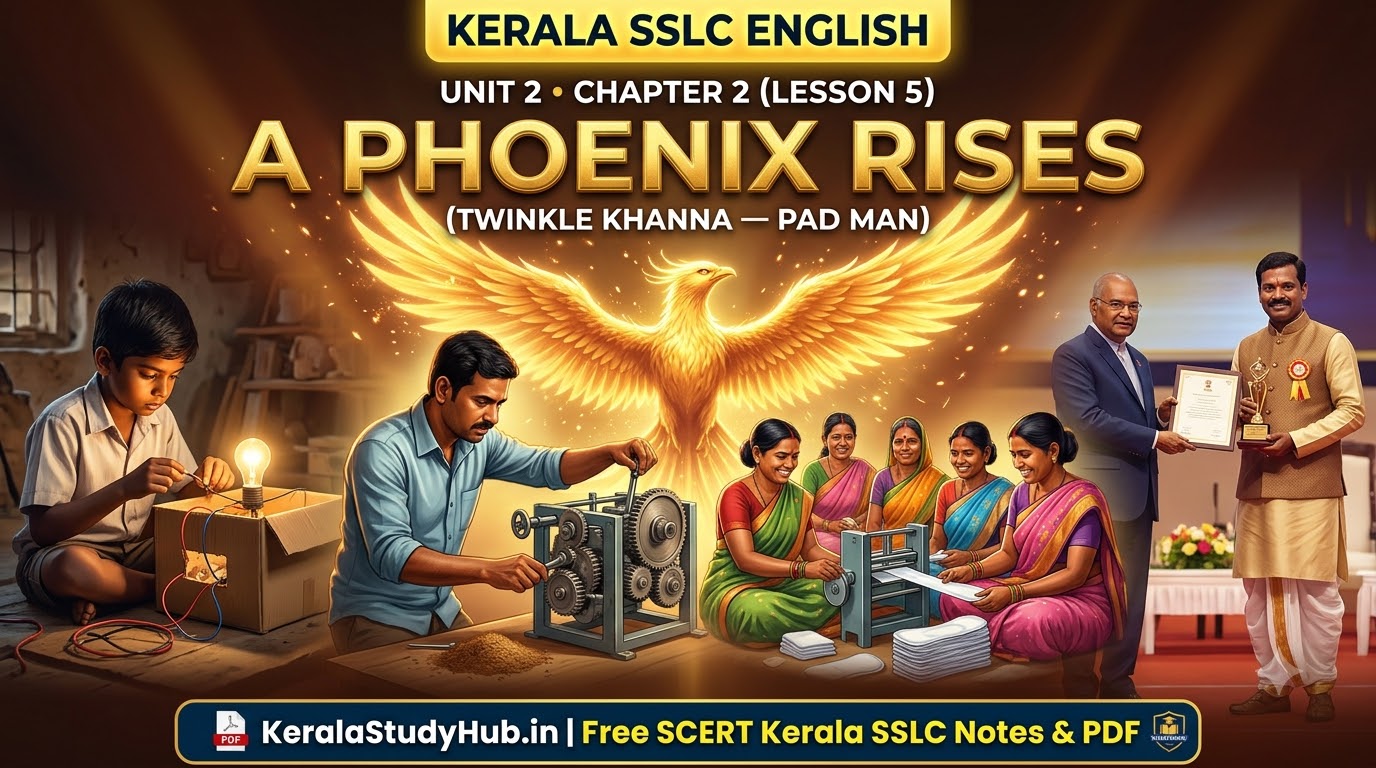
Kerala SSLC English Chapter 5 Notes on A Phoenix Rises by bestselling Indian author and columnist Twinkle Khanna welcome you to the second lesson of Unit II (Paths to Progress) in the newly revised Class 10 (Std 10) Kerala Reader English textbook published by the State Council of Educational Research and Training (SCERT Kerala). In my classroom, when we read this powerful biographical story (adapted from Twinkle Khanna’s “The Sanitary Man of Sacred Land” in The Legend of Lakshmi Prasad, inspired by the real-life Padma Shri innovator Arunachalam Muruganantham), I ask my students: “How did a school dropout named Bablu Kewat—abandoned by his wife Gauri, ostracized by his entire village, and mocked as mad or possessed—rise from the ashes of humiliation like a mythical Phoenix to invent a low-cost sanitary napkin machine that empowered millions of rural women across India?”
- 1. Detailed Stage-by-Stage Story Summary (English & Malayalam)
- 2. Exam-Ready Character Sketches (6-Mark SSLC Questions)
- Character Sketch of Bablu Kewat / Arunachalam Muruganantham (6 Marks)
- 3. Solved Exam Discourses (Apology Letter from Wife, School Invitation Letter & Speech)
- Discourse 1: Letter from Bablu’s Wife (Gauri / Shanthi) Expressing Her Apology and Support After His National Recognition (6 Marks)
- Discourse 2: Formal Letter / Email Inviting Arunachalam Muruganantham (Bablu Kewat) as Chief Guest for the School Young Innovators Programme (6 Marks)
- Discourse 3: Speech on “The Role of Social Entrepreneurship in the Nation’s Progress” (6 Marks)
- 4. Complete Textbook Solutions & Extra Exam Questions (16 Fully Solved Q&As)
Prepared strictly for the Kerala Pareeksha Bhavan SSLC Public Examination, this complete classroom guide covers the Detailed Story Summary (English & Malayalam), Significance of the Title “A Phoenix Rises”, Character Sketch of Bablu Kewat (Arunachalam Muruganantham) & His Wife Gauri (Shanthi), Solved Exam Discourses (Wife’s Letter of Apology & Support, School Invitation Letter for Young Innovators Programme, Speech on Social Entrepreneurship & Diary Entry), and 16 Solved Textbook & Exam Questions and Answers.
Quick SSLC English Navigation: SSLC English All 15 Chapters Master Hub | Previous: Chapter 4: Breaking Barriers, I Will Fly (Srikanth Bolla) | Next: Chapter 6: The Seedling (Poem by Paul Laurence Dunbar).
CHAPTER 5 AT A GLANCE: A PHOENIX RISES BY TWINKLE KHANNA (LITERARY BLUEPRINT)
- Title, Author & Real-Life Inspiration: A Phoenix Rises by Twinkle Khanna; adapted from The Legend of Lakshmi Prasad and based on the life of Arunachalam Muruganantham (“Pad Man of India”), fictionalized in the story as Bablu Kewat.
- Symbolism of the Title (“Phoenix”): The Phoenix is a mythical bird that burns to ashes and rises again stronger and renewed. Similarly, after his father’s death, school dropout, social boycott, and abandonment by his wife and mother, Bablu rises from total ruin to win the National Innovation Award from the President of India!
- Main Characters: Bablu Kewat (curious innovator, welding apprentice, devoted husband, and social entrepreneur), Gauri (his shy young wife who initially leaves him due to social stigma but returns in pride), Mrs. Sharma (his school science teacher who praised his egg-incubator project), and his Mother.
- Core Discovery & Invention: Discovering that commercial pads use treated pine bark cellulose fibre (not ordinary cotton) and inventing a simple, low-cost, foot-pedal sanitary napkin machine operated by rural Self-Help Group (SHG) women.
1. Detailed Stage-by-Stage Story Summary (English & Malayalam)
| Story Stage | Key Events & Classroom Analysis |
|---|---|
| 1. Bablu’s School Days, Egg Incubator & Dropping Out at 14 | Bablu Kewat was an indifferent textbook student, but possessed a brilliant practical curiosity: in school, encouraged by his science teacher Mrs. Sharma, he built an egg incubator using a cardboard box and an electric bulb that hatched chicken eggs! However, when his father died suddenly in a road accident, 14-year-old Bablu had to drop out of school and work at a welding workshop to support his widowed mother and sisters. |
| 2. Marriage to Gauri & Discovering the Unhygienic Rags | Years later, Bablu marries Gauri, whom he loves dearly. One day, he notices Gauri hiding a dirty, stained rag behind her back and is shocked to learn that she and his sisters use filthy old cloths during menstruation because commercial sanitary napkins sold at the chemist’s shop are too expensive—if they bought them, the family could not afford milk! |
| 3. Failed Cotton Experiments, Social Stigma & Abandonment | Determined to make a cheap, hygienic sanitary pad for Gauri, Bablu buys cotton, wraps it in cloth, and asks Gauri and his sisters to test it. Because menstruation is treated as a strict social taboo, Gauri is mortified by his obsession. When medical college girls refuse to return feedback forms, Bablu courageously tests the pad on himself by wearing an artificial rubber bladder filled with goat’s blood while cycling and walking! Seeing blood stains on his clothes and washed used pads drying in his yard, the superstitious villagers accuse him of madness and dark magic. Embarrassed by the gossip, Gauri leaves him for her parents’ house, his mother also leaves him, and the villagers threaten to tie him upside down to the sacred banyan tree! |
| 4. The Pine-Bark Cellulose Breakthrough & Low-Cost Machine | Forced to leave his village, Bablu works as a domestic help for a college professor in the city to use his computer and internet, sending emails to foreign paper mills until he discovers after two years that sanitary pads are made not of raw cotton, but of cellulose fibre extracted from pine wood bark! Instead of paying Rs 35 lakh for an imported commercial machine that tears the hard cellulose sheets into fluffy fibres, Bablu spends another four years inventing a simple, low-cost Rs 65,000 four-step machine (for defibration, compression, sealing, and UV sterilization) that rural women can operate easily. |
| 5. Rising Like a Phoenix: IIT Madras, Presidential Award & Reunion | The professor secretly enters Bablu’s machine in the National Innovation Foundation competition at IIT Madras, where it wins first prize out of 943 entries! When the President of India honours Bablu in New Delhi and newspapers publish his photo on the front page, his phone rings—it is Gauri, weeping with pride and remorse, ready to return home. Refusing crores of rupees from corporate giants who want to buy his patent, Bablu supplies his machines directly to rural women’s Self-Help Groups (SHGs), creating both menstrual hygiene and financial independence across rural India. |
മലയാളം സംഗ്രഹം (Malayalam Summary — A Phoenix Rises by Twinkle Khanna):
പ്രശസ്ത എഴുത്തുകാരിയായ ട്വിങ്കിൾ ഖന്ന (Twinkle Khanna) രചിച്ച ‘A Phoenix Rises’ എന്ന പാഠഭാഗം ഇന്ത്യയുടെ ‘പാഡ് മാൻ’ (Pad Man) എന്നറിയപ്പെടുന്ന അരുണാചലം മുരുകനന്ദത്തിന്റെ (Arunachalam Muruganantham) യഥാർത്ഥ ജീവിതകഥയെ ആസ്പദമാക്കിയുള്ളതാണ് (കഥയിൽ ബബ്ലു കേവത് / Bablu Kewat എന്ന പേരിലാണ് അവതരിപ്പിച്ചിരിക്കുന്നത്). അച്ഛന്റെ മരണത്തെത്തുടർന്ന് പതിനാലാം വയസ്സിൽ പഠനം ഉപേക്ഷിച്ച് വെൽഡിംഗ് ജോലിക്ക് പോയ ബബ്ലു, തന്റെ പ്രിയഭാര്യ ഗൗരി (Gauri) വിലകൂടിയ സാനിറ്ററി പാഡുകൾ വാങ്ങാൻ പണമില്ലാത്തതിനാൽ വൃത്തിഹീനമായ പഴന്തുണികൾ ഉപയോഗിക്കുന്നത് കണ്ട് ഞെട്ടിപ്പോകുന്നു. ഭാര്യയ്ക്കും ഗ്രാമത്തിലെ സ്ത്രീകൾക്കും വേണ്ടി കുറഞ്ഞ ചെലവിൽ സാനിറ്ററി പാഡ് നിർമ്മിക്കാൻ ഇറങ്ങിത്തിരിച്ച ബബ്ലുവിനെ സമൂഹം ഭ്രാന്തനായി മുദ്രകുത്തുകയും, ഭാര്യയും അമ്മയും പോലും അവനെ ഉപേക്ഷിച്ചു പോവുകയും ചെയ്യുന്നു. എന്നാൽ തോറ്റുകൊടുക്കാൻ തയ്യാറാകാതിരുന്ന ബബ്ലു, പാഡുകളിൽ ഉപയോഗിക്കുന്നത് പൈൻ മരത്തിന്റെ തൊലിയിൽ നിന്നുള്ള സെല്ലുലോസ് ഫൈബർ (Pine bark cellulose fibre) ആണെന്ന് കണ്ടെത്തുകയും, കുറഞ്ഞ ചെലവിൽ പാഡ് നിർമ്മിക്കാനുള്ള യന്ത്രം സ്വയം വികസിപ്പിച്ചെടുക്കുകയും ചെയ്യുന്നു. ഐ.ഐ.ടി. മദ്രാസിന്റെയും ഇന്ത്യൻ രാഷ്ട്രപതിയുടെയും ദേശീയ അംഗീകാരം നേടിയതോടെ ഫീനിക്സ് പക്ഷിയെപ്പോലെ ചാരത്തിൽ നിന്ന് ഉയർത്തെഴുന്നേറ്റ ബബ്ലുവിന്റെ അടുത്തേക്ക് ഭാര്യ ഗൗരി അഭിമാനത്തോടെ തിരിച്ചെത്തുന്നു!

2. Exam-Ready Character Sketches (6-Mark SSLC Questions)
Character Sketch of Bablu Kewat / Arunachalam Muruganantham (6 Marks)
Bablu Kewat (modeled on real-life social innovator Arunachalam Muruganantham) is the inspiring protagonist of Twinkle Khanna’s A Phoenix Rises. Though an average textbook student who had to drop out of school at age fourteen after his father’s sudden death, Bablu possesses the inquisitive mind of a true scientist—evident early on when he built a working egg incubator in school. He is a deeply loving and empathetic husband: discovering that his wife Gauri uses unhygienic rags during menstruation because commercial pads are unaffordable, he makes it his life’s mission to create low-cost sanitary napkins. Bablu displays extraordinary scientific perseverance and moral courage in the face of rigid social taboos. When no one agrees to test his prototypes, he tests them on himself using a rubber bladder filled with goat’s blood. Even when his wife Gauri, his mother, and his entire village abandon and humiliate him, he rises from the ashes like a mythical Phoenix—working for a professor to research pine-bark cellulose fibre and inventing a low-cost sanitary pad machine. Selfless to the core, after winning the Presidential Innovation Award, he refuses to sell his patent for crores of rupees, choosing instead to empower rural women across India.
3. Solved Exam Discourses (Apology Letter from Wife, School Invitation Letter & Speech)
Discourse 1: Letter from Bablu’s Wife (Gauri / Shanthi) Expressing Her Apology and Support After His National Recognition (6 Marks)
Rampur Village
18 November 2026
My dearest Bablu,
My eyes are filled with tears of both shame and overwhelming pride as I look at your photograph on the front page of today’s newspaper receiving the National Innovation Award from the President of India!
Please forgive me for leaving you when you needed my support the most. Bound by our village’s narrow customs and afraid of the cruel gossip of our neighbours, I doubted your sanity and felt embarrassed by your experiments. I was too blind to see that every humiliation you endured was born out of your pure love for me and your desire to protect millions of poor women like me from disease and indignity.
Your unyielding determination has silenced every critic and changed the lives of rural women across our country. I am coming back home today, and I promise to stand beside you in all your work from this day forward.
Yours forever with love and pride,
Gauri
Discourse 2: Formal Letter / Email Inviting Arunachalam Muruganantham (Bablu Kewat) as Chief Guest for the School Young Innovators Programme (6 Marks)
From: The Secretary, English & Young Innovators Club, Government High School, Kerala
To: Sri Arunachalam Muruganantham, Founder, Jayaashree Industries, Coimbatore
Date: 15 November 2026
Subject: Cordial Invitation as Chief Guest for the Young Innovators Programme (YIP) & National Entrepreneurship Day
Respected Sir,
Greetings from the English Club and Young Innovators Forum of Government High School! Having recently studied your inspiring journey of social innovation in our Class 10 English syllabus, our students are deeply moved by how you overcame every social barrier to revolutionize women’s health and rural entrepreneurship in India.
Our school is organizing an Idea Generation Contest under the Young Innovators Programme (YIP) on Friday, 28 November 2026, at 10:00 AM in our school auditorium to encourage students to become problem-solvers and job creators. We would be deeply honoured if you would kindly consent to grace the occasion as our Chief Guest and address our budding innovators.
We eagerly await your positive confirmation.
Yours faithfully,
[Sd/-]
Secretary, Young Innovators Club
Discourse 3: Speech on “The Role of Social Entrepreneurship in the Nation’s Progress” (6 Marks)
Respected Principal, teachers, and my dear friends,
Good morning to everyone! Today, in connection with Unit II of our English Reader, Paths to Progress, I wish to speak on “The Role of Social Entrepreneurship in the Nation’s Progress.”
For decades, we thought the sole purpose of education was to secure a safe salaried job. But true national progress happens when young minds become problem-solvers and job creators! Look at the two heroes we studied in this unit: Srikanth Bolla and Bablu Kewat (Arunachalam Muruganantham). Neither of them chased personal wealth alone. Srikanth Bolla built Bollant Industries to turn agricultural waste into eco-friendly packaging while employing hundreds of differently-abled workers. Bablu Kewat endured years of social boycott to invent a low-cost sanitary napkin machine, refusing crores of rupees from corporate giants so that rural women’s Self-Help Groups could manufacture affordable pads and earn a dignified livelihood.
That is the power of social entrepreneurship—it solves grassroots problems with affordable technology and builds a healthier, self-reliant India. Thank you!
4. Complete Textbook Solutions & Extra Exam Questions (16 Fully Solved Q&As)
Q1: What kind of student was Bablu Kewat in school, and what science project did he build with Mrs. Sharma’s encouragement?
Answer: Bablu Kewat was an indifferent student when it came to rote learning from textbooks, but he had a keen practical interest in how things worked. Encouraged by his science teacher Mrs. Sharma, he built a low-cost egg incubator using a cardboard box and an electric bulb that successfully hatched chicken eggs, winning first prize at the school science fair.
Q2: Why did Bablu have to drop out of school at the age of fourteen?
Answer: When Bablu’s father died suddenly in a road accident, the family was plunged into financial crisis. To help his widowed mother feed the family and bring up his sisters, fourteen-year-old Bablu dropped out of school and took up a job as an apprentice at a local welding workshop.
Q3: What incident after his marriage to Gauri sparked Bablu’s mission to make low-cost sanitary napkins?
Answer: One afternoon, Bablu saw his wife Gauri hiding a filthy, stained rag behind her back—a cloth he would not even use to clean his scooter! When he asked her why she did not use sanitary napkins, she explained that if the women in the house bought expensive commercial napkins, the family would have no money left to buy milk. Shocked by the health hazard this posed, Bablu resolved to make an affordable sanitary pad for her.
Q4: Describe how the chemist reacted when Bablu went to buy a packet of sanitary napkins for the first time.
Answer: The chemist looked around furtively, wrapped the packet of sanitary napkins tightly in old newspaper, and slipped it into a black plastic bag as if he were handing over contraband or illegal goods! This highlighted the deep social taboo and shame surrounding menstruation.
Q5: Why did Bablu’s first homemade cotton pad fail, and why was it so slow to test improvements?
Answer: Bablu noticed that a commercial pad weighed barely 10 grams (costing about 10 paise of raw cotton) yet was sold for Rs 40. However, the pad he made from ordinary surgical cotton failed to absorb liquid properly and leaked immediately. Testing each new version was frustratingly slow because he had to wait a whole month for Gauri’s next menstrual cycle to get feedback.
Q6: How did Bablu test the sanitary napkins on himself when women refused to help him?
Answer: When Gauri, his sisters, and even medical college students refused to test his pads or give honest feedback out of shyness, Bablu decided to become his own test subject! He made an artificial uterus out of a rubber football bladder, filled it with goat’s blood mixed with an anti-clotting additive from a butcher friend, tied it around his waist with a tube leading to the sanitary pad, and squeezed it periodically while walking and riding his bicycle.
Q7: Why did Gauri, Bablu’s mother, and the villagers turn against him?
Answer: Rumours spread that Bablu was chasing medical college girls and collecting used sanitary cloths. Unable to bear the humiliation and village gossip, Gauri left for her maternal home and sent him a divorce notice. Soon after, when villagers saw blood-stained clothes and washed pads laid out in his courtyard, they concluded he was possessed by an evil spirit or had gone mad; his mother also left him, and the village panchayat threatened to tie him upside down to the banyan tree to exorcise him.
Q8: How did the college professor help Bablu discover the true raw material used in commercial sanitary pads?
Answer: After leaving his village, Bablu worked as a household helper for an English-speaking college professor in town in exchange for access to a computer and the professor’s help in writing emails to foreign manufacturers. Pretending to be a factory owner in Coimbatore, Bablu received free sample boards from a multinational supplier and discovered after two years and three months that sanitary pads are made from cellulose fibre extracted from pine wood bark, not raw cotton!
Q9: Why did Bablu have to invent his own machine after discovering pine-bark cellulose?
Answer: The pine-bark cellulose came in hard compressed sheets that could not be torn by hand, and the imported industrial machine required to defibrate and process it cost Rs 35 lakh (3.5 million rupees)! Determined to make production affordable at the village level, Bablu spent four years engineering a simple, low-cost machine costing only about Rs 65,000 that anyone could learn to operate in an hour.
Q10: What are the four simple steps of Bablu’s low-cost sanitary napkin machine?
Answer:
1. Defibration: Grinding the hard pine-wood cellulose sheet into soft, fluffy fibres in a modified grinder.
2. Compression: Pressing the fluffy cellulose into uniform rectangular cakes using a foot-operated pedal mould.
3. Sealing: Wrapping the compressed core in a breathable non-woven cloth and sealing the edges.
4. Sterilization: Disinfecting the finished pads inside an ultraviolet (UV) sterilization unit.
Q11: How did Bablu win national recognition at IIT Madras and from the President of India?
Answer: The professor submitted Bablu’s low-cost sanitary napkin machine to the National Innovation Competition at IIT Madras in 2006. Competing against 943 inventions from across India, Bablu’s machine won first place, and he received the National Grassroots Innovation Award directly from the President of India in New Delhi!
Q12: Why did Bablu refuse to sell his patent to big corporate companies for crores of rupees?
Answer: Bablu realized that if he sold his patent to a corporate giant, they would maximize profit rather than keep the pads cheap for poor rural women. Instead, he chose to supply his machines directly to rural women’s Self-Help Groups (SHGs) and NGOs across India, turning thousands of village women into both users and manufacturers of affordable pads.
Q13: Explain the significance of the title “A Phoenix Rises”.
Answer: In mythology, the Phoenix is an immortal bird that is consumed by fire and rises reborn from its own ashes. In the story, Bablu’s personal life, marriage, and reputation are completely reduced to ashes by poverty, social taboo, and public humiliation; yet through sheer perseverance and noble purpose, he rises from ruin to national honour and reconciles with his family.
Q14: Compare the entrepreneurial vision of Srikanth Bolla (Chapter 4) and Bablu Kewat / Arunachalam Muruganantham (Chapter 5).
Answer: Both Srikanth Bolla and Bablu Kewat faced severe social exclusion—Srikanth due to congenital blindness and Bablu due to poverty and menstrual taboos. Both refused to chase personal wealth alone and instead became social entrepreneurs: Srikanth empowered differently-abled people through eco-friendly packaging at Bollant Industries, while Bablu empowered rural women through low-cost sanitary napkin machines.
Q15: How did the villagers’ attitude toward Bablu change after he won the Presidential Award?
Answer: The very same villagers who had mocked Bablu as a lunatic, ostracized his mother, and threatened to tie him upside down to the banyan tree suddenly celebrated him as their village hero, putting up banners and welcoming him back with pride once his photograph with the President of India appeared in the newspapers!
Q16 (Grammar & Vocabulary — Passive Voice & Idioms from Chapter 5):
(a) Change into Passive Voice:
(i) Bablu invented a low-cost sanitary napkin machine.
(ii) The President of India honoured Bablu with the National Innovation Award.
(b) Give the meaning of the idiom: “To rise like a phoenix from the ashes.”
Answer:
• (a)(i) Passive Voice: A low-cost sanitary napkin machine was invented by Bablu.
• (a)(ii) Passive Voice: Bablu was honoured with the National Innovation Award by the President of India.
• (b) Idiom Meaning: To emerge renewed, stronger, and successful after suffering total defeat, ruin, or destruction.
Teacher’s Classroom Note & Student Discussion Question:
In your SSLC English exam, remember both names—Bablu Kewat (the name used by Twinkle Khanna in the story) and Arunachalam Muruganantham (the real-life innovator on whom the story is based, featured in the textbook activities)!
Quick Challenge for You (Drop Your Answer in the Comments Below!): What was the special natural raw material (instead of ordinary cotton) that Bablu discovered is used inside sanitary napkins to absorb liquid effectively? Write your answer in the comments!


Latest SCERT & DHSE Kerala Study Notes
- Kerala Class 9 Physics Chapter 2 Notes: Equations of Motion (ചലനസമവാക്യങ്ങൾ) Std 9 Let Us Assess Questions and Answers PDF
- Kerala SSLC Christmas Exam Question Paper 2025-27: All Subjects Second Term & Model Question Papers with Solved Answer Keys PDF (New SCERT Syllabus)
- Kerala SSLC English Christmas Exam Question Paper 2025-27: Second Term & Model Solved 80-Mark Answer Key, Discourses & Grammar PDF
- Kerala SSLC Social Science Christmas Exam Question Paper 2025-27: Second Term & Model Solved 80-Mark Answer Key, Weightage & Map Study PDF
- Kerala SSLC Maths Christmas Exam Question Paper 2025-27: Second Term & Model Solved Answer Key, Weightage & Formula Sheet PDF (New SCERT Syllabus)
- Kerala SSLC Biology Christmas Exam Question Paper 2025-27: Second Term & Model Solved Answer Key, Weightage & Flowcharts PDF (New SCERT Syllabus)
- Kerala SSLC Chemistry Christmas Exam Question Paper 2025-27: Second Term & Model Solved Answer Key, Weightage & Sure A+ Questions PDF (New SCERT Syllabus)
- Kerala SSLC Physics Christmas Exam Question Paper 2025-27: Second Term & Model Solved Answer Key, Weightage & Formula Sheet PDF (New SCERT Syllabus)