
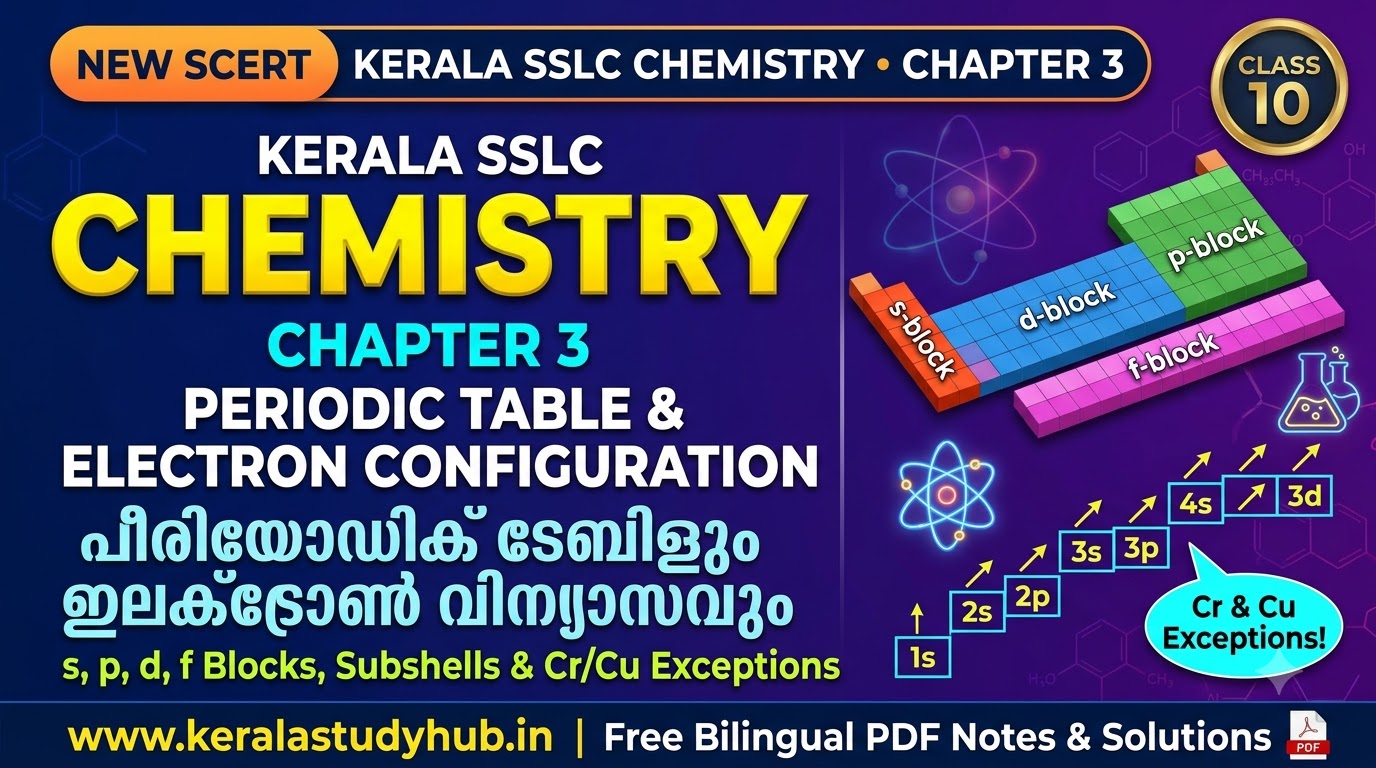
Kerala SSLC Chemistry Chapter 3 Notes for the revised SCERT Class 10 Chemistry textbook chapter Periodic Table and Electron Configuration (Malayalam Medium: പീരിയോഡിക് ടേബിളും ഇലക്ട്രോൺ വിന്യാസവും) provide a complete guide to shells and subshells, subshell electronic configurations from atomic number 1 to 30, exceptional configurations of Chromium and Copper, determination of Period, Block, and Group numbers, characteristic properties of d-block transition elements, and solved Let Us Assess exercises. Prepared in strict compliance with the curriculum of the State Council of Educational Research and Training (SCERT Kerala) and the public examination blueprint of Kerala Pareeksha Bhavan, these bilingual notes help students score full marks in periodic table questions.
- 1. Kerala SSLC Chemistry Chapter 3 Notes: Shells, Subshells and Electron Capacity
- 2. Subshell Electronic Configuration (Z = 1 to 30) and Chromium & Copper Exceptions
- Why Chromium (24Cr) and Copper (29Cu) Show Exceptional Configurations
- 3. How to Find Period, Block (s, p, d, f) and Group Number from Configuration
- 4. Characteristics of d-Block (Transition) Elements, f-Block and Periodic Trends
- Periodic Trends in Ionisation Enthalpy and Electronegativity
- 5. SCERT Textbook Let Us Assess & Sure A+ Public Exam Questions with Answers
- 6. Malayalam Medium Summary Notes (പീരിയോഡിക് ടേബിളും ഇലക്ട്രോൺ വിന്യാസവും)
Previous & Next SSLC Chemistry Chapters: Review Chapter 1: Nomenclature of Organic Compounds and Isomerism, Chapter 2: Chemical Reactions of Organic Compounds, or continue to Chapter 4: Gas Laws and Mole Concept.
Table of Contents: Chapter 3 Periodic Table and Electron Configuration
- Kerala SSLC Chemistry Chapter 3 Notes: Shells, Subshells and Electron Capacity
- Subshell Electronic Configuration (Z = 1 to 30) and Chromium & Copper Exceptions
- How to Find Period, Block (s, p, d, f) and Group Number from Configuration
- Characteristics of d-Block (Transition) Elements, f-Block and Periodic Trends
- SCERT Textbook Let Us Assess & Sure A+ Public Exam Questions with Answers
- Malayalam Medium Summary Notes (പീരിയോഡിക് ടേബിളും ഇലക്ട്രോൺ വിന്യാസവും)
1. Kerala SSLC Chemistry Chapter 3 Notes: Shells, Subshells and Electron Capacity
In the Bohr model of the atom studied in lower classes, electrons revolve around the nucleus in fixed circular paths called shells (orbits or main energy levels) designated as K, L, M, N… corresponding to shell numbers n = 1, 2, 3, 4.... The maximum number of electrons that can be accommodated in any main shell n is given by the formula 2n2.
However, detailed spectroscopic studies and the Quantum Mechanical Model of the atom revealed that electrons within the same shell differ slightly in energy and are distributed into smaller sub-energy levels called Subshells, denoted by the letters s (sharp), p (principal), d (diffuse), and f (fundamental). As highlighted in Kerala SSLC Chemistry Chapter 3 Notes, the number of subshells present in any main shell is equal to its shell number (n):
| Main Shell Symbol & Number (n) | Subshells Present | Maximum Electrons in Each Subshell | Total Shell Capacity (2n2) |
|---|---|---|---|
K Shell (n = 1) |
1s |
s = 2 |
2 |
L Shell (n = 2) |
2s, 2p |
s = 2, p = 6 |
2 + 6 = 8 |
M Shell (n = 3) |
3s, 3p, 3d |
s = 2, p = 6, d = 10 |
2 + 6 + 10 = 18 |
N Shell (n = 4) |
4s, 4p, 4d, 4f |
s = 2, p = 6, d = 10, f = 14 |
2 + 6 + 10 + 14 = 32 |
2. Subshell Electronic Configuration (Z = 1 to 30) and Chromium & Copper Exceptions
According to the Aufbau Principle, electrons fill subshells in the increasing order of their energies. Because the energy of the 4s subshell is slightly lower than that of the 3d subshell, electrons fill 4s before entering 3d:
Increasing Order of Subshell Energy:
1s < 2s < 2p < 3s < 3p < 4s < 3d < 4p < 5s < 4d < 5p …
When writing a subshell electronic configuration, the number written in front of the subshell symbol indicates the shell number, and the superscript indicates the number of electrons in that subshell (for example, in 3p5, 3 is the shell number, p is the subshell, and 5 is the number of electrons). Note that while electrons enter 4s before 3d, when writing the configuration in shell order, 3d is written before 4s:
- Sodium (
11Na):1s2 2s2 2p6 3s1(Noble gas shorthand:[Ne] 3s1) - Chlorine (
17Cl):1s2 2s2 2p6 3s2 3p5([Ne] 3s2 3p5) - Argon (
18Ar):1s2 2s2 2p6 3s2 3p6 - Potassium (
19K):1s2 2s2 2p6 3s2 3p6 4s1([Ar] 4s1) - Calcium (
20Ca):1s2 2s2 2p6 3s2 3p6 4s2([Ar] 4s2) - Scandium (
21Sc):1s2 2s2 2p6 3s2 3p6 3d1 4s2([Ar] 3d1 4s2) - Iron (
26Fe):1s2 2s2 2p6 3s2 3p6 3d6 4s2([Ar] 3d6 4s2) - Zinc (
30Zn):1s2 2s2 2p6 3s2 3p6 3d10 4s2([Ar] 3d10 4s2)
Why Chromium (24Cr) and Copper (29Cu) Show Exceptional Configurations
Subshells that are exactly half-filled (d5) or completely filled (d10) possess extra symmetrical stability and lower energy. Therefore, in Chromium (Z = 24) and Copper (Z = 29), one electron shifts from the 4s subshell to the 3d subshell to achieve stable 3d5 and 3d10 arrangements:
- Chromium (
24Cr): Correct Configuration is1s2 2s2 2p6 3s2 3p6 3d5 4s1([Ar] 3d5 4s1) — NOT3d4 4s2, because half-filled3d5is extra stable. - Copper (
29Cu): Correct Configuration is1s2 2s2 2p6 3s2 3p6 3d10 4s1([Ar] 3d10 4s1) — NOT3d9 4s2, because completely filled3d10is extra stable.
3. How to Find Period, Block (s, p, d, f) and Group Number from Configuration
The Modern Periodic Table is divided into 7 horizontal rows (Periods), 18 vertical columns (Groups), and 4 Blocks (s, p, d, f) based on subshell electronic configuration:
- Finding the Period Number: The Period Number of an element is equal to the highest shell number (outermost principal quantum number
n) in its subshell electronic configuration. - Finding the Block: The Block to which an element belongs is the subshell into which the last electron enters:- s-Block: Groups 1 and 2 (Alkali metals and Alkaline earth metals, plus Helium).
– p-Block: Groups 13 to 18 (contains metals, metalloids, and non-metals).
– d-Block: Groups 3 to 12 (Transition elements, where the last electron enters the penultimate
(n–1)dsubshell).– f-Block: Placed separately at the bottom in two rows (Lanthanoids in Period 6 and Actinoids in Period 7).
| Block | Formula to Find Group Number | Worked Example |
|---|---|---|
| s-Block (Groups 1 & 2) | Group No. = Number of electrons in the outermost s subshell |
12Mg: 1s2 2s2 2p6 3s2 → Period = 3, Block = s, Group = 2 |
| p-Block (Groups 13 to 18) | Group No. = Number of electrons in outermost p subshell + 12(or Total outermost s + p electrons + 10) |
15P: 1s2 2s2 2p6 3s2 3p3 → Period = 3, Block = p, Group = 3 + 12 = 15 |
| d-Block (Groups 3 to 12) | Group No. = Sum of electrons in outermost ns and penultimate (n–1)d subshells |
25Mn: [Ar] 3d5 4s2 → Period = 4, Block = d, Group = 5 + 2 = 7 |
4. Characteristics of d-Block (Transition) Elements, f-Block and Periodic Trends
Elements of the d-block (Groups 3 to 12) are known as Transition Elements. Because the energy difference between the outermost ns subshell and the inner (n–1)d subshell is very small, electrons from both subshells participate in chemical bonding:
- All d-block elements are Metals: They possess high density, high melting and boiling points, and good electrical and thermal conductivity.
- Similarity in Properties Along a Period and Down a Group: Unlike
sandpblock elements, transition elements show horizontal similarity along a period because the outermost shell electronic configuration remains almost identical (typicallyns2) while incoming electrons enter the inner(n–1)dsubshell. - Variable Oxidation States (വ്യത്യസ്ത ഓക്സീകരണാവസ്ഥകൾ): Since both
nsand(n–1)delectrons can be lost during chemical reactions, transition metals exhibit multiple oxidation states. For example, Iron (26Fe: [Ar] 3d6 4s2) loses two4selectrons to form Ferrous ion (Fe2+:[Ar] 3d6), and loses one more3delectron to form the extra-stable half-filled Ferric ion (Fe3+:[Ar] 3d5). - Formation of Coloured Compounds (നിറമുള്ള സംയുക്തങ്ങൾ): Most transition metal ions and their compounds are coloured in solid state as well as in aqueous solution (e.g., Copper sulphate
CuSO4·5H2Ois blue, Potassium permanganateKMnO4is deep purple, Potassium dichromateK2Cr2O7is orange, Ferrous sulphateFeSO4is light green, and Cobalt nitrate is pink). - Catalytic Property: Transition metals and their compounds act as industrial catalysts (e.g., Spongy Iron in the Haber process for ammonia, Vanadium pentoxide
V2O5in the Contact process for sulphuric acid, and Nickel in hydrogenation of oils).
Periodic Trends in Ionisation Enthalpy and Electronegativity
- Ionisation Enthalpy (Ionisation Energy): The minimum amount of energy required to remove the most loosely bound electron from the outermost shell of an isolated gaseous atom.- Down a Group: Decreases (as number of shells and atomic radius increase, nuclear attraction on valence electrons decreases).
– Across a Period (Left to Right): Increases (as atomic size decreases and nuclear charge increases).
- Electronegativity: The relative tendency of an atom to attract the shared pair of electrons towards itself in a covalent bond. Across a period from left to right, electronegativity increases; down a group, it decreases.
5. SCERT Textbook Let Us Assess & Sure A+ Public Exam Questions with Answers
Q1. Among the subshells given below, which ones do not actually exist in an atom? Why?
1p, 2s, 2d, 3f, 3d, 4f
Answer: The subshells 1p, 2d, and 3f do not exist. The number of subshells in any shell is equal to its shell number (n): the 1st shell (n = 1) has only 1s (no 1p); the 2nd shell (n = 2) has only 2s and 2p (no 2d); the 3rd shell (n = 3) has only 3s, 3p, and 3d (no 3f).
Q2. The atomic number of Iron (Fe) is 26. Fe forms two chlorides: FeCl2 and FeCl3.
(a) Write the subshell electronic configuration of the neutral Iron atom (26Fe).
(b) Find the oxidation state of Fe in FeCl2 and FeCl3 and write the subshell electronic configurations of Fe2+ and Fe3+ ions.
(c) Which ion (Fe2+ or Fe3+) is more stable? Give reason.
Answer:
(a) 26Fe = 1s2 2s2 2p6 3s2 3p6 3d6 4s2.
(b)Since Chlorine has an oxidation state of -1:
– In FeCl2, Fe is in the +2 state (Fe2+). Removing 2 electrons from the outermost 4s subshell gives: Fe2+ = 1s2 2s2 2p6 3s2 3p6 3d6.
– In FeCl3, Fe is in the +3 state (Fe3+). Removing 2 electrons from 4s and 1 electron from 3d gives: Fe3+ = 1s2 2s2 2p6 3s2 3p6 3d5.
(c) Fe3+ is more stable because its outermost 3d subshell is exactly half-filled (3d5), which gives extra symmetrical stability.
Q3. An element ‘X’ has the subshell electronic configuration 1s2 2s2 2p6 3s2 3p6 3d3 4s2. Find its (a) Atomic Number, (b) Period, (c) Block, and (d) Group Number.
Answer:
(a) Atomic Number: 2 + 2 + 6 + 2 + 6 + 3 + 2 = 23 (Vanadium).
(b) Period: Highest shell number = 4.
(c) Block: Last electron enters 3d subshell = d-block.
(d) Group Number: Sum of electrons in 3d and 4s = 3 + 2 = 5.
6. Malayalam Medium Summary Notes (പീരിയോഡിക് ടേബിളും ഇലക്ട്രോൺ വിന്യാസവും)
പത്താം ക്ലാസ് രസതന്ത്രം അദ്ധ്യായം 3: പീരിയോഡിക് ടേബിളും ഇലക്ട്രോൺ വിന്യാസവും (മലയാളം മീഡിയം നോട്ടുകൾ)
- സബ്ഷെല്ലുകളും പരമാവധി ഇലക്ട്രോണുകളും: ഓരോ മുഖ്യ ഊർജ്ജനിലയിലും (Shells: K, L, M, N) ഉപഊർജ്ജനിലകളായ സബ്ഷെല്ലുകൾ (s, p, d, f) അടങ്ങിയിരിക്കുന്നു. ഇവയിൽ ഉൾക്കൊള്ളാവുന്ന പരമാവധി ഇലക്ട്രോണുകളുടെ എണ്ണം:
s = 2, p = 6, d = 10, f = 14. - സബ്ഷെല്ലുകളുടെ ഊർജ്ജക്രമം:
1s < 2s < 2p < 3s < 3p < 4s < 3d < 4p...(3d-യേക്കാൾ ഊർജ്ജം കുറവായതിനാൽ ഇലക്ട്രോൺ ആദ്യം4s-ൽ നിറയുന്നു). - ക്രോമിയത്തിന്റെയും (24Cr) കോപ്പറിന്റെയും (29Cu) സവിശേഷ വിന്യാസം: പകുതി നിറഞ്ഞതോ (
d5) പൂർണ്ണമായി നിറഞ്ഞതോ (d10) ആയ സബ്ഷെല്ലുകൾക്ക് സ്ഥിരത കൂടുതലായതിനാൽ:-24Cr:1s2 2s2 2p6 3s2 3p6 3d5 4s1–
29Cu:1s2 2s2 2p6 3s2 3p6 3d10 4s1 - പീരിയഡ്, ബ്ലോക്ക്, ഗ്രൂപ്പ് എന്നിവ കണ്ടെത്തുന്ന വിധം:– പീരിയഡ് നമ്പർ: ബാഹ്യതമ ഷെല്ലിന്റെ നമ്പർ (ഉയർന്ന ഷെൽ നമ്പർ).
– ബ്ലോക്ക്: അവസാനത്തെ ഇലക്ട്രോൺ പ്രവേശിക്കുന്ന സബ്ഷെൽ (s, p, d, f).
– ഗ്രൂപ്പ് നമ്പർ: s-ബ്ലോക്ക് = ബാഹ്യതമ
sസബ്ഷെല്ലിലെ ഇലക്ട്രോണുകളുടെ എണ്ണം; p-ബ്ലോക്ക് = ബാഹ്യതമpസബ്ഷെല്ലിലെ ഇലക്ട്രോണുകളുടെ എണ്ണം+ 12; d-ബ്ലോക്ക് = ബാഹ്യതമsസബ്ഷെല്ലിലെയും തൊട്ടുമുമ്പുള്ള(n–1)dസബ്ഷെല്ലിലെയും ഇലക്ട്രോണുകളുടെ ആകെ തുക. - d-ബ്ലോക്ക് (സംക്രമണ മൂലകങ്ങൾ / Transition Elements) സവിശേഷതകൾ: ഇവയെല്ലാം ലോഹങ്ങളാണ്, വ്യത്യസ്ത ഓക്സീകരണാവസ്ഥകൾ (Variable oxidation states) പ്രകടിപ്പിക്കുന്നു, നിറമുള്ള സംയുക്തങ്ങൾ (Coloured compounds) നിർമ്മിക്കുന്നു, മികച്ച ഉൽപ്രേരകങ്ങളായി (Catalysts) പ്രവർത്തിക്കുന്നു.