
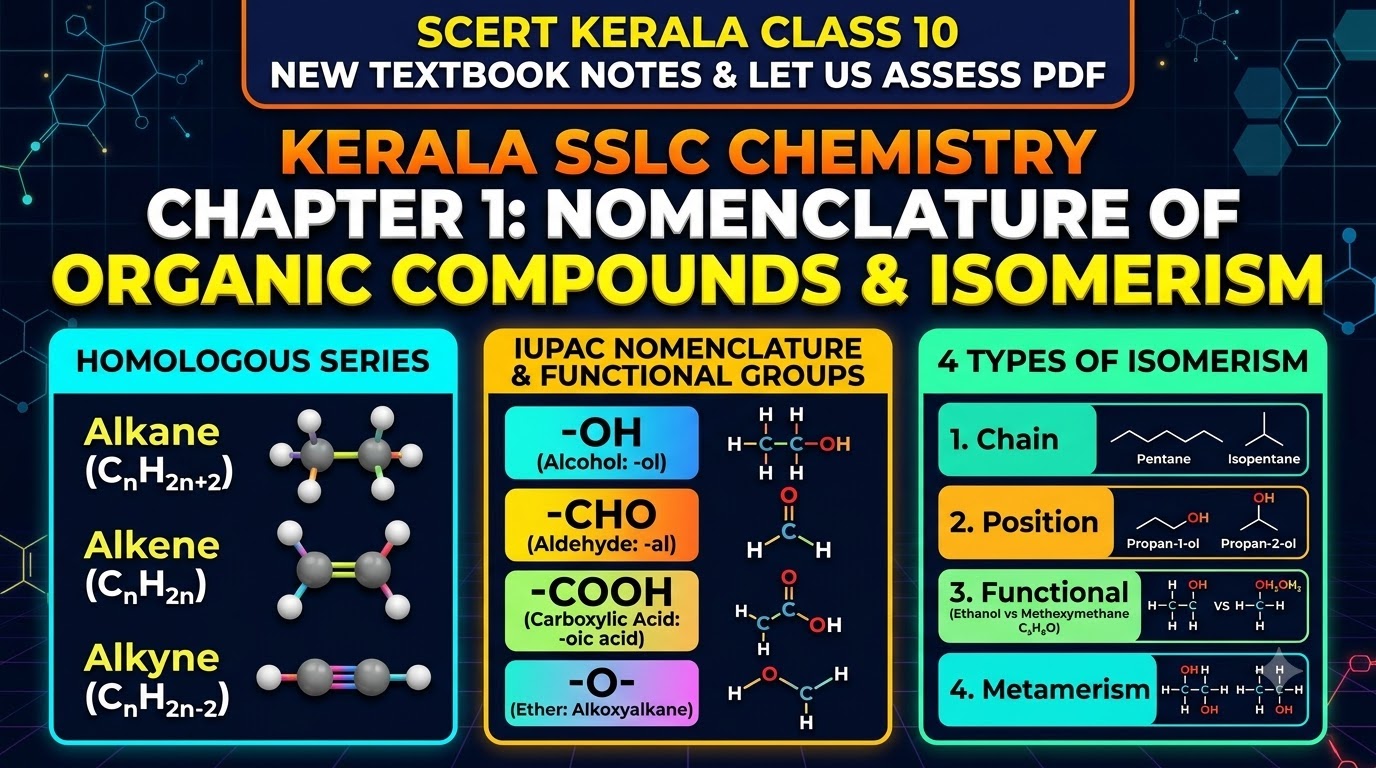
Kerala SSLC Chemistry Chapter 1 Notes on Nomenclature of Organic Compounds and Isomerism (Malayalam Medium: ഓർഗാനിക് സംയുക്തങ്ങളുടെ നാമകരണവും ഐസോമെറിസവും) cover the first unit of the newly revised Class 10 (Std 10) Chemistry textbook published by the State Council of Educational Research and Training (SCERT Kerala). In the revised textbook for the Kerala Pareeksha Bhavan SSLC Public Examination, SCERT moved Organic Chemistry from Part 2 to the very first chapter of Part 1—carrying 6 to 7 marks across IUPAC naming of branched alkanes, functional groups, and structural isomerism.
As a High School Physical Science teacher, I always tell my Class 10 students that Chapter 1 is the easiest unit to score 100% marks if you follow two simple rules: always number the longest carbon chain from the end nearest to the functional group or branch, and always use commas between numbers and hyphens between numbers and letters (e.g., 2,2-Dimethylpropane)!
Quick Navigation Across SSLC Chemistry: Continue to Chapter 2: Chemical Reactions of Organic Compounds, Chapter 3: Periodic Table and Electron Configuration, or visit our Kerala SSLC Chemistry All 7 Chapters Master Hub.
CHAPTER 1 AT A GLANCE: CLASS 10 CHEMISTRY QUICK REVISION BLUEPRINT
- Chapter 1 Title (EM & MM): Nomenclature of Organic Compounds and Isomerism (ഓർഗാനിക് സംയുക്തങ്ങളുടെ നാമകരണവും ഐസോമെറിസവും)
- Expected SSLC Exam Weightage: 6 to 7 Marks (IUPAC Naming + Functional Groups + Isomerism)
- General Formulas: Alkanes =
CnH2n+2(-ane) | Alkenes & Cycloalkanes =CnH2n(-ene) | Alkynes =CnH2n-2(-yne) - Homologous Series Difference: Successive members differ by a
–CH2–group and14 umolecular mass - 3 Types of Structural Isomerism: (1) Chain Isomerism | (2) Position Isomerism | (3) Functional Group Isomerism (Alcohol ↔ Ether; Aldehyde ↔ Ketone; Acid ↔ Ester)
1. Kerala SSLC Chemistry Chapter 1 Notes: Hydrocarbons, Catenation and Homologous Series
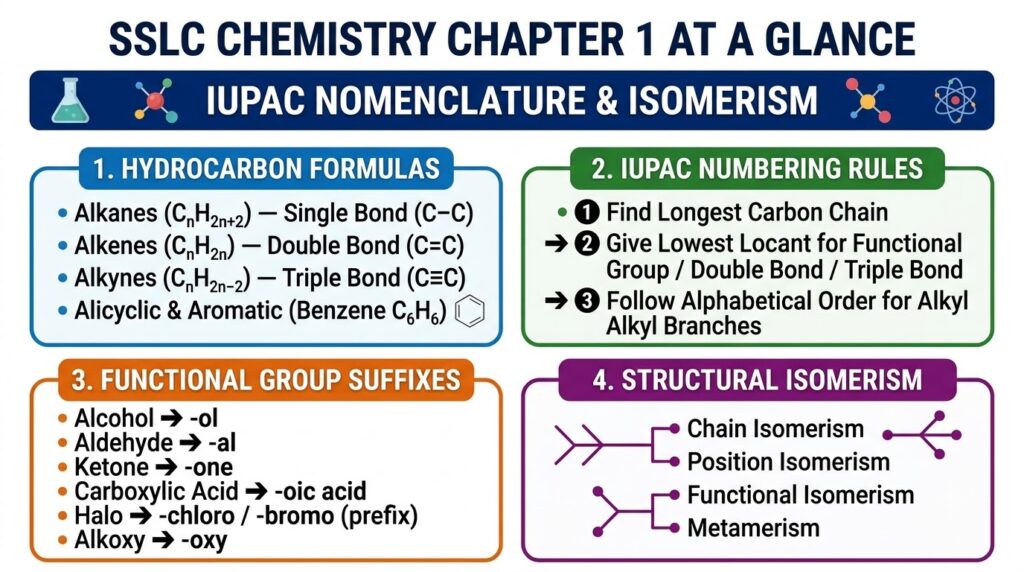
Carbon (Z = 6, configuration 2, 4) forms millions of organic compounds due to two unique properties: Tetravalency (ability to form four covalent bonds) and Catenation (self-linking ability of carbon atoms through single, double, or triple bonds to form straight chains, branched chains, and closed rings). Compounds containing only carbon and hydrogen are called Hydrocarbons:
| Hydrocarbon Family | Carbon-Carbon Bond | General Formula & Suffix | Examples |
|---|---|---|---|
| 1. Alkanes (Saturated) | Only single bonds (C–C) |
CnH2n+2 (Suffix: -ane) |
Methane (CH4), Ethane (C2H6), Propane (C3H8), Butane (C4H10) |
| 2. Alkenes (Unsaturated) | At least one double bond (C=C) |
CnH2n (Suffix: -ene) |
Ethene (C2H4), Propene (C3H6), Butene (C4H8) |
| 3. Alkynes (Unsaturated) | At least one triple bond (C≡C) |
CnH2n-2 (Suffix: -yne) |
Ethyne (C2H2), Propyne (C3H4), Butyne (C4H6) |
| 4. Alicyclic & Aromatic | Closed carbon ring structures | Cycloalkanes: CnH2n |
Cyclopropane (C3H6), Cyclohexane (C6H12), Benzene (C6H6) |
2. IUPAC Nomenclature Rules and Complete Functional Groups Table
Word Roots (C1 to C10): C1 = Meth, C2 = Eth, C3 = Prop, C4 = But, C5 = Pent, C6 = Hex, C7 = Hept, C8 = Oct, C9 = Non, C10 = Dec. When naming branched hydrocarbons, select the longest continuous carbon chain, number it to give the lowest locant to branches (–CH3 Methyl, –C2H5 Ethyl) or double/triple bonds, use prefixes di-, tri-, tetra- for identical branches, and list different branches in alphabetical order (Ethyl before Methyl).
| Compound Class | Functional Group | IUPAC Pattern | Examples |
|---|---|---|---|
| Alcohols | Hydroxyl (–OH) |
Alkanol (-ol) | CH3–CH2–OH (Ethanol), CH3–CH(OH)–CH3 (Propan-2-ol) |
| Carboxylic Acids | Carboxylic (–COOH) |
Alkanoic acid (-oic acid) | HCOOH (Methanoic acid), CH3–COOH (Ethanoic acid) |
| Aldehydes | Aldehyde (–CHO) |
Alkanal (-al) | HCHO (Methanal), CH3–CHO (Ethanal) |
| Ketones | Keto (–CO–) |
Alkanone (-one) | CH3–CO–CH3 (Propanone), CH3–CO–CH2–CH3 (Butan-2-one) |
| Ethers | Alkoxy (–O–R) |
Alkoxyalkane | CH3–O–CH3 (Methoxymethane), CH3–O–CH2–CH3 (Methoxyethane) |
| Esters & Haloalkanes | –COO– / –F, –Cl, –Br, –I |
Alkyl alkanoate / Haloalkane | CH3–COO–CH3 (Methyl ethanoate), CH3–CH(Cl)–CH3 (2-Chloropropane) |
3. Isomerism in Organic Compounds & Class 10 Let Us Assess Questions and Answers
- 1. Chain Isomerism: Same molecular formula, different carbon chain skeleton. Example (
C4H10): Butane (CH3–CH2–CH2–CH3) and 2-Methylpropane (CH3–CH(CH3)–CH3). - 2. Position Isomerism: Same carbon chain, different position of functional group or double/triple bond. Example (
C3H8O): Propan-1-ol and Propan-2-ol; (C4H8): But-1-ene and But-2-ene. - 3. Functional Group Isomerism: Same molecular formula, different functional groups:
–C2H6O: Ethanol (CH3–CH2–OH) and Methoxymethane (CH3–O–CH3).
–C3H6O: Propanal (CH3–CH2–CHO) and Propanone (CH3–CO–CH3).
–C2H4O2: Ethanoic acid (CH3–COOH) and Methyl methanoate (HCOO–CH3).
പത്താം ക്ലാസ് രസതന്ത്രം അദ്ധ്യായം 1: ഓർഗാനിക് സംയുക്തങ്ങളുടെ നാമകരണവും ഐസോമെറിസവും (മലയാളം മീഡിയം നോട്ടുകൾ)
- ഹൈഡ്രോകാർബണുകൾ: ആൽക്കെയ്നുകൾ (
CnH2n+2, ഏകബന്ധനം, Suffix: -ane), ആൽക്കീനുകൾ (CnH2n, ദ്വിബന്ധനം, Suffix: -ene), ആൽക്കൈനുകൾ (CnH2n-2, ത്രിബന്ധനം, Suffix: -yne). - ഫങ്ഷണൽ ഗ്രൂപ്പുകൾ: ഹൈഡ്രോക്സിൽ (
–OH, ആൽക്കഹോൾ -ol), കാർബോക്സിലിക് (–COOH, ആസിഡ് -oic acid), ആൽഡിഹൈഡ് (–CHO, -al), കീറ്റോ (–CO–, -one), ആൽക്കോക്സി (–O–R, ഈഥർ). - ഐസോമെറിസം: ഒരേ തന്മാത്രാസൂത്രവും വ്യത്യസ്ത ഘടനാസൂത്രവുമുള്ള സംയുക്തങ്ങളാണ് ഐസോമെറുകൾ (ചെയിൻ ഐസോമെറിസം, പൊസിഷൻ ഐസോമെറിസം, ഫങ്ഷണൽ ഐസോമെറിസം).
Teacher’s Classroom Note & Student Discussion Question:
Dear SSLC Students, always count the total carbon atoms carefully before deciding whether two structures are chain isomers or identical molecules! Quick Question for You: Write the IUPAC name and one functional isomer of CH3–CH2–CH2–OH. Share your answer in the comments below!


Latest SCERT & DHSE Kerala Study Notes
- Kerala Class 9 Physics Chapter 2 Notes: Equations of Motion (ചലനസമവാക്യങ്ങൾ) Std 9 Let Us Assess Questions and Answers PDF
- Kerala SSLC Christmas Exam Question Paper 2025-27: All Subjects Second Term & Model Question Papers with Solved Answer Keys PDF (New SCERT Syllabus)
- Kerala SSLC English Christmas Exam Question Paper 2025-27: Second Term & Model Solved 80-Mark Answer Key, Discourses & Grammar PDF
- Kerala SSLC Social Science Christmas Exam Question Paper 2025-27: Second Term & Model Solved 80-Mark Answer Key, Weightage & Map Study PDF
- Kerala SSLC Maths Christmas Exam Question Paper 2025-27: Second Term & Model Solved Answer Key, Weightage & Formula Sheet PDF (New SCERT Syllabus)
- Kerala SSLC Biology Christmas Exam Question Paper 2025-27: Second Term & Model Solved Answer Key, Weightage & Flowcharts PDF (New SCERT Syllabus)
- Kerala SSLC Chemistry Christmas Exam Question Paper 2025-27: Second Term & Model Solved Answer Key, Weightage & Sure A+ Questions PDF (New SCERT Syllabus)
- Kerala SSLC Physics Christmas Exam Question Paper 2025-27: Second Term & Model Solved Answer Key, Weightage & Formula Sheet PDF (New SCERT Syllabus)