
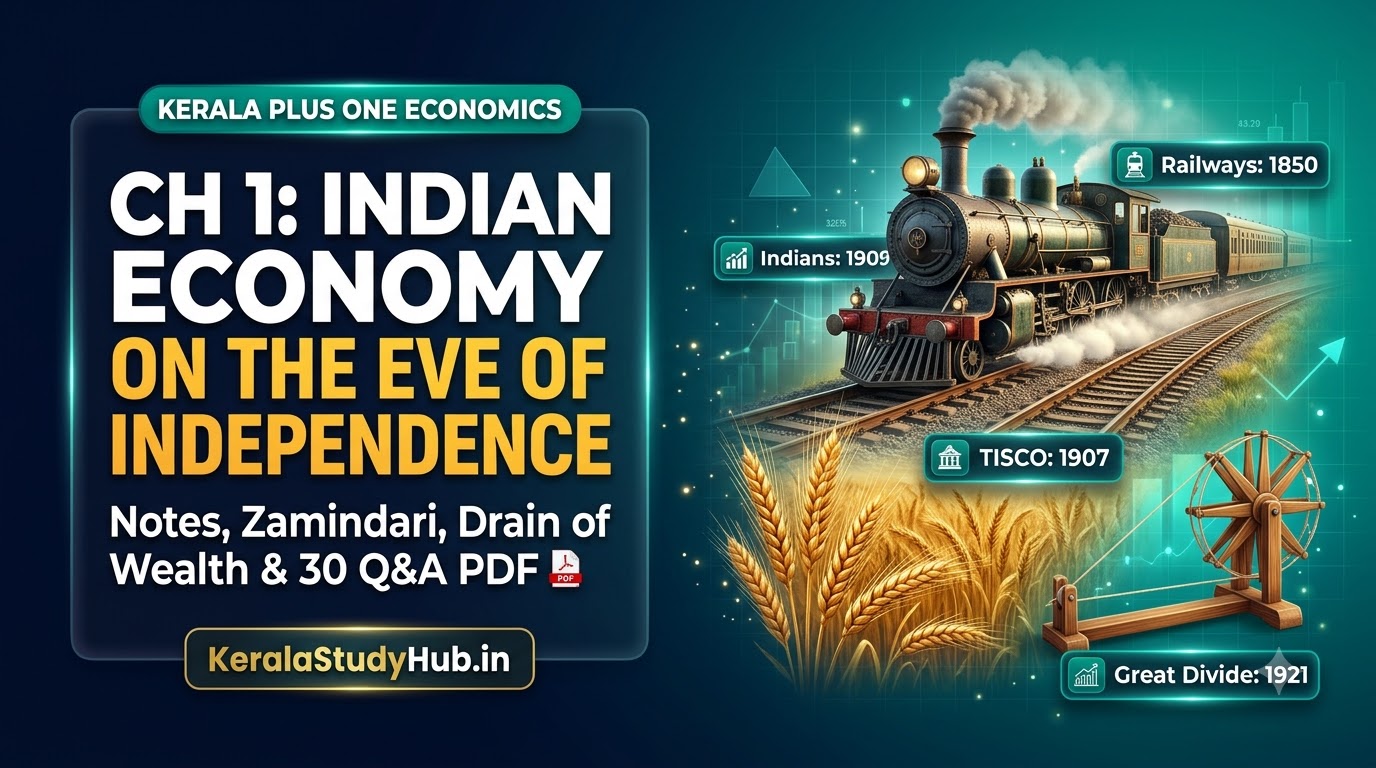
Welcome to the complete, exam-oriented study guide for Kerala Plus One Economics Chapter 1 Notes 2026–27 (Indian Economy on the Eve of Independence / സ്വാതന്ത്ര്യലബ്ധിയുടെ സമയത്തെ ഇന്ത്യൻ സമ്പദ്വ്യവസ്ഥ). Whether you are a Commerce student studying Plus One Accountancy Chapter 1 and Plus One Business Studies Chapter 1, or a Humanities student preparing for your DHSE Kerala Higher Secondary Class 11 examinations, Economics is one of the highest-scoring subjects in your curriculum. Part A of the Class 11 Economics textbook—Indian Economic Development—opens with a critical historical analysis of how nearly 200 years of British colonial rule (from the Battle of Plassey in 1757 to 15 August 1947) transformed a prosperous, self-reliant Indian economy into a stagnant, backward, and impoverished feeder economy.
- Kerala Plus One Economics Chapter 1 Overview & Weightage 2026–27 (പാഠഭാഗത്തിന്റെ സംഗ്രഹം)
- 1. Low Level of Economic Development Under Colonial Rule (കൊളോണിയൽ ഭരണകാലത്തെ താഴ്ന്ന സാമ്പത്തിക വികസനം)
- 1.1 Prosperous Pre-British India & Famous Handicrafts
- 1.2 Fundamental Purpose of British Colonial Rule in India
- 1.3 Estimators of National Income & Per Capita Income During Colonial Period (ദേശീയ വരുമാന കണക്കുകൾ — 2-Mark Sure Question!)
- 2. Agricultural Sector on the Eve of Independence (കാർഷിക മേഖലയുടെ അവസ്ഥ — 4-Mark / 8-Mark Topic!)
- Four Main Causes of Stagnation in the Indian Agricultural Sector (കാർഷിക മേഖലയിലെ തകർച്ചയുടെ 4 പ്രധാന കാരണങ്ങൾ):
- 3. Industrial Sector — Systematic De-industrialisation (വ്യവസായ മേഖലയും വ്യവസായ തകർച്ചയും)
- 3.1 The Two-Fold Motive Behind British “Systematic De-industrialisation” (ബ്രിട്ടീഷ് വ്യവസായ തകർച്ചയുടെ ഇരട്ട ലക്ഷ്യങ്ങൾ — Guaranteed 3-Mark Question!)
- 3.2 Bleak Growth of Modern Industry in India & TISCO (1907)
- 4. Foreign Trade Under British Rule & Drain of Indian Wealth (വിദേശ വ്യാപാരവും സാമ്പത്തിക ചോർച്ചയും)
- 5. Demographic Condition on the Eve of Independence (ജനസംഖ്യാപരമായ അവസ്ഥ — 4-Mark Topic!)
- 6. Occupational Structure on the Eve of Independence (തൊഴിൽ ഘടന — 3-Mark Question!)
- 7. Infrastructure Under Colonial Rule — Railways, Roads & Ports (അടിസ്ഥാന സൗകര്യങ്ങൾ — 4M / 5M)
- Complete Mark-Wise Question Bank (30 Solved Board & Previous Year Questions — ചോദ്യോത്തരങ്ങൾ)
- Section A: 1 Mark Objective & One-Word Questions (ഒരു മാർക്ക് ചോദ്യങ്ങൾ)
- Section B: 2 Mark & 3 Mark Short Answer Questions (രണ്ട് / മൂന്ന് മാർക്ക് ചോദ്യങ്ങൾ)
- Section C: 4 Mark & 5 Mark Short Essay Questions (നാല് / അഞ്ച് മാർക്ക് ചോദ്യങ്ങൾ)
- Section D: 8 Mark Long Essay Questions (എട്ട് മാർക്ക് ഉപന്യാസ ചോദ്യങ്ങൾ)
- Frequently Asked Questions (FAQ) — Kerala Plus One Economics Chapter 1
- 1. Why is 1921 called the “Year of Great Divide” in Indian Economics?
- 2. When were Railways introduced in India and when was the Suez Canal opened?
- 3. Where can I study Plus One Business Studies, Accountancy, and English notes on Kerala Study Hub?
In the DHSE Kerala Plus One Economics Public Examination for 2026–27, Chapter 1 carries a solid weightage of 6 to 8 marks (and up to 12 marks in the First Term Onam Exam and Second Term Christmas Exam). Every year, examiners ask direct questions on National Income Estimators (Dr. V.K.R.V. Rao & Dadabhai Naoroji), Causes of Stagnation in Indian Agriculture (Zamindari System & Commercialisation), the Two-Fold Motive behind De-industrialisation, Drain of Indian Wealth (സാമ്പത്തിക ചോർച്ച), Opening of the Suez Canal (1869), Year of Great Divide (1921), and the State of Infrastructure (Railways, 1850). In this comprehensive long-form guide by Kerala Study Hub (KeralaStudyHub.in), we present detailed revision notes in simple English and Malayalam Medium (മലയാളം മീഡിയം) along with 30 solved 1-Mark to 8-Mark Board Questions and Answers.
Kerala Plus One Economics Chapter 1 Overview & Weightage 2026–27 (പാഠഭാഗത്തിന്റെ സംഗ്രഹം)
Check the official SCERT Kerala and NCERT syllabus structure and expected marks breakdown for Class 11 Economics Chapter 1 before starting your revision:
| Exam Feature | Details for 2026–27 DHSE Kerala Plus One Economics Syllabus |
|---|---|
| Board & Class | DHSE & SCERT Kerala — Plus One (Class 11 Commerce & Humanities Streams) |
| Subject & Textbook | Economics — Part A: Indian Economic Development (ഇന്ത്യൻ സാമ്പത്തിക വികസനം) |
| Chapter Number & Title | Chapter 1: Indian Economy on the Eve of Independence (സ്വാതന്ത്ര്യലബ്ധിയുടെ സമയത്തെ ഇന്ത്യൻ സമ്പദ്വ്യവസ്ഥ) |
| Medium Covered | English Medium (EM) & Malayalam Medium (MM) |
| Expected Marks Weightage | 6 to 8 Marks in Public Board Exam (10 to 12 Marks in Term Exams) |
| Guaranteed Exam Topics | Zamindari System (4M), Two-Fold De-industrialisation (3M), Drain of Wealth (4M), Demographic Profile & 1921 Great Divide (4M), Railways & Sectoral Review (8M Essay) |
1. Low Level of Economic Development Under Colonial Rule (കൊളോണിയൽ ഭരണകാലത്തെ താഴ്ന്ന സാമ്പത്തിക വികസനം)
1.1 Prosperous Pre-British India & Famous Handicrafts
Before the advent of British rule, India had an independent, self-reliant, and prosperous economy. Although agriculture was the main source of livelihood for most people, the country’s economy was world-famous for its handicraft industries (കരകൗശല വ്യവസായങ്ങൾ) in the fields of cotton and silk textiles, metal and precious stone works, gold and silver jewellery, and perfumery. Indian products enjoyed a worldwide market due to the high reputation of the fine quality of materials used and the high standards of craftsmanship.
- 💡 Dacca Muslin (ധാക്ക മസ്ലിൻ — 1-Mark / 2-Mark Exam Favourite!):
Muslin is a type of superfine cotton textile which had its origin in Bengal, particularly in places in and around Dhaka (spelled Dacca during the pre-independence period, now the capital of Bangladesh).
• ‘Dacca Muslin’ had gained worldwide fame as an exquisite type of cotton textile.
• The finest variety of muslin was called Malmal (മൽമൽ). Foreign travellers also used to refer to it as Malmal Shahi or Malmal Khas, implying that it was worn by, or fit for, the royalty (kings and queens) because a 20-yard piece of this fabric was so fine that it could pass through a finger ring and fit inside a small matchbox!
1.2 Fundamental Purpose of British Colonial Rule in India
The economic policies pursued by the colonial government in India were concerned more with the protection and promotion of the economic interests of their home country (Britain) than with the development of the Indian economy. Such policies brought about a fundamental change in the structure of the Indian economy—transforming India into:
1. A mere supplier of raw materials (raw cotton, raw silk, jute, indigo, wool, sugar) for Britain’s rapidly expanding modern industrial base, and
2. A sprawling consumer market for finished industrial products manufactured in Britain! (Thus turning India into a “Feeder Economy” for Great Britain).
1.3 Estimators of National Income & Per Capita Income During Colonial Period (ദേശീയ വരുമാന കണക്കുകൾ — 2-Mark Sure Question!)
The British colonial government never made any sincere attempt to estimate India’s national and per capita income. However, some notable Indian economists and individual scholars made individual attempts to measure such incomes:
| Five Famous Economists Who Estimated India’s National Income (Memorize All 5 Names!) | Key Exam Highlights & Growth Rate Figures |
|---|---|
| 1. Dadabhai Naoroji (ദാദാഭായ് നവറോജി) 2. William Digby (വില്യം ഡിഗ്ബി) 3. Findlay Shirras (ഫിൻഡ്ലെ ഷിറാസ്) 4. Dr. V.K.R.V. Rao (ഡോ. വി.കെ.ആർ.വി. റാവു) 5. R.C. Desai (ആർ.സി. ദേശായി) |
• Among all these estimators, the estimates given by Dr. V.K.R.V. Rao during the colonial period were considered very significant and most scientific! *(1-Mark Guaranteed Question!)* • During the first half of the 20th century (1900–1950), India’s aggregate real output (GDP) growth was less than 2% (< 2%) per year! • Growth of per capita output per year was a meagre half percent (0.5%) per year! |
2. Agricultural Sector on the Eve of Independence (കാർഷിക മേഖലയുടെ അവസ്ഥ — 4-Mark / 8-Mark Topic!)
Under British colonial rule, India remained fundamentally an agrarian economy. About 85% of the country’s population lived mostly in villages and derived their livelihood directly or indirectly from agriculture. Despite being the occupation of such a large population, the agricultural sector continued to experience stagnation (നിശ്ചലാവസ്ഥ) and constant deterioration, with extremely low agricultural productivity and frequent famines.
Four Main Causes of Stagnation in the Indian Agricultural Sector (കാർഷിക മേഖലയിലെ തകർച്ചയുടെ 4 പ്രധാന കാരണങ്ങൾ):
- Land Settlement Systems — Especially the Zamindari System (സമീന്ദാരി സമ്പ്രദായം / ഭൂവുടമ സമ്പ്രദായം):
The most important reason for the stagnation in agriculture was the introduction of various systems of land settlement by the colonial government, particularly the Zamindari System implemented in the then Bengal Presidency (comprising parts of present-day eastern states of India).
• Under the Zamindari system, the profit accruing out of the agriculture sector went to the Zamindars (ജന്മിമാർ / സമീന്ദാർമാർ) in the form of ‘Lagaan’ (rent) instead of the actual cultivators (tillers of the soil).
• Neither the Zamindars nor the colonial government did anything to improve the condition of agriculture or the soil.
• Role of ‘Revenue Settlement’ Terms: The dates for depositing specified sums of revenue with the British government were fixed strictly (Sunset Law), failing which the Zamindars were to lose their rights over the land! This made the Zamindars ruthless and cruel in collecting rent from poor farmers regardless of whether the monsoon failed or crops were destroyed. - Low Level of Technology, Lack of Irrigation & Negligible Use of Fertilisers (താഴ്ന്ന സാങ്കേതികവിദ്യയും ജലസേചന സൗകര്യങ്ങളുടെ അഭാവവും):
Agricultural productivity remained shockingly low because farmers used primitive wooden ploughs, had almost no assured irrigation facilities (relying entirely on uncertain monsoon rains), and used negligible chemical fertilisers. - Commercialisation of Agriculture (കൃഷിയുടെ വാണിജ്യവൽക്കരണം — 3-Mark Repeated Question!):
Commercialisation of agriculture means shifting from cultivating food crops (like rice, wheat, and pulses meant for family/village consumption) to cultivating cash crops (like Indigo / നീലം, raw cotton, jute, sugarcane, and opium) for sale in the market.
• British rulers forced Indian farmers to grow Indigo (നീലം) because it was urgently required by the textile dyeing and bleaching industries in Britain.
• However, this commercialisation did NOT improve the economic condition of Indian farmers! Instead of producing food grains for their survival, farmers were forced to produce cash crops for British industries, which led to acute food shortages and frequent deadly famines across India. - Adverse Impact of the Partition of the Country in 1947 (വിഭജനത്തിന്റെ ആഘാതം):
India’s agricultural production received a further setback due to the country’s partition at the time of independence:
• A sizeable portion of the undivided country’s highly irrigated and fertile land went to Pakistan.
• Almost the whole of the jute-producing area became part of East Pakistan (now Bangladesh). Consequently, India’s thriving jute goods industry (located in Kolkata) suffered heavily for lack of raw material!
3. Industrial Sector — Systematic De-industrialisation (വ്യവസായ മേഖലയും വ്യവസായ തകർച്ചയും)
As in agriculture, so also in manufacturing, India could not develop a sound industrial base under colonial rule. Even as the country’s world-famous handicraft industries declined rapidly, no corresponding modern industrial base was allowed to come up to take pride of place so long enjoyed by the former.
3.1 The Two-Fold Motive Behind British “Systematic De-industrialisation” (ബ്രിട്ടീഷ് വ്യവസായ തകർച്ചയുടെ ഇരട്ട ലക്ഷ്യങ്ങൾ — Guaranteed 3-Mark Question!)
The primary motive of the colonial government behind this policy of systematically de-industrialising India was two-fold (ഇരട്ട ലക്ഷ്യങ്ങൾ):
| Motive No. | Exact Statement for DHSE Board Exam | Malayalam Explanation (മലയാളത്തിൽ) |
|---|---|---|
| First Motive | To reduce India to the status of a mere exporter of important raw materials for the upcoming modern industries in Britain. | ബ്രിട്ടനിലെ ആധുനിക വ്യവസായങ്ങൾക്ക് ആവശ്യമായ അസംസ്കൃത വസ്തുക്കൾ (Raw Materials) കയറ്റുമതി ചെയ്യുന്ന ഒരു രാജ്യമായി മാത്രം ഇന്ത്യയെ മാറ്റുക. |
| Second Motive | To turn India into a sprawling market for the finished products of those industries so that their continued expansion could be ensured to the maximum advantage of their home country—Britain. | ബ്രിട്ടീഷ് വ്യവസായശാലകളിൽ ഉൽപ്പാദിപ്പിക്കുന്ന നിർമ്മിത വസ്തുക്കൾ (Finished Goods) വിറ്റഴിക്കാനുള്ള ഒരു വലിയ കമ്പോളമായി ഇന്ത്യയെ മാറ്റുക. |
- Two Harmful Effects of the Decline of Handicraft Industries on the Indian Economy:
1. Massive Unemployment (വൻതോതിലുള്ള തൊഴിലില്ലായ്മ): Millions of skilled traditional weavers and artisans lost their livelihood and were forced to crowd back into already overburdened agriculture.
2. Import of British Manufactured Goods: Deprived of domestic supply of locally made goods, Indian consumers were forced to buy cheap machine-made clothes and goods imported from Britain.
3.2 Bleak Growth of Modern Industry in India & TISCO (1907)
During the second half of the nineteenth century, modern industry began to take root in India, but its progress remained very slow:
- Cotton and Jute Textile Mills: Initially, development was confined to setting up cotton and jute textile mills.
• Cotton Textile Mills (mainly dominated by Indians) were located in the western parts of the country—namely, Maharashtra and Gujarat.
• Jute Mills (dominated by foreigners/British) were mainly concentrated in Bengal. - Establishment of TISCO (1907 — 1-Mark Guaranteed Question!):
In the beginning of the 20th century, iron and steel industries began coming up. The Tata Iron and Steel Company (TISCO) was incorporated in 1907 (at Jamshedpur). Other industries like sugar, cement, and paper came up after the Second World War. - Three Major Drawbacks / Shortcomings of the New Industrial Sector (3-Mark Question):
1. Acute Lack of Capital Goods Industries (മൂലധന വസ്തു വ്യവസായങ്ങളുടെ അഭാവം): There were hardly any capital goods industries (industries which can produce machine tools and heavy machinery that are, in turn, used for producing articles for current consumption).
2. Meagre Contribution to GDP: The growth rate of the new industrial sector and its contribution to the Gross Domestic Product (GDP) or Gross Value Added remained very small.
3. Very Limited Area of Operation of the Public Sector: The public (government) sector remained confined only to the railways, power generation, communications, ports, and a few departmental undertakings.
4. Foreign Trade Under British Rule & Drain of Indian Wealth (വിദേശ വ്യാപാരവും സാമ്പത്തിക ചോർച്ചയും)
India has been an important trading nation since ancient times (as we also studied in Plus One Business Studies Chapter 1). However, the restrictive policies of commodity production, trade, and tariff (discriminatory tariff policy) pursued by the colonial government adversely affected the structure, composition, and volume of India’s foreign trade:
- Composition of Trade (Exporter of Primary Products & Importer of Finished Goods):
India became an exporter of primary products such as raw silk, cotton, wool, sugar, indigo, jute, etc., and an importer of finished consumer goods like cotton, silk, and woollen clothes and capital goods (light machinery) produced in the factories of Britain. - Direction of Trade — Britain’s Monopoly Control & Suez Canal (1869):
For all practical purposes, Britain maintained a monopoly control (കുത്തക നിയന്ത്രണം) over India’s exports and imports:
• More than half (> 50%) of India’s foreign trade was restricted strictly to Britain, while the rest was allowed with a few other countries like China, Ceylon (Sri Lanka), and Persia (Iran).
• 💡 Opening of the Suez Canal in 1869 (സൂയസ് കനാൽ — 1-Mark / 2-Mark Sure Question!):
The opening of the Suez Canal in 1869 further intensified British control over India’s foreign trade! The Suez Canal is an artificial waterway running from north to south across the Isthmus of Suez in north-eastern Egypt, connecting Port Said on the Mediterranean Sea with the Gulf of Suez (an arm of the Red Sea). It provided a direct, shorter sea route for ships operating between European/British ports and Indian/South Asian ports without having to sail all the way around the African continent, drastically reducing the cost and time of transportation! - Generation of Large Export Surplus & “Drain of Indian Wealth” (സാമ്പത്തിക ചോർച്ച — Guaranteed 3-Mark / 4-Mark Question!):
The most striking characteristic of India’s foreign trade throughout the colonial period was the generation of a large Export Surplus (Exports were greater than Imports). However, this export surplus came at a huge cost to the country’s economy and did NOT result in any flow of gold or silver into India!
How was India’s Export Surplus misused by the British (Drain of Wealth)?
• Several essential commodities—food grains, clothes, kerosene, etc.—were scarcely available in the domestic market.
• First, the export surplus was used to make payments for the expenses incurred by an office set up by the colonial government in Britain (Home Charges).
• Second, it was used to meet expenses on war, again fought by the British government.
• Third, it was used to pay for the import of invisible items (services). All of this led to the systematic Drain of Indian Wealth (a theory famously propounded by Dadabhai Naoroji in his book “Poverty and Un-British Rule in India”).
5. Demographic Condition on the Eve of Independence (ജനസംഖ്യാപരമായ അവസ്ഥ — 4-Mark Topic!)
Various details about the population of British India were first collected through a census in 1881. Since 1881, decennial census operations have been carried out every ten years.
- 💡 Why is 1921 Called the “Year of Great Divide” (മഹാവിഭജന വർഷം)? [1-Mark / 2-Mark Guaranteed Question!]:
Before 1921, India was in the first stage of demographic transition (both birth rate and death rate were very high, so population growth was stagnant and sometimes even negative due to famines and epidemics). From the year 1921 onwards, India entered the second stage of demographic transition, where the death rate started falling and India’s population never declined thereafter, recording a consistent upward rise! Hence, 1921 is called the “Year of Great Divide” in India’s demographic history.
Master Table of India’s Demographic Indicators on the Eve of Independence (1947):
| Demographic Indicator (സൂചിക) | Value in 1947 (On the Eve of Independence) | What It Revealed About British Rule |
|---|---|---|
| 1. Overall Literacy Level (സാക്ഷരതാ നിരക്ക്) | Less than 16% (< 16%) | Extreme social and educational backwardness; colonial neglect of mass education. |
| 2. Female Literacy Level (സ്ത്രീ സാക്ഷരത) | About 7% (Negligible!) | Severe gender inequality and neglect of girls’ education. |
| 3. Infant Mortality Rate — IMR (ശിശുമരണ നിരക്ക്) | 218 per 1,000 live births! *(Compared to ~28–30 per 1,000 today)* |
Absence of public health facilities, lack of maternal care, and frequent water/air-borne diseases. |
| 4. Life Expectancy at Birth (ആയുർദൈർഘ്യം) | Only 32 Years! *(Compared to ~69–70 years today)* |
Widespread malnutrition, recurring famines, epidemics, and lack of medical care. |
| 5. Birth Rate & Death Rate | Both were VERY HIGH (Birth rate ~48/1000; Death rate ~40/1000) |
Characteristic of an underdeveloped, impoverished agrarian economy. |
6. Occupational Structure on the Eve of Independence (തൊഴിൽ ഘടന — 3-Mark Question!)
Occupational Structure (തൊഴിൽ ഘടന) refers to the distribution of working persons across different industries and sectors—namely, the Primary (Agricultural), Secondary (Manufacturing), and Tertiary (Service) sectors. During the colonial period, the occupational structure of India showed little sign of change:
| Economic Sector | Share of Workforce in 1947 (%) | Key Regional Variation & Exam Notes |
|---|---|---|
| 1. Agricultural (Primary) Sector (കാർഷിക മേഖല) |
70% to 75% (Largest share!) |
• Declining dependence on agriculture was seen in the Madras Presidency (present-day Tamil Nadu, Andhra Pradesh, Kerala, and Karnataka), Bombay, and Bengal. • However, during the same time, there was an increase in the share of workforce in agriculture in states such as Orissa, Rajasthan, and Punjab! |
| 2. Manufacturing (Secondary) Sector (നിർമ്മാണ / വ്യവസായ മേഖല) |
Only 10% | Reflected the lack of modern industrialization and destruction of traditional handicrafts. |
| 3. Services (Tertiary) Sector (സേവന മേഖല) |
15% to 20% | Included trade, transport, and colonial administration. |
7. Infrastructure Under Colonial Rule — Railways, Roads & Ports (അടിസ്ഥാന സൗകര്യങ്ങൾ — 4M / 5M)
Under the colonial regime, basic infrastructure such as railways, ports, water transport, posts, and telegraphs did develop. However, the real motive behind this development was NOT to provide basic amenities to the Indian people, but to subserve various colonial interests!
- 1. Roads (റോഡുകൾ): The roads that were built primarily served the purposes of:
(i) Mobilising the British army within India, and
(ii) Drawing out raw materials from the countryside to the nearest railway station or the port to send these to far-away England! There always remained an acute shortage of all-weather roads to reach out to the rural areas during the rainy season, causing rural people to suffer grievously during natural calamities and famines. - 2. Railways — Introduced in 1850 (റെയിൽവേ — Most ImportantContribution of the British!):
The British introduced the Railways in India in 1850 (and the first passenger train ran from Bombay to Thane on 16 April 1853). It is considered one of their most important contributions. The railways affected the structure of the Indian economy in two important ways:
• Positive Impact: It enabled people to undertake long-distance travel and thereby broke geographical and cultural barriers across India.
• Negative Economic Impact: It fostered commercialisation of Indian agriculture, which adversely affected the self-sufficiency of the village economies in India. Although the volume of India’s exports expanded, its benefits rarely accrued to the Indian people. Thus, the social benefits which the Indian people gained owing to the introduction of the railways were outweighed by the country’s huge economic loss! - 3. Inland Trade, Sea Lanes & Coast Canal on the Orissa Coast:
The inland waterways developed by the British proved uneconomical, as in the case of the Coast Canal on the Orissa coast—built at a huge cost to the government exchequer, it failed to compete with the railways running parallel to the canal and had to be ultimately abandoned! - 4. Electric Telegraph & Postal Services:
The introduction of the expensive system of electric telegraph in India served the purpose of maintaining law and order and crushing freedom movements. The postal services, despite serving a useful public purpose, remained all through inadequate.
Complete Mark-Wise Question Bank (30 Solved Board & Previous Year Questions — ചോദ്യോത്തരങ്ങൾ)
Section A: 1 Mark Objective & One-Word Questions (ഒരു മാർക്ക് ചോദ്യങ്ങൾ)
Q1. What was the sole purpose of British colonial rule in India?
Answer:
To reduce India into a raw material supplier (feeder economy) for Great Britain’s own rapidly expanding modern industrial base and a consumer market for British finished goods.
Q2. Name the five notable economists who estimated India’s National Income and Per Capita Income during the colonial period.
Answer:
Dadabhai Naoroji, William Digby, Findlay Shirras, Dr. V.K.R.V. Rao, and R.C. Desai.
Q3. Whose estimate of India’s national and per capita income during the colonial period was considered very significant?
Answer:
Dr. V.K.R.V. Rao (ഡോ. വി.കെ.ആർ.വി. റാവു).
Q4. What was the finest variety of Dacca Muslin called, which was worn by royalty?
Answer:
Malmal (also referred to by foreign travellers as Malmal Shahi or Malmal Khas).
Q5. In which year was the Tata Iron and Steel Company (TISCO) incorporated in India?
Answer:
In the year 1907 (at Jamshedpur).
Q6. In which year was the Suez Canal opened for international maritime trade?
Answer:
In the year 1869.
Q7. When was India’s first official Census operation undertaken by the British?
Answer:
In the year 1881.
Q8. Which year is regarded as the “Year of Great Divide” (മഹാവിഭജന വർഷം) in the demographic history of India?
Answer:
The year 1921 (marking India’s transition from the first stage to the second stage of demographic transition).
Q9. What was the overall literacy rate and female literacy rate in India on the eve of independence (1947)?
Answer:
• Overall literacy level: Less than 16% (< 16%).
• Female literacy level: About 7%.
Q10. What was the Infant Mortality Rate (IMR) and Life Expectancy in India on the eve of independence?
Answer:
• Infant Mortality Rate (IMR): 218 per thousand (218/1000).
• Life Expectancy: 32 years.
Q11. In which year did the British introduce the Railways in India?
Answer:
In the year 1850 (and the first train ran in 1853).
Q12. What percentage of India’s workforce was engaged in the (a) Agricultural sector, (b) Manufacturing sector, and (c) Service sector on the eve of independence?
Answer:
• (a) Agricultural Sector: 70% to 75%
• (b) Manufacturing Sector: 10%
• (c) Service Sector: 15% to 20%
Section B: 2 Mark & 3 Mark Short Answer Questions (രണ്ട് / മൂന്ന് മാർക്ക് ചോദ്യങ്ങൾ)
Q13. What was the focus of the economic policies pursued by the colonial government in India? What were the impacts of these policies?
Answer:
• Focus: The economic policies of the colonial government were focused strictly on protecting and promoting the economic interests of their home country (Britain) rather than developing the Indian economy.
• Impact: They transformed India into a mere supplier of raw materials and a consumer of finished industrial products from Britain, resulting in acute poverty, agricultural stagnation, and de-industrialisation.
Q14. Explain how the Zamindari System became a major cause of stagnation in the Indian agricultural sector under British rule.
Answer:
1. Under the Zamindari system introduced in the Bengal Presidency, the profit accruing out of the agricultural sector went to the Zamindars in the form of Lagaan instead of the actual cultivators.
2. The main interest of the Zamindars was only to collect rent regardless of the economic condition of the cultivators, and they did nothing to invest in or improve agriculture.
3. Fixed dates for depositing revenue with the British government (failing which Zamindars lost their rights) made Zamindars exploit farmers mercilessly.
Q15. What is meant by “Commercialisation of Agriculture”? Did it help Indian farmers during the colonial period?
Answer:
Commercialisation of agriculture refers to the shift from cultivating food crops (for self-consumption) to cultivating cash crops (like Indigo, cotton, and jute) for sale in the market.
• No, it did NOT help Indian farmers! Instead of improving their economic condition, the higher yield of cash crops was used by British industries, while Indian farmers suffered from acute shortage of food grains and frequent famines.
Q16. What was the two-fold motive behind the systematic de-industrialisation effected by the British in pre-independent India?
Answer:
The two-fold motive of British systematic de-industrialisation was:
1. To reduce India to the status of a mere exporter of raw materials for the upcoming modern industries in Britain.
2. To turn India into a sprawling market for the finished products of those British industries so that their continued expansion could be ensured to the maximum advantage of Britain.
Q17. What are “Capital Goods Industries”? What was their status in India on the eve of independence?
Answer:
Capital Goods Industries (മൂലധന വസ്തു വ്യവസായങ്ങൾ) are industries which can produce machine tools and heavy machinery that are, in turn, used for producing articles for current consumption.
• On the eve of independence, there was an almost complete absence of capital goods industries in India, which prevented rapid industrialisation.
Q18. How did the opening of the Suez Canal in 1869 affect India’s foreign trade?
Answer:
1. The Suez Canal (opened in 1869) provided a direct, shorter sea route for ships operating between European/British ports and Indian ports, avoiding the long voyage around the African continent.
2. It drastically reduced the cost and time of transportation, make access to the Indian market much easier, and intensified British monopoly control over India’s foreign trade.
Q19. Define “Occupational Structure”. Mention one regional variation in India’s occupational structure during the colonial period.
Answer:
Occupational Structure refers to the distribution of working persons across different industries and sectors (Primary, Secondary, and Tertiary).
• Regional Variation: Parts of the then Madras Presidency, Bombay, and Bengal witnessed a decline in the dependence of the workforce on the agricultural sector with a commensurate increase in the manufacturing and services sectors. Conversely, states like Orissa, Rajasthan, and Punjab saw an increase in the share of workforce in agriculture.
Q20. What were the main motives of the British rulers behind the development of infrastructure (especially roads and railways) in India?
Answer:
1. Roads were built primarily to mobilize the British army within India and to draw out raw materials from the countryside to the nearest railway station or port for export to England.
2. Railways were developed to commercialise Indian agriculture and transport British finished goods into the interior markets of India.
3. Electric Telegraph was introduced to maintain colonial law and order.
Section C: 4 Mark & 5 Mark Short Essay Questions (നാല് / അഞ്ച് മാർക്ക് ചോദ്യങ്ങൾ)
Q21. “The traditional handicrafts industries were ruined under the British rule.” Do you agree with this view? Give reasons in support of your answer.
Answer:
Yes, I completely agree with this view. India’s world-renowned traditional handicraft industries were systematically ruined by the British colonial government due to the following reasons:
1. Discriminatory Tariff Policy of the State: The British allowed tariff-free (duty-free) export of raw materials from India to Britain and tariff-free import of British industrial goods into India, while placing heavy duty on the export of Indian handicraft products!
2. Stiff Competition from Machine-Made Goods: Handmade Indian goods could not compete with cheap, mass-produced machine-made textiles imported from British mills.
3. Disappearance of Princely Courts: Prior to British rule, Indian nawabs, kings, and emperors patronised fine handicrafts like Dacca Muslin. With the end of princely rule, handicraft artisans lost their biggest domestic patrons.
4. Introduction of Railways: Railways enabled British machine-made goods to reach the remotest villages of India, wiping out local village artisans and creating massive unemployment.
Q22. What do you understand by the “Drain of Indian Wealth” (സാമ്പത്തിക ചോർച്ച) during the colonial period? Explain how India’s large export surplus was misused.
Answer:
Throughout the colonial period, India’s foreign trade generated a large export surplus (Exports > Imports). However, this surplus came at a huge cost to the Indian economy:
1. Scarcity of Essential Goods at Home: Essential commodities like food grains, clothes, and kerosene were exported, causing acute scarcity and famines inside India.
2. No Inflow of Gold or Silver: Despite the export surplus, no gold, silver, or foreign exchange flowed into India to develop the domestic economy.
3. Three Ways the Export Surplus Was Drained to Britain:
• (i) To make payments for the administrative expenses incurred by an office set up by the colonial government in Britain (Home Charges),
• (ii) To meet the expenses on wars fought by the British government, and
• (iii) To pay for the import of invisible items (shipping, banking, and insurance services).
This unilateral transfer of India’s wealth to Britain without any economic return is known as the Drain of Indian Wealth.
Q23. Give a quantitative appraisal of India’s demographic profile during the colonial period. (കൊളോണിയൽ കാലഘട്ടത്തിലെ ഇന്ത്യയുടെ ജനസംഖ്യാപരമായ സവിശേഷതകൾ വിലയിരുത്തുക.)
Answer:
India’s demographic condition during the British rule exhibited all features of a stagnant and backward economy:
1. Year of Great Divide (1921): Before 1921, India was in the first stage of demographic transition with fluctuating population growth. After 1921, it entered the second stage.
2. Extremely Low Literacy Rate: The overall literacy level was less than 16 percent. Out of this, the female literacy level was at a negligible low of about 7 percent.
3. Lack of Public Health Facilities: Public health facilities were either unavailable to large chunks of the population or, when available, were highly inadequate. Consequently, water and air-borne diseases were rampant.
4. High Infant Mortality Rate (IMR): The overall mortality rate was very high, and the infant mortality rate was particularly alarming—about 218 per thousand in contrast to about 28 per thousand today.
5. Low Life Expectancy: Life expectancy was also very low—only 32 years in contrast to the present 69–70 years, accompanied by extensive poverty.
Q24. Critically appraise some of the shortfalls of the industrial policy pursued by the British colonial administration.
Answer:
The industrial policy pursued by the British colonial administration suffered from the following severe shortfalls:
1. Destruction of Handicrafts without Modern Replacement: While traditional handicrafts were destroyed through discriminatory tariffs, no modern industrial base was promoted to replace them.
2. Lopsided Geographical Growth: Modern industries were confined only to a few pockets (Cotton mills in Maharashtra/Gujarat and Jute mills in Bengal), leaving the rest of India industrially backward.
3. Absence of Capital Goods Industries: There were almost no heavy machine-building or capital goods industries to support further industrialisation.
4. Negligible Contribution to GDP & Employment: The industrial sector contributed barely 10% of employment and a tiny fraction of GDP.
5. Restricted Role of Public Sector: The government invested only in railways, ports, and communications that served colonial trade and military interests.
Q25. Were there any positive contributions made by the British in India? Discuss. (ഇന്ത്യയിൽ ബ്രിട്ടീഷ് ഭരണത്തിന്റെ എന്തെങ്കിലും അനുകൂല സംഭാവനകൾ ഉണ്ടായിരുന്നോ?)
Answer:
Although the sole motive of British rule was colonial exploitation, some of their policies and infrastructure projects yielded unintentional positive side-effects (by-products) for India:
1. Introduction of Railways (1850): Railways connected distant regions of India, broke geographical and cultural barriers, facilitated faster movement of food grains during famines, and promoted national unity.
2. Development of Ports, Posts, and Telegraphs: Modern postal and telegraph systems and seaports laid the physical foundation for post-independence communication and trade.
3. Commercialisation of Agriculture: Gradually changed the mindset of farmers from subsistence farming towards market-oriented production.
4. Monetary System & Banking: Transition from the barter system to a modern monetary system of exchange and introduction of banking.
5. Administrative & Judicial Setup: The British left behind a well-organized civil service, unified legal system, and administrative machinery that served as a ready reckoner for independent India’s politicians and planners.
Section D: 8 Mark Long Essay Questions (എട്ട് മാർക്ക് ഉപന്യാസ ചോദ്യങ്ങൾ)
Q26. Explain the main causes of India’s agricultural stagnation during the colonial period. Also discuss the condition of India’s industrial sector and foreign trade on the eve of independence.
Answer:
(To score full 8/8 marks in this comprehensive essay question, structure your answer under three clear headings:)
I. Causes of Stagnation in the Agricultural Sector:
• 1. Land Settlement Systems (Zamindari System): Profit went to Zamindars as rent rather than cultivators; strict revenue settlement dates led to extreme exploitation.
• 2. Low Level of Technology & Lack of Irrigation: Dependence on monsoon rains, wooden tools, and lack of fertilisers kept productivity very low.
• 3. Commercialisation of Agriculture: Forced shift from food crops to cash crops (Indigo, cotton) for British factories caused food shortages and famines.
• 4. Impact of Partition (1947): Loss of fertile irrigated land to West Pakistan and raw jute-growing areas to East Pakistan.
II. Condition of the Industrial Sector:
• 1. Systematic De-industrialisation: Two-fold motive to make India an exporter of raw materials and importer of British finished goods.
• 2. Slow Growth of Modern Industries: Cotton and Jute mills in late 19th century; TISCO set up in 1907.
• 3. Lack of Capital Goods Industries and limited role of the Public Sector.
III. Condition of Foreign Trade:
• 1. Composition: Exporter of primary raw materials and importer of finished consumer goods.
• 2. Direction: Britain held monopoly control over > 50% of trade, intensified by the opening of the Suez Canal in 1869.
• 3. Drain of Indian Wealth: Large export surplus was misused for British administrative expenses, wars, and invisible imports.
Q27. Highlight the salient features of India’s pre-independence occupational structure and infrastructure. What were the biggest economic challenges before India at the time of independence in 1947?
Answer:
I. Salient Features of Occupational Structure:
• Predominance of the Agricultural Sector (70–75% of workforce), while Manufacturing accounted for only 10% and Services 15–20%.
• Regional variations between Madras/Bombay/Bengal Presidencies (where agricultural dependence declined) and Orissa/Rajasthan/Punjab (where agricultural share increased).
II. State of Infrastructure:
• Development of Roads, Railways (1850), Ports, Water Transport, and Electric Telegraph primarily to serve colonial economic and military interests rather than public welfare.
III. Five Biggest Economic Challenges Before India in 1947:
1. Vicious Circle of Poverty and Unemployment: Widespread mass poverty, disguised unemployment in agriculture, and open unemployment among artisans.
2. Agricultural Backwardness & Food Insecurity: Low productivity, feudal Zamindari system, and loss of fertile lands during Partition.
3. Industrial Vacuum: Absence of heavy and capital goods industries and modern technology.
4. Poor Social Infrastructure: Literacy below 16%, IMR at 218/1000, and life expectancy at just 32 years.
5. Refugee Rehabilitation & Economic Integration after the Partition of 1947.
Frequently Asked Questions (FAQ) — Kerala Plus One Economics Chapter 1
1. Why is 1921 called the “Year of Great Divide” in Indian Economics?
Before 1921, India was in the first stage of demographic transition where high birth rates and high death rates kept population growth low and fluctuating. From 1921 onwards, India entered the second stage of demographic transition and its population recorded a continuous, steady rise—making 1921 the Year of Great Divide.
2. When were Railways introduced in India and when was the Suez Canal opened?
The British introduced Railways in India in 1850 (first train ran in 1853), and the Suez Canal was opened in 1869.
3. Where can I study Plus One Business Studies, Accountancy, and English notes on Kerala Study Hub?
Explore our complete DHSE Kerala Higher Secondary Commerce and Humanities study guides below:
• Plus One Business Studies Chapter 1: Business, Trade and Commerce Notes & 28 Q&A
• Plus One Accountancy Chapter 1: Introduction to Accounting Notes & Q&A
• Plus One English Chapter 1: His First Flight Summary, Character Sketch & Speech
• SSLC History Chapter 1: Revolutions that Influenced the World Notes



Latest SCERT & DHSE Kerala Study Notes
- Kerala Class 9 Physics Chapter 2 Notes: Equations of Motion (ചലനസമവാക്യങ്ങൾ) Std 9 Let Us Assess Questions and Answers PDF
- Kerala SSLC Christmas Exam Question Paper 2025-27: All Subjects Second Term & Model Question Papers with Solved Answer Keys PDF (New SCERT Syllabus)
- Kerala SSLC English Christmas Exam Question Paper 2025-27: Second Term & Model Solved 80-Mark Answer Key, Discourses & Grammar PDF
- Kerala SSLC Social Science Christmas Exam Question Paper 2025-27: Second Term & Model Solved 80-Mark Answer Key, Weightage & Map Study PDF
- Kerala SSLC Maths Christmas Exam Question Paper 2025-27: Second Term & Model Solved Answer Key, Weightage & Formula Sheet PDF (New SCERT Syllabus)
- Kerala SSLC Biology Christmas Exam Question Paper 2025-27: Second Term & Model Solved Answer Key, Weightage & Flowcharts PDF (New SCERT Syllabus)
- Kerala SSLC Chemistry Christmas Exam Question Paper 2025-27: Second Term & Model Solved Answer Key, Weightage & Sure A+ Questions PDF (New SCERT Syllabus)
- Kerala SSLC Physics Christmas Exam Question Paper 2025-27: Second Term & Model Solved Answer Key, Weightage & Formula Sheet PDF (New SCERT Syllabus)