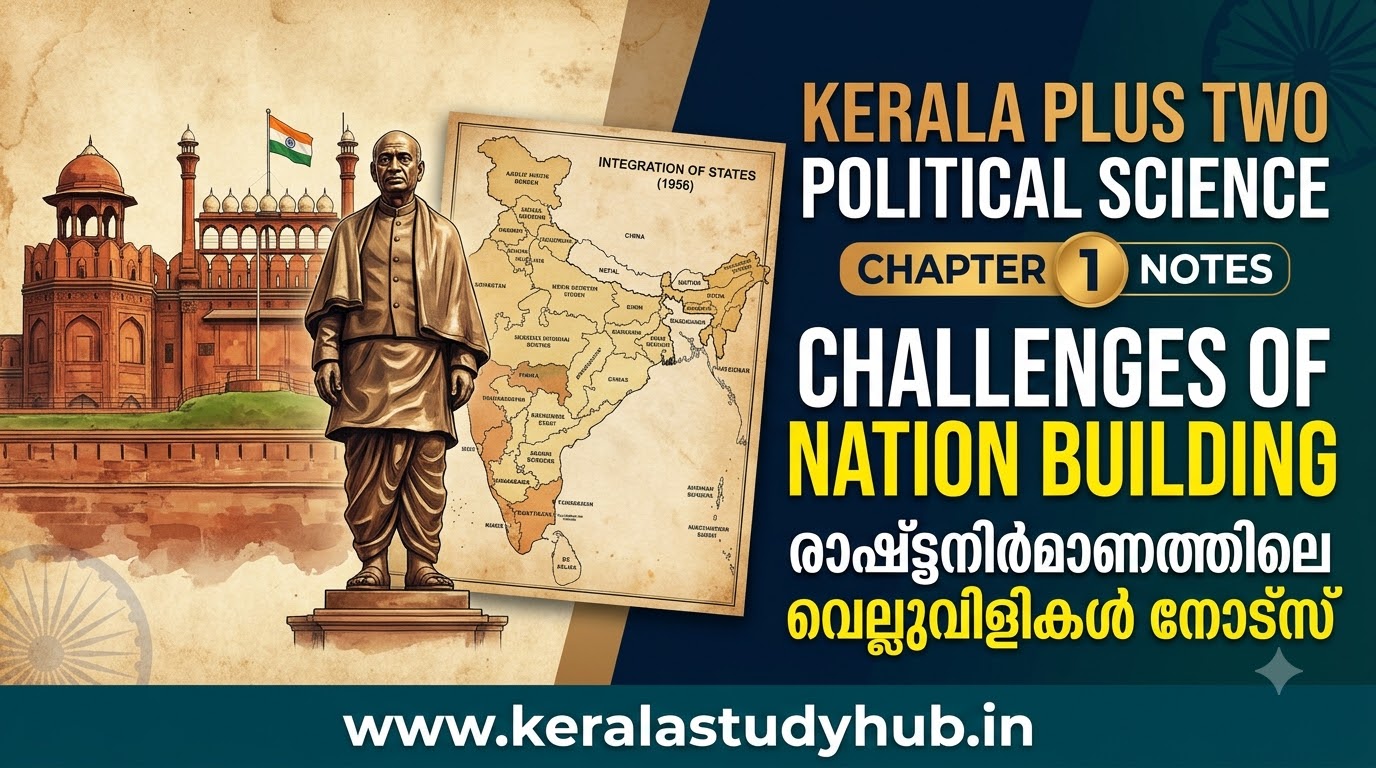
Kerala Plus Two Political Science Chapter 1 Notes: Challenges of Nation Building Questions and Answers PDF (English and Malayalam Medium)
- Kerala Plus Two Political Science Chapter 1 Notes: Challenges of Nation Building Questions and Answers PDF (English and Malayalam Medium)
- Kerala Plus Two Political Science Chapter 1 Notes: Chapter Blueprint
- 1. Three Challenges of Nation Building (സ്വതന്ത്ര ഇന്ത്യ നേരിട്ട മൂന്ന് പ്രധാന വെല്ലുവിളികൾ — Guaranteed 4 or 6 Marks)
- 2. Partition: Displacement and Rehabilitation (ഇന്ത്യാ വിഭജനം: പലായനവും പുനരധിവാസവും — 8-Mark Essay Topic)
- 2.1 The Process of Partition and Four Major Difficulties (വിഭജന പ്രക്രിയയിലെ 4 പ്രധാന പ്രതിസന്ധികൾ)
- 2.2 Consequences of Partition (ഇന്ത്യാ വിഭജനത്തിന്റെ പ്രത്യാഘാതങ്ങൾ)
- 3. Integration of Princely States (നാട്ടുരാജ്യങ്ങളുടെ സംയോജനം — 8-Mark Sure Essay!)
- 3.1 The Crisis of Paramountcy and Sardar Patel’s Historic Role
- 3.2 Integration of Junagadh, Hyderabad, and Manipur
- 4. Reorganisation of States on Linguistic Basis (സംസ്ഥാന പുനഃസംഘടന — ഭാഷാടിസ്ഥാനത്തിൽ)
- 5. Solved Textbook Exercises & 25 Important Public Exam Questions
- Part A: 1-Mark & 2-Mark Objective and Short Questions (Q1 to Q12)
- Part B: 3-Mark, 4-Mark & 5-Mark Short Essay Questions (Q13 to Q21)
- Part C: 8-Mark Long Essay Questions (Q22 to Q25)
- D+ (Just Pass / 30% Rule) Quick Revision Capsule — Plus Two Political Science Ch 1
- Teacher’s Corner: SCERT Kerala Scheme of Work & Learning Outcomes (പഠനനേട്ടങ്ങൾ)
- Popular Student & Teacher Search Terms for This Chapter
- Related Kerala Board Higher Secondary Study Notes
Kerala Plus Two Political Science Chapter 1 Notes on Challenges of Nation Building (രാഷ്ട്രനിർമ്മാണത്തിലെ വെല്ലുവിളികൾ) is the most important opening chapter of Part B (Politics in India Since Independence) in the Class 12 Higher Secondary syllabus prescribed by SCERT Kerala and NCERT. In the DHSE Kerala Plus Two Public Examination, this chapter carries a high weightage of 8 to 10 Marks, almost always featuring an 8-Mark Long Essay Question (on the Three Challenges of Nation Building, Consequences of Partition, or Integration of Princely States) or a 4-Mark Short Essay on the Reorganisation of States.
Compiled by senior Higher Secondary Political Science faculty for Kerala Study Hub, these complete bilingual notes provide clear point-wise explanations in Simple English and Malayalam Medium (മലയാളം മീഡിയം), historical timelines, solved textbook questions, and 25 board exam questions and answers.
Kerala Plus Two Political Science Chapter 1 Notes: Chapter Blueprint
- Chapter Title: Chapter 1 — Challenges of Nation Building (രാഷ്ട്രനിർമ്മാണത്തിലെ വെല്ലുവിളികൾ)
- Textbook Section: Politics in India Since Independence (Class XII)
- DHSE Public Exam Weightage: 8 to 10 Marks (Guaranteed 8-Mark Essay or 4-Mark Short Essays + 1-Mark Objective)
- Core Topics Covered: Nehru’s “Tryst with Destiny” Speech, Three Challenges of Independent India, Partition: Displacement and Rehabilitation (1947), Integration of Princely States (Role of Sardar Patel, Instrument of Accession, Junagadh, Hyderabad, Kashmir, Manipur), and Reorganisation of States on Linguistic Basis (Vishalandhra Movement, Potti Sriramulu, SRC 1953 & Act of 1956).
1. Three Challenges of Nation Building (സ്വതന്ത്ര ഇന്ത്യ നേരിട്ട മൂന്ന് പ്രധാന വെല്ലുവിളികൾ — Guaranteed 4 or 6 Marks)
At the hour of midnight on 14–15 August 1947, India attained independence. India’s first Prime Minister, Jawaharlal Nehru, addressed a special session of the Constituent Assembly that night with his famous speech known as “Tryst with Destiny” (വിധിയുമായുള്ള സമാഗമം).
Independent India started its journey under tragic circumstances of Partition and faced three broad challenges of nation building:
- First Challenge — To Shape a United Nation that Accommodated Diversity (ഐക്യവും അഖണ്ഡതയും നിലനിർത്തുക): India was a land of continental size and immense diversity — people spoke different languages and followed different cultures and religions. Many foreign observers predicted that a country so diverse could not remain united for long, especially after the trauma of Partition. The immediate challenge was to forge national unity without erasing regional and cultural diversity.
- Second Challenge — To Establish Democracy (ജനാധിപത്യം സ്ഥാപിക്കുക): The Indian Constitution granted Fundamental Rights and extended the right to vote to every adult citizen (Universal Adult Franchise) within a representative parliamentary democracy. However, merely writing a democratic constitution was not enough; the challenge was to develop democratic practices and political competition in accordance with the Constitution.
- Third Challenge — To Ensure the Development and Well-Being of the Entire Society (എല്ലാവരെയും ഉൾക്കൊള്ളുന്ന സാമ്പത്തിക വികസനം ഉറപ്പാക്കുക): The third challenge was to ensure economic development and eradication of poverty not just for a privileged few, but for all sections of society, especially socially disadvantaged groups and religious/cultural minorities, guided by the Directive Principles of State Policy.
മലയാളം മീഡിയം സംഗ്രഹം: രാഷ്ട്രനിർമ്മാണത്തിലെ 3 പ്രധാന വെല്ലുവിളികൾ
- രാഷ്ട്രത്തിന്റെ ഐക്യവും അഖണ്ഡതയും കാത്തുസൂക്ഷിക്കുക (To Shape a Nation): വ്യത്യസ്ത ഭാഷകളും മതങ്ങളും സംസ്കാരങ്ങളുമുള്ള ഇന്ത്യയെ വൈവിധ്യങ്ങൾ നിലനിർത്തിക്കൊണ്ടുതന്നെ ഒറ്റ രാഷ്ട്രമായി നിലനിർത്തുക.
- ജനാധിപത്യ വ്യവസ്ഥ സ്ഥാപിക്കുക (To Establish Democracy): പാർലമെന്ററി ഭരണസംവിധാനവും പ്രായപൂർത്തി വോട്ടവകാശവും മൗലികാവകാശങ്ങളും പ്രായോഗിക ജീവിതത്തിൽ നടപ്പിലാക്കുക.
- സമഗ്ര സാമ്പത്തിക വികസനവും ക്ഷേമവും ഉറപ്പാക്കുക (Ensure Development and Well-being): ദാരിദ്ര്യവും അസമത്വവും തുടച്ചുനീക്കി പിന്നാക്ക വിഭാഗങ്ങൾ ഉൾപ്പെടെ മുഴുവൻ ജനങ്ങളുടെയും സാമ്പത്തിക പുരോഗതി ഉറപ്പാക്കുക.
2. Partition: Displacement and Rehabilitation (ഇന്ത്യാ വിഭജനം: പലായനവും പുനരധിവാസവും — 8-Mark Essay Topic)
On 14–15 August 1947, not one, but two nation-states came into existence — India and Pakistan — as a result of the Partition of British India.
2.1 The Process of Partition and Four Major Difficulties (വിഭജന പ്രക്രിയയിലെ 4 പ്രധാന പ്രതിസന്ധികൾ)
According to the “Two-Nation Theory” (ദ്വിരാഷ്ട്ര സിദ്ധാന്തം) advanced by the Muslim League, India consisted of not one, but two ‘people’ — Hindus and Muslims — which led to the demand for Pakistan. Congress and Khan Abdul Ghaffar Khan (the undisputed leader of the North Western Frontier Province, known as “Frontier Gandhi” / അതിർത്തി ഗാന്ധി) staunchly opposed the Two-Nation Theory. Ultimately, it was decided to follow the principle of religious majorities (areas where Muslims were in a majority would make up Pakistan). However, executing this caused four severe difficulties:
- No Single Belt of Muslim Majority: There was no single continuous belt of Muslim-majority areas in British India. There were two separate concentrations — one in the West and one in the East — which could not be joined. Thus, Pakistan comprised two territories, West Pakistan and East Pakistan (now Bangladesh), separated by a long expanse of Indian territory!
- Not All Muslim-Majority Areas Wanted to Join Pakistan: Khan Abdul Ghaffar Khan (“Frontier Gandhi”) and his movement in the North Western Frontier Province (NWFP) strongly opposed the Two-Nation Theory, yet ignoring his voice, the NWFP was made to merge with Pakistan.
- Bifurcation of Punjab and Bengal: Two huge Muslim-majority provinces of British India — Punjab and Bengal — had very large continuous areas where non-Muslims were in a majority. Therefore, Punjab and Bengal had to be bifurcated (divided) at the district and lower levels on the midnight of 14–15 August, leaving millions confused about whether they were in India or Pakistan!
- The Problem of ‘Minorities’ on Both Sides of the Border: This was the most intractable problem. Lakhs of Hindus and Sikhs in areas that went to Pakistan, and an equally large number of Muslims on the Indian side of Punjab and Bengal (and in Delhi), suddenly found themselves trapped as “undesirable aliens” in their own ancestral homes.
2.2 Consequences of Partition (ഇന്ത്യാ വിഭജനത്തിന്റെ പ്രത്യാഘാതങ്ങൾ)
- Unprecedented Communal Violence and Tragic Transfer of Population: The year 1947 witnessed one of the largest, most abrupt, unplanned, and tragic transfers of population in human history. Cities like Lahore, Amritsar, and Kolkata became divided into “communal zones” where Muslims avoided Hindu/Sikh areas and vice versa.
- Refugee Camps and Human Toll: About 80 lakh (8 million) people were forced to migrate across the new border, and between 5 to 10 lakh people were killed in Partition-related violence.
- Suffering of Women and Children: Thousands of women were abducted on both sides of the border, forced to convert and marry their abductors, or even killed by their own families in the name of preserving “family honour.”
- Division of Financial Assets and Hearts: Partition was not merely a division of properties, liabilities, railways, police, government employees, tables, chairs, and typewriters — as writers and poets called it, it was a painful “division of hearts” (ഹൃദയങ്ങളുടെ വിഭജനം).
- Mahatma Gandhi’s Sacrifice: Mahatma Gandhi did not participate in any Independence Day celebrations on 15 August 1947; instead, he was in Kolkata trying to stop communal riots through prayer and fasting, and later moved to Delhi to protect Muslims’ dignity before he was assassinated by Nathuram Vinayak Godse on 30 January 1948.
3. Integration of Princely States (നാട്ടുരാജ്യങ്ങളുടെ സംയോജനം — 8-Mark Sure Essay!)
British India was divided into two types of territories: British Indian Provinces (directly under the control of the British government) and Princely States (നാട്ടുരാജ്യങ്ങൾ). Just before Independence, there were 565 Princely States ruled by princes who accepted British ‘Paramountcy’ (പരമാധികാരം), covering one-third of the land area of the British Indian Empire and one out of four (25%) Indians!
3.1 The Crisis of Paramountcy and Sardar Patel’s Historic Role
- The British Announcement: With the end of British rule, Paramountcy over the Princely States lapsed, meaning all 565 states became legally independent and free to join either India or Pakistan or remain independent! This decision rested not with the people, but with the princely rulers.
- Immediate Threat to Indian Unity: First, the ruler of Travancore (തിരുവിതാംകൂർ) announced that the state had decided on independence. The next day, the Nizam of Hyderabad made a similar announcement, while the Nawab of Bhopal was averse to joining the Constituent Assembly. India faced the real danger of breaking up into hundreds of small countries!
- Role of Sardar Vallabhbhai Patel (സർദാർ വല്ലഭായ് പട്ടേലിന്റെ പങ്ക്): Sardar Vallabhbhai Patel, India’s Deputy Prime Minister and first Home Minister (known as the “Iron Man of India”), played a historic diplomatic and firm role in negotiating with the rulers of princely states and bringing almost all of them into the Indian Union before 15 August 1947.
- Three Considerations Guiding the Government’s Approach:
- The people of most princely states clearly wanted to become part of the Indian Union.
- The government was prepared to be flexible in giving autonomy to some regions to accommodate plurality.
- In the backdrop of Partition, the integration and consolidation of the territorial boundaries of the nation assumed supreme importance.
- Instrument of Accession (ലയന ഉടമ്പടി): Before 15 August 1947, peaceful negotiations brought almost all states whose territories were contiguous to the new boundaries of India into the Indian Union through signing a legal document called the ‘Instrument of Accession’. However, the accession of four states proved more difficult: Junagadh, Hyderabad, Kashmir, and Manipur.
3.2 Integration of Junagadh, Hyderabad, and Manipur
- Junagadh (ജുനഗഡ്): The issue of Junagadh (in Saurashtra, Gujarat) was resolved after a Plebiscite (ജനഹിതപരിശോധന) confirmed the overwhelming desire of its Hindu-majority population to join India.
- Hyderabad (ഹൈദരാബാദ് — 4-Mark Question!):
- The Nizam and Standstill Agreement: Hyderabad, the largest of the Princely States, was surrounded entirely by Indian territory. Its ruler carried the title ‘Nizam’ (നിസാം) and was one of the world’s richest men. While the Nizam wanted an independent status for Hyderabad and signed a Standstill Agreement with India in November 1947 for a year, the people of Hyderabad rose against the Nizam’s oppressive rule (especially the peasantry in the Telangana region and women).
- The Razakars (റസാക്കർമാർ): To crush the people’s movement, the Nizam unleashed a para-military force known as the Razakars (led by Kasim Razvi), who committed terrible atrocities, murders, and looting, targeting particularly the non-Muslims.
- Operation Polo (September 1948): In September 1948, the Indian government moved in the Indian Army to control the situation. After a few days of intermittent fighting, the Nizam surrendered, leading to Hyderabad’s accession to India.
- Manipur (മണിപ്പൂർ — 4-Mark Question!):
- First Election Based on Universal Adult Franchise (June 1948): A few days before Independence, the Maharaja of Manipur, Bodhachandra Singh (ബോധചന്ദ്ര സിംഗ്), signed the Instrument of Accession with the Indian government on the assurance that the internal autonomy of Manipur would be maintained. Under pressure of public opinion, the Maharaja held elections in Manipur in June 1948 and the state became a constitutional monarchy. Thus, Manipur was the first part of India to hold an election based on Universal Adult Franchise!
- The Merger Agreement (September 1949): In the Legislative Assembly of Manipur, there were sharp differences over merging Manipur with India (only the state Congress supported it, while other parties opposed it). The Government of India succeeded in pressuring the Maharaja into signing a Merger Agreement in September 1949 without consulting the popularly elected Legislative Assembly of Manipur, causing anger and resentment whose repercussions are felt even today.
4. Reorganisation of States on Linguistic Basis (സംസ്ഥാന പുനഃസംഘടന — ഭാഷാടിസ്ഥാനത്തിൽ)
Integration of princely states was not the end of nation-building; the next major challenge was drawing the internal boundaries of Indian states so that linguistic and cultural plurality could be reflected without harming national unity.
- Nagpur Congress Session (1920): During the national movement, the Indian National Congress had recognized at its 1920 Nagpur session that after independence, states would be reorganised on a linguistic basis. However, after Partition in 1947, national leaders feared that carving out states on the basis of language might lead to disruption and disintegration.
- The Vishalandhra Movement & Martyrdom of Potti Sriramulu (വിശാലാന്ധ്ര പ്രസ്ഥാനവും പോട്ടി ശ്രീരാമുലുവും):
- Protests erupted in the Telugu-speaking areas of the old Madras province (which included present-day Tamil Nadu, parts of Andhra Pradesh, Kerala, and Karnataka). The Vishalandhra Movement demanded that the Telugu-speaking areas be separated from the Madras province to form a separate Andhra province.
- Potti Sriramulu (പോട്ടി ശ്രീരാമുലു): A veteran Gandhian leader, went on an indefinite fast demanding a separate Andhra state. After 56 days of fasting, he died on 15 December 1952!
- Creation of Andhra State (December 1952): His death caused violent protests and unrest throughout the Andhra region. Finally, Prime Minister Nehru announced the formation of a separate Andhra state in December 1952 — the first state in independent India created on a linguistic basis!
- States Reorganisation Commission (SRC 1953) & States Reorganisation Act (1956):
- The creation of Andhra spurred struggles in other regions, forcing the Central Government to appoint a States Reorganisation Commission (SRC) in 1953 (chaired by Fazl Ali, with K.M. Panikkar and H.N. Kunzru as members).
- The Commission in its report accepted that the boundaries of states should reflect the boundaries of different languages.
- On the basis of its report, the States Reorganisation Act was passed in 1956, which led to the creation of 14 States and 6 Union Territories (including the formation of Kerala state on 1 November 1956 by merging Travancore-Cochin with the Malabar district of Madras Presidency!).
- Subsequent Creation of New States Timeline:
- 1960: Bilingual Bombay state was divided into Maharashtra and Gujarat.
- 1966: Punjab and Haryana (and Himachal Pradesh) were carved out of the larger Punjab state.
- 1963–1987 (North-East Reorganisation): Nagaland (1963), Meghalaya, Manipur, and Tripura (1972), and Mizoram and Arunachal Pradesh (1987).
- 2000: Three states created on the basis of regional/administrative imbalance and tribal identity — Chhattisgarh, Uttarakhand, and Jharkhand.
- 2014 (2 June): Telangana emerged as a new state carved out of Andhra Pradesh.
- How Linguistic States Strengthened Unity and Democracy: Far from dividing the country as originally feared, linguistic states (1) strengthened national unity by removing regional grievances, (2) deepened democracy by opening the path to politics and administration for people speaking regional languages rather than just a small English-speaking elite, and (3) established the principle of acceptance of diversity (വൈവിധ്യങ്ങളെ അംഗീകരിക്കൽ).
5. Solved Textbook Exercises & 25 Important Public Exam Questions
Part A: 1-Mark & 2-Mark Objective and Short Questions (Q1 to Q12)
- Name the famous speech delivered by Jawaharlal Nehru at the midnight session of the Constituent Assembly on 14–15 August 1947.
Ans: “Tryst with Destiny” (വിധിയുമായുള്ള സമാഗമം). - Who advanced the ‘Two-Nation Theory’ that led to the demand for Pakistan?
Ans: The Muslim League (led by Muhammad Ali Jinnah). - Who is known as ‘Frontier Gandhi’ (അതിർത്തി ഗാന്ധി)?
Ans: Khan Abdul Ghaffar Khan, the undisputed leader of the North Western Frontier Province (NWFP) who staunchly opposed the Two-Nation Theory. - Name the legal document signed by rulers of Princely States to join the Indian Union.
Ans: The Instrument of Accession (ലയന ഉടമ്പടി). - Who played the historic diplomatic role in integrating the 565 Princely States into the Indian Union?
Ans: Sardar Vallabhbhai Patel, India’s first Deputy Prime Minister and Home Minister. - Who were the ‘Razakars’?
Ans: The Razakars were a communal para-military force unleashed by the Nizam of Hyderabad to suppress the people’s democratic movement in Hyderabad. - Which was the first part of India to hold an election based on Universal Adult Franchise in June 1948, and who was its Maharaja?
Ans: Manipur, under Maharaja Bodhachandra Singh. - Who went on a 56-day fast unto death demanding a separate Andhra state for Telugu speakers?
Ans: Veteran Gandhian leader Potti Sriramulu (who died on 15 December 1952). - Which was the first state created on a linguistic basis in independent India?
Ans: Andhra State (announced in December 1952). - In which year was the States Reorganisation Commission (SRC) appointed, and in which year was the States Reorganisation Act passed?
Ans: SRC was appointed in 1953 (chaired by Justice Fazl Ali), and the States Reorganisation Act was passed in 1956. - How many States and Union Territories were created by the States Reorganisation Act of 1956?
Ans: 14 States and 6 Union Territories. - Name the three states created in the year 2000 on the basis of regional development and tribal identity.
Ans: Chhattisgarh, Uttarakhand, and Jharkhand.
Part B: 3-Mark, 4-Mark & 5-Mark Short Essay Questions (Q13 to Q21)
- Explain the three broad challenges of nation building faced by independent India in 1947. (4 Marks)
Ans: Refer to the detailed 3-point explanation in Section 1 above: (1) Shaping a united nation that accommodated India’s vast linguistic, religious, and cultural diversity; (2) Establishing representative parliamentary democracy and democratic practices in accordance with the Constitution; and (3) Ensuring inclusive economic development and eradication of poverty for all sections of society. - What were the four major difficulties encountered in implementing the Partition of British India on the basis of religious majorities? (4 Marks)
Ans: Refer to Section 2.1 above: (1) Absence of a single continuous belt of Muslim-majority areas (leading to West Pakistan and East Pakistan separated by Indian territory); (2) Opposition to Pakistan by Muslim-majority regions like the NWFP led by Khan Abdul Ghaffar Khan (“Frontier Gandhi”); (3) Painful district-level bifurcation of the large provinces of Punjab and Bengal; and (4) The plight of लाखों of religious minorities trapped on both sides of the border. - How was the Princely State of Hyderabad integrated into the Indian Union? (4 Marks)
Ans: Hyderabad was the largest Princely State surrounded entirely by Indian territory. Its ruler, the Nizam, desired independent status and signed a Standstill Agreement with India in November 1947. Meanwhile, peasants in the Telangana region, women, and the Hyderabad Congress launched a powerful movement against the Nizam’s oppressive rule. To crush the uprising, the Nizam deployed a brutal para-military force called the Razakars. In response to the Razakars’ atrocities, the Government of India sent the Indian Army in September 1948 (Operation Polo). After a few days of fighting, the Nizam surrendered and Hyderabad acceded to India. - Explain the events that led to the accession and merger of Manipur with the Indian Union. (4 Marks)
Ans: Before 15 August 1947, the Maharaja of Manipur, Bodhachandra Singh, signed the Instrument of Accession with India on the assurance that Manipur’s internal autonomy would be preserved. Responding to public pressure, the Maharaja held elections in June 1948 based on Universal Adult Franchise (making Manipur the first part of India to do so) and became a constitutional monarchy. In the Manipur Legislative Assembly, political parties except the Congress opposed a full merger with India. However, in September 1949, the Government of India pressured the Maharaja into signing a Merger Agreement without consulting the elected Legislative Assembly, leaving a legacy of resentment in the state. - Write a short note on the Vishalandhra Movement and its historical outcome. (4 Marks)
Ans: The Vishalandhra Movement demanded that the Telugu-speaking areas be separated from the composite Madras Province to form a separate Andhra state. Nearly all political forces in the Andhra region supported this demand. When the Central Government hesitated, veteran Gandhian leader Potti Sriramulu began an indefinite fast and died after 56 days on 15 December 1952. His martyrdom sparked widespread protests and forced Prime Minister Nehru to announce the formation of a separate Andhra state in December 1952, which subsequently led to the appointment of the States Reorganisation Commission in 1953. - Explain the recommendations and impact of the States Reorganisation Commission (SRC 1953) and the States Reorganisation Act of 1956. (4 Marks)
Ans: Appointed by the Central Government in 1953 after the creation of Andhra State, the States Reorganisation Commission (headed by Fazl Ali) recommended that the boundaries of Indian states should reflect the boundaries of different languages. Accepting its report, Parliament enacted the States Reorganisation Act in 1956, reorganising India into 14 States and 6 Union Territories. Far from weakening India’s unity, linguistic reorganisation strengthened national integration, democratised politics by empowering regional language speakers, and affirmed respect for cultural diversity. - What were the three considerations that guided the Indian government’s approach to the integration of Princely States? (3 Marks)
Ans: (1) The people of most Princely States clearly desired to become part of the Indian Union; (2) The government was willing to be flexible in granting regional autonomy to accommodate diversity; and (3) In the wake of Partition, the territorial consolidation and integration of the nation’s boundaries was of supreme importance. - Why did Mahatma Gandhi not participate in any of the Independence Day celebrations on 15 August 1947? (3 Marks)
Ans: Mahatma Gandhi was deeply saddened by the failure of his principles of Ahimsa (non-violence) and Hindu-Muslim unity during the Partition riots. On 15 August 1947, he stayed in riot-torn Kolkata (and later moved to Delhi), walking barefoot through affected neighbourhoods, fasting, and persuading people to give up communal violence and protect minorities. - “Linguistic states and the movements for the formation of these states changed the nature of democratic politics and leadership in some basic ways.” Explain. (4 Marks)
Ans: Before linguistic reorganisation, politics and administration were dominated by a small English-speaking elite. Once states were reorganised on a linguistic basis in 1956, the path to politics and power opened up to ordinary citizens and leaders speaking regional languages. Moreover, the uniform division of states along linguistic lines underscored the constitutional principle that Indian nationalism does not require giving up one’s mother tongue or regional culture.
Part C: 8-Mark Long Essay Questions (Q22 to Q25)
- Explain the three broad challenges of nation building faced by independent India and analyse the causes and consequences of the Partition of India in 1947. (8 Marks — Top Priority Public Exam Essay!)
Ans: Combine Section 1 (Three Challenges: Unity with Diversity, Establishing Democracy, and Inclusive Economic Development) with Section 2.1 (Four difficulties of Partition under the Two-Nation Theory: West & East Pakistan split, NWFP & Frontier Gandhi, Bifurcation of Punjab and Bengal, and plight of Minorities) and Section 2.2 (Consequences: 80 lakh refugees, 5–10 lakh killed, communal zones in Lahore/Amritsar/Kolkata, abduction of women, division of financial assets & hearts, and Gandhiji’s sacrifice). - Examine the problems faced during the integration of Princely States into the Indian Union. Explain the role of Sardar Vallabhbhai Patel and the integration of Junagadh, Hyderabad, and Manipur. (8 Marks — Top Priority Public Exam Essay!)
Ans: Combine Section 3.1 (565 Princely States, lapse of British Paramountcy, Travancore & Hyderabad announcements, Sardar Patel’s diplomatic wisdom, three guiding considerations, and the Instrument of Accession) with Section 3.2 (Junagadh Plebiscite, Hyderabad Nizam, Standstill Agreement, Telangana peasant uprising, Razakars, and September 1948 army action; Manipur Maharaja Bodhachandra Singh, June 1948 Universal Adult Franchise election, and September 1949 Merger Agreement). - Describe the process of the Reorganisation of States in India on a linguistic basis, highlighting the Vishalandhra Movement, States Reorganisation Commission (1953), and subsequent formation of new states up to 2014. (8 Marks)
Ans: Combine all structured points from Section 4 above covering: (1) The 1920 Nagpur Congress promise vs post-Partition hesitation, (2) The Vishalandhra Movement and martyrdom of Potti Sriramulu after a 56-day fast in December 1952, (3) Appointment of the States Reorganisation Commission (1953) and the States Reorganisation Act of 1956 (14 States & 6 UTs), (4) Subsequent state formations in 1960 (Maharashtra & Gujarat), 1966 (Punjab & Haryana), North-East (1963–1987), 2000 (Chhattisgarh, Uttarakhand, Jharkhand), and 2014 (Telangana), and (5) How linguistic states strengthened democracy and national unity. - Compare the process of nation-building in India (1947–1956) with European nationalism. How did India successfully combine national unity with cultural diversity? (6 Marks)
Ans: Unlike traditional European nation-states that often saw cultural or linguistic diversity as a threat to national survival (following the rigid “one language — one nation” formula), Indian nationalism under the Constitution embraced a democratic pluralist approach. By rejecting theocratic nationalism during Partition, accommodating regional autonomy during the integration of Princely States, and redrawing state boundaries on a linguistic basis in 1956, India proved that acknowledging regional and linguistic identities strengthens rather than weakens national unity.
D+ (Just Pass / 30% Rule) Quick Revision Capsule — Plus Two Political Science Ch 1
- Three Challenges of Nation Building (3 വെല്ലുവിളികൾ): (1) Shaping a united nation with diversity, (2) Establishing democracy, (3) Ensuring economic development and well-being for all.
- Partition Facts (1947): Nehru’s midnight speech: “Tryst with Destiny” | Two-Nation Theory: Muslim League | Frontier Gandhi: Khan Abdul Ghaffar Khan (NWFP) | Divided Provinces: Punjab & Bengal | Communal Zone Cities: Lahore, Amritsar, Kolkata | Refugees: 80 Lakh.
- Integration of 565 Princely States: Led by Sardar Vallabhbhai Patel | Legal document: Instrument of Accession | Junagadh: Joined via Plebiscite | Hyderabad: Ruler = Nizam; Para-military = Razakars; Joined in Sept 1948 via Army intervention | Manipur: Maharaja Bodhachandra Singh; First election on Universal Adult Franchise (June 1948); Merger Agreement (Sept 1949).
- Reorganisation of States: Vishalandhra Movement (Telugu speakers) → Potti Sriramulu died after 56-day fast (Dec 1952) → First linguistic state: Andhra → SRC appointed in 1953 → States Reorganisation Act 1956 (14 States & 6 UTs).
Teacher’s Corner: SCERT Kerala Scheme of Work & Learning Outcomes (പഠനനേട്ടങ്ങൾ)
- Recommended Period Allocation: June (18 Periods) — High-priority unit carrying 8 to 10 Marks in First Term (Onam), Christmas, and March Public Examinations.
- Learning Outcomes (പഠനനേട്ടങ്ങൾ): Learners critically analyse the three foundational challenges faced by independent India, evaluate the human trauma of the 1947 Partition, examine Sardar Patel’s diplomatic integration of 565 Princely States, and trace the linguistic reorganisation of Indian states from 1952 to 2014.
- Classroom Map Activity: Use an outline political map of India (1947 vs 1956) to locate Junagadh, Hyderabad, Manipur, Jammu & Kashmir, Travancore, and Madras Presidency.
Popular Student & Teacher Search Terms for This Chapter
Kerala Plus Two Political Science Chapter 1 Notes, plus two political science challenges of nation building notes pdf, രാഷ്ട്രനിർമ്മാണത്തിലെ വെല്ലുവിളികൾ നോട്സ്, three challenges of nation building essay 8 marks, integration of princely states hyderabad manipur junagadh notes, states reorganisation commission 1953 potti sriramulu plus two politics questions and answers.
Related Kerala Board Higher Secondary Study Notes
- Kerala Plus One Political Science Chapter 1 Notes: Constitution Why and How PDF
- Kerala Plus Two History Theme 1 & 2 Notes: Bricks, Beads and Bones & Kings, Farmers and Towns PDF
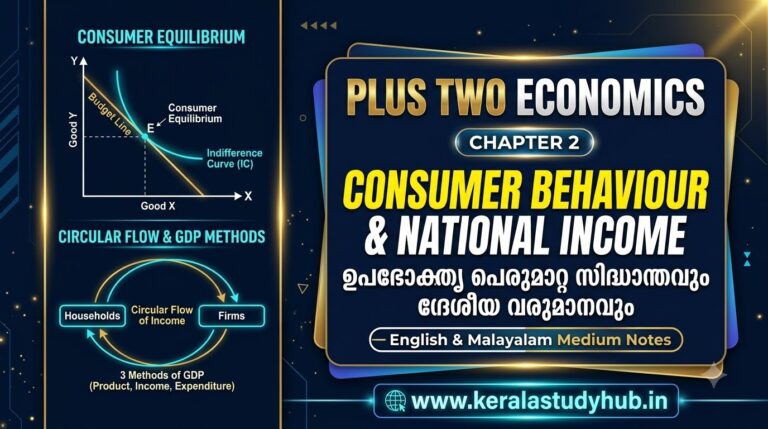
- Kerala Plus Two Economics Chapter 2 Notes: Theory of Consumer Behaviour & National Income PDF
- Kerala Plus Two English Unit 1 & 2 Complete Notes, Appreciation & Solved Discourses PDF


Latest SCERT & DHSE Kerala Study Notes
- Kerala Class 9 Physics Chapter 2 Notes: Equations of Motion (ചലനസമവാക്യങ്ങൾ) Std 9 Let Us Assess Questions and Answers PDF
- Kerala SSLC Christmas Exam Question Paper 2025-27: All Subjects Second Term & Model Question Papers with Solved Answer Keys PDF (New SCERT Syllabus)
- Kerala SSLC English Christmas Exam Question Paper 2025-27: Second Term & Model Solved 80-Mark Answer Key, Discourses & Grammar PDF
- Kerala SSLC Social Science Christmas Exam Question Paper 2025-27: Second Term & Model Solved 80-Mark Answer Key, Weightage & Map Study PDF
- Kerala SSLC Maths Christmas Exam Question Paper 2025-27: Second Term & Model Solved Answer Key, Weightage & Formula Sheet PDF (New SCERT Syllabus)
- Kerala SSLC Biology Christmas Exam Question Paper 2025-27: Second Term & Model Solved Answer Key, Weightage & Flowcharts PDF (New SCERT Syllabus)
- Kerala SSLC Chemistry Christmas Exam Question Paper 2025-27: Second Term & Model Solved Answer Key, Weightage & Sure A+ Questions PDF (New SCERT Syllabus)
- Kerala SSLC Physics Christmas Exam Question Paper 2025-27: Second Term & Model Solved Answer Key, Weightage & Formula Sheet PDF (New SCERT Syllabus)