
Kerala SSLC Biology Chapter 2 Notes on Paths of Evolution (Malayalam Medium: പരിണാമത്തിന്റെ വഴികൾ) cover one of the most comprehensive and newly restructured chapters in the revised Class 10 (Std 10) Biology textbook published by the State Council of Educational Research and Training (SCERT Kerala). In the updated syllabus for the Kerala Pareeksha Bhavan SSLC Public Examination, SCERT uniquely integrates Organic Evolution (Lamarckism, Darwin’s Finches & Natural Selection, Neo-Darwinism, Antibiotic-Resistant Bacteria, Fossil & Molecular Evidences, and Human Evolution) with the Evolution and Working of the Nervous System (Neuron structure, Myelin Sheath, Synapse, Human Brain, Spinal Cord, Reflex Arc, and Autonomous Nervous System).
- 1. Kerala SSLC Biology Chapter 2 Notes: Lamarckism, Darwin’s Natural Selection & Neo-Darwinism
- A. Lamarckism (Inheritance of Acquired Characters — Jean-Baptiste Lamarck)
- B. Darwinism (Theory of Natural Selection — Charles Robert Darwin)
- C. Neo-Darwinism & Contemporary Evolution (Antibiotic-Resistant Bacteria & RNA Viruses)
- 2. Evidences of Evolution (Fossils, Homologous Organs, Molecular Biology) & Human Evolution
- Human Evolutionary Path (From MRCA to Homo sapiens)
- 3. Evolution of the Nervous System: Neuron, Synapse, Human Brain, Spinal Cord & Reflex Arc
- A. Structure of a Neuron, Myelin Sheath, and Synapse
- B. Structure and Functions of the Human Brain (Protected by Meninges & CSF)
- C. Spinal Cord, Reflex Action (Reflex Arc), and Autonomous Nervous System
- 4. Class 10 Biology Chapter 2 Let Us Assess Questions and Answers (SCERT Solutions)
- 5. Class 10 Biology Chapter 2 Malayalam Medium Notes (പരിണാമത്തിന്റെ വഴികൾ – ചോദ്യോത്തരങ്ങൾ)
In my classroom teaching, I always remind Class 10 students that this single chapter carries nearly 8 to 9 marks in the examination—usually combining a 3-mark question on Darwin’s Finches or Haemoglobin beta-chain molecular evidence with a 4-mark diagram question on the Human Brain or Reflex Arc.
Quick Navigation: Missed the first chapter? Read Kerala SSLC Biology Chapter 1 Notes: Genetics of Life, or explore our completed SSLC Physics All 7 Chapters Hub and SSLC Chemistry All 7 Chapters Hub.
CHAPTER 2 AT A GLANCE: CLASS 10 BIOLOGY QUICK REVISION BLUEPRINT
- Chapter 2 Title (EM & MM): Paths of Evolution (പരിണാമത്തിന്റെ വഴികൾ)
- Expected SSLC Public Exam Weightage: 8 to 9 Marks (Evolution + Human Nervous System)
- Evolution Theories: Lamarckism (Acquired characters) | Darwinism (Natural Selection & Galapagos Finches) | Neo-Darwinism (Mutation + Genetic recombination)
- Closest Relative to Humans (Molecular Evidence): Chimpanzee (
0amino acid difference in the beta-chain of Haemoglobin compared to humans) - Myelin Sheath Formation: Formed by Schwann cells in peripheral nerves and Oligodendrocytes in the brain & spinal cord
- Spinal Reflex Arc Pathway:
Receptor → Sensory Neuron → Interneuron (in Spinal Cord) → Motor Neuron → Related Muscle (Effector)
1. Kerala SSLC Biology Chapter 2 Notes: Lamarckism, Darwin’s Natural Selection & Neo-Darwinism
How did millions of diverse species evolve from primitive life forms on Earth? In Kerala SSLC Biology Chapter 2 Notes, we begin by comparing the classical theories of evolution proposed by Jean-Baptiste Lamarck, Charles Darwin, and Hugo de Vries:
A. Lamarckism (Inheritance of Acquired Characters — Jean-Baptiste Lamarck)
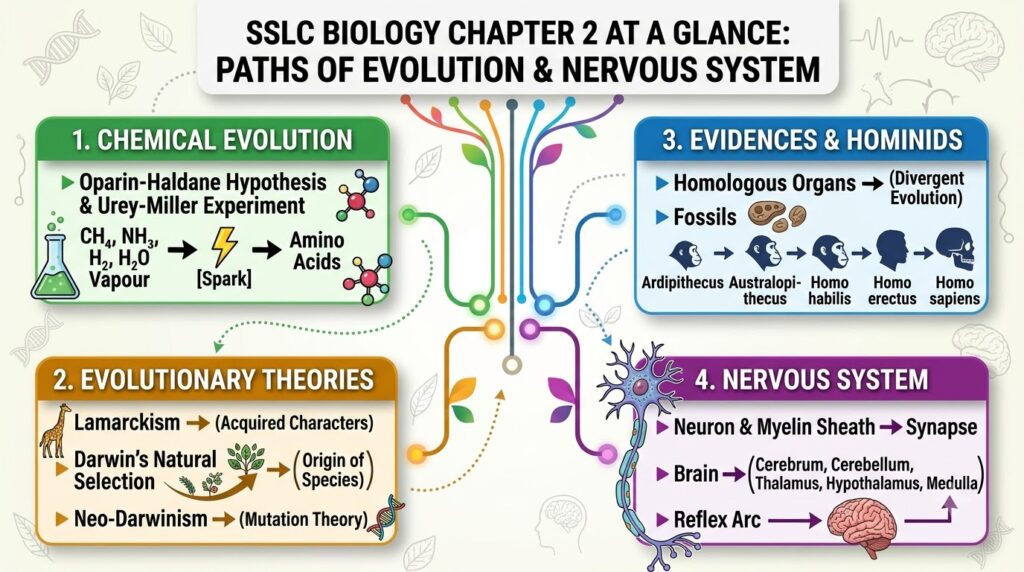
French biologist Jean-Baptiste Lamarck proposed that changes in environmental conditions force organisms to use certain organs more and others less. Continuous use of an organ causes it to develop and strengthen, producing Acquired Characters (സാർജ്ജിത സ്വഭാവങ്ങൾ)—for example, ancestral giraffes with short necks stretched their necks continuously to eat leaves from tall trees as ground vegetation became scarce, and this acquired long neck was passed on to succeeding generations.
Why Science Rejected Lamarckism: Modern genetics proved that acquired physical changes occurring in somatic (body) cells do not alter the nucleotide sequences of genes in reproductive (germ) cells, and therefore acquired characters are not inherited by offspring.
B. Darwinism (Theory of Natural Selection — Charles Robert Darwin)
During his historic five-year expedition aboard the survey ship HMS Beagle to the Galapagos Islands, British naturalist Charles Darwin observed 14 distinct species of finches (Darwin’s Finches) that had evolved from a single ancestral seed-eating finch species. Although they lived on nearby islands, ground finches (seed-eaters), cactus finches, and tree finches (insect-eaters) exhibited striking differences in the shape and size of their beaks adapted to the specific food sources available in their habitats. Influenced also by Thomas Robert Malthus’s essay on population, Darwin formulated the Theory of Natural Selection:
Flowchart of Darwin’s Theory of Natural Selection & Speciation:
Overproduction of Offspring + Limited Resources → Struggle for Existence → Organisms with Favourable Variations Survive (Survival of the Fittest / Natural Selection) → Favourable Variations Accumulated Over Generations → Origin of New Species (Speciation)
C. Neo-Darwinism & Contemporary Evolution (Antibiotic-Resistant Bacteria & RNA Viruses)
- Neo-Darwinism: Charles Darwin could not explain the exact cellular origin of variations. Later, Hugo de Vries explained the role of Mutations. Incorporating discoveries from genetics, crossing over, mutation, genetic recombination, and geographical isolation into Darwinism gave rise to Neo-Darwinism.
- Antibiotic-Resistant Bacteria (1966 Tuberculosis Case Study): When a patient with tuberculosis is treated with antibiotics, a random mutation in a specific gene of a few bacteria may make them resistant to that antibiotic. While normal bacteria die, the mutated antibiotic-resistant bacteria survive by natural selection and multiply rapidly.
- Rapid Evolution in RNA Viruses (COVID-19 Delta & Omicron Variants): Most viruses have RNA as their genetic material. Because single-stranded RNA undergoes mutation much more rapidly than DNA, new viral variants (such as mutations in Omicron’s spike protein) arise continuously and spread through natural selection.
2. Evidences of Evolution (Fossils, Homologous Organs, Molecular Biology) & Human Evolution
- Fossil Evidences (Palaeontology): Fossils are the preserved remains or impressions of ancient organisms. They prove that: (a) Evolution is a gradual process from simple to complex forms (e.g., evolution of modern horses from short-legged ancestors); (b) Many ancient species like Dinosaurs and Mammoths became extinct; and (c) Connecting Links like Archaeopteryx (a fossil possessing teeth and long tail of reptiles along with feathers and wings of birds) prove that birds evolved from reptiles.
- Comparative Morphology & Anatomy (Homologous Organs — സമജാത അവയവങ്ങൾ): The forelimbs of humans, forelimbs of cats, flippers of whales, and wings of bats perform different external functions (holding, walking, swimming, flying), yet they share the exact same internal skeletal arrangement (humerus, radius, ulna, carpals, metacarpals, and phalanges). Such organs that are similar in internal structure and embryonic origin but perform different functions are called Homologous Organs, proving evolution from a common ancestor.
- Molecular Biology Evidence (Beta-Chain of Haemoglobin Comparison): Comparing the sequence of amino acids in the beta-chain of the respiratory pigment Haemoglobin with humans reveals evolutionary closeness:- Chimpanzee:
0amino acid differences from humans (proving Chimpanzee is the closest living evolutionary relative to humans!).– Gorilla:
1amino acid difference | Rhesus Monkey:8amino acid differences.
Human Evolutionary Path (From MRCA to Homo sapiens)
Humans belong to the primate superfamily Hominoidea (characterized by a large brain, ability to walk upright, and absence of a tail, unlike tailed monkeys in Cercopithecoidea). Key stages along the human evolutionary branch from the Most Recent Common Ancestor (MRCA) shared with chimpanzees include:
- Ardipithecus ramidus → Australopithecus afarensis: Early hominids from Africa with slender bodies and bipedal locomotion.
- Homo habilis: Made weapons and tools from stone and bone fragments.
- Homo erectus: Fossils recovered from Africa, Asia, and Europe; walked fully upright on two legs, had a large forehead, were omnivores, and used superior stone weapons for hunting.
- Homo neanderthalensis → Homo sapiens: Modern humans with highly developed cranial capacity, language, agriculture, and culture.
3. Evolution of the Nervous System: Neuron, Synapse, Human Brain, Spinal Cord & Reflex Arc
As organisms evolved from simple invertebrates to complex vertebrates, their nervous coordination evolved from a diffuse nerve net in Hydra, to paired head ganglia in Planaria and Earthworm, to the highly specialized Human Nervous System:
A. Structure of a Neuron, Myelin Sheath, and Synapse
- Parts of a Neuron:– Dendrite & Dendron: Receive impulses from adjacent neurons and carry them towards the cell body (Cyton).
– Axon & Axonite: Carry impulses away from the cell body to the Synaptic Knob.
- Myelin Sheath (മയലിൻ ഷീത്ത്): A lipid-rich membrane wrapping the axon. In peripheral nerves, the myelin sheath is formed by Schwann cells; in the brain and spinal cord, it is formed by Oligodendrocytes. Functions of Myelin Sheath: (1) Acts as an electrical insulator, (2) Increases the speed of impulse transmission, (3) Provides nutrients and oxygen to the axon, and (4) Protects the axon from external shocks.
- Synapse & Neurotransmitters: The junction between two neurons (or between a neuron and a muscle/gland cell) is called a Synapse. When an electrical impulse reaches the synaptic knob, it secretes chemical messengers called Neurotransmitters (such as Acetylcholine and Dopamine) into the synaptic cleft, which stimulate the adjacent dendrite and ensure impulses travel in one direction only.
B. Structure and Functions of the Human Brain (Protected by Meninges & CSF)
| Part of the Brain | Structural Peculiarity | Major Physiological Functions |
|---|---|---|
| 1. Cerebrum (സെറിബ്രം) | Largest part of the brain; outer grey cortex has numerous fissures and folds; inner white medulla. | Centre of memory, intelligence, thinking, imagination, voluntary movements, and sensory perception (vision, hearing, taste, smell). |
| 2. Cerebellum (സെറിബെല്ലം) | Second largest part; situated behind and below the cerebrum with two flaps and fissures. | Maintains body equilibrium (balance) and coordinates muscular activities. |
| 3. Medulla Oblongata | Rod-shaped lower part near the cerebellum that continues into the spinal cord. | Controls involuntary actions such as heartbeat, breathing, blood vessel contraction, vomiting, coughing, and sneezing. |
| 4. Thalamus (തലാമസ്) | Situated deep below the cerebrum. | Acts as the Relay Station of impulses to and from the cerebrum; analyses impulses and sends important ones to the cerebrum. |
| 5. Hypothalamus | Situated just below the thalamus. | Plays a major role in maintaining Homeostasis (internal balance, body temperature, hunger, thirst, and endocrine control). |
C. Spinal Cord, Reflex Action (Reflex Arc), and Autonomous Nervous System
- Spinal Cord & Reflex Arc (റിഫ്ലക്സ് ആർക്ക്): Sudden, involuntary, protective responses to stimuli occurring without conscious thought of the cerebrum are called Reflex Actions (e.g., pulling the hand back when touching a hot object — Spinal Reflex; blinking the eyes when a fly approaches — Cerebral Reflex). The pathway of impulses in a reflex action is the Reflex Arc:
Stimulus → Receptor (Sense Organ) → Sensory Neuron (via Dorsal Root) → Interneuron (in Spinal Cord) → Motor Neuron (via Ventral Root) → Muscle / Gland (Effector) - Autonomous Nervous System (Sympathetic vs Parasympathetic): During an emergency or fear, the Sympathetic System prepares the body for “fight or flight” (dilates pupil, increases heartbeat and breathing, decreases saliva and peristalsis, converts glycogen to glucose). Once the emergency passes, the Parasympathetic System restores normal calm state.
4. Class 10 Biology Chapter 2 Let Us Assess Questions and Answers (SCERT Solutions)
Q1. How did the observation of finches in the Galapagos Islands help Charles Darwin formulate his Theory of Natural Selection?
Answer: Darwin observed 14 species of finches on the Galapagos Islands that had evolved from a common seed-eating ancestor. Although similar in general appearance, their beaks differed in shape and size according to the food available in their respective habitats (large seeds, small seeds, cactus, or insects). Finches with beak variations best suited to obtain the available food survived in the struggle for existence and left more offspring, leading to the evolution of new species by Natural Selection.
Q2. Compare the changes caused by the Sympathetic System and Parasympathetic System in the following organs: (a) Pupil of the eye, (b) Heartbeat, (c) Trachea, (d) Saliva production, (e) Peristalsis in the digestive tract.
Answer:
(a) Pupil of the eye: Sympathetic dilates; Parasympathetic constricts.
(b) Heartbeat: Sympathetic increases; Parasympathetic returns to normal.
(c) Trachea: Sympathetic expands; Parasympathetic contracts.
(d) Saliva production: Sympathetic decreases; Parasympathetic increases.
(e) Peristalsis: Sympathetic slows down; Parasympathetic accelerates.
5. Class 10 Biology Chapter 2 Malayalam Medium Notes (പരിണാമത്തിന്റെ വഴികൾ – ചോദ്യോത്തരങ്ങൾ)
പത്താം ക്ലാസ് ജീവശാസ്ത്രം അദ്ധ്യായം 2: പരിണാമത്തിന്റെ വഴികൾ (മലയാളം മീഡിയം നോട്ടുകൾ)
- പരിണാമ സിദ്ധാന്തങ്ങൾ: ലാമാർക്കിന്റെ സാർജ്ജിത സ്വഭാവങ്ങളുടെ പാരമ്പര്യ സിദ്ധാന്തം ജനിതകമാറ്റം ഉണ്ടാക്കാത്തതിനാൽ ശാസ്ത്രലോകം തള്ളിക്കളഞ്ഞു. ഗാലപ്പഗോസ് ദ്വീപുകളിലെ ഫിഞ്ച് പക്ഷികളുടെ കൊക്കുകളിലെ വൈവിധ്യം നിരീക്ഷിച്ചാണ് ചാൾസ് ഡാർവിൻ പ്രകൃതി നിർദ്ധാരണ സിദ്ധാന്തം (Theory of Natural Selection) ആവിഷ്കരിച്ചത്. ഹ്യൂഗോ ഡി വ്രിസ് മ്യൂട്ടേഷൻ സിദ്ധാന്തം അവതരിപ്പിച്ചു.
- പരിണാമത്തിന്റെ തെളിവുകൾ: ഫോസിലുകൾ (ഉരഗങ്ങളുടെയും പക്ഷികളുടെയും സവിശേഷതകളുള്ള ആർക്കിയോപ്റ്റെറിക്സ്), ആന്തരിക ഘടനയിൽ സമാനതയുള്ള സമജാത അവയവങ്ങൾ (Homologous organs), തന്മാത്രാ ജീവശാസ്ത്രം (ഹീമോഗ്ലോബിനിലെ ബീറ്റാ ശൃംഖലയിലെ അമിനോ ആസിഡ് ക്രമം – മനുഷ്യനോട് പരിണാമപരമായി ഏറ്റവും അടുത്ത ജീവി ചിമ്പാൻസി ആണ്).
- നാഡീകോശവും മയലിൻ ഷീത്തും: ആക്സോണിനെ വലയം ചെയ്യുന്ന മയലിൻ ഷീത്ത് നാഡികളിൽ ഷ്വാൻ കോശങ്ങളാലും (Schwann cells) മസ്തിഷ്കത്തിലും സുഷുമ്നയിലും ഒളിഗോഡെൻഡ്രോസൈറ്റുകളാലും (Oligodendrocytes) നിർമ്മിക്കപ്പെട്ടിരിക്കുന്നു. രണ്ട് നാഡീകോശങ്ങൾ തമ്മിലുള്ള ബന്ധനസ്ഥാനമാണ് സിനാപ്സ് (Synapse) (നാഡീയ പ്രേഷകങ്ങൾ: അസറ്റൈൽ കൊളീൻ, ഡോപമിൻ).
- മസ്തിഷ്ക ഭാഗങ്ങളും ധർമ്മങ്ങളും: സെറിബ്രം (ചിന്ത, ബുദ്ധി, ഓർമ്മ, ഐച്ഛിക ചലനങ്ങൾ), സെറിബെല്ലം (ശരീരതുലനനില), മെഡുല്ല ഒബ്ലോംഗേറ്റ (ഹൃദയസ്പന്ദനം, ശ്വസനം തുടങ്ങിയ അനൈച്ഛിക പ്രവർത്തനങ്ങൾ), തലാമസ് (റിലേ സ്റ്റേഷൻ), ഹൈപ്പോതലാമസ് (ആന്തരസമസ്ഥിതി പാലനം).
- റിഫ്ലക്സ് ആർക്ക് (Reflex Arc):
ഗ്രാഹി (Receptor) → സംവേദ നാഡീകോശം → ഇന്റർന്യൂറോൺ → പ്രേരക നാഡീകോശം → ബന്ധപ്പെട്ട പേശി.
Teacher’s Classroom Note & Student Discussion Question:
Dear SSLC Students, Chapter 2 (Paths of Evolution) is one of the highest-scoring units in your Biology exam if you practise the Human Brain diagram and the Reflex Arc pathway thoroughly. Quick Question for You: Which organism shows zero amino acid differences from humans in the beta-chain of Haemoglobin, and which cells form the myelin sheath inside the brain and spinal cord? Drop your answer or any chapter doubt in the comments below, and I will reply right away!