

Kerala SSLC Chemistry Chapter 7 Notes on Some Compounds of Industrial Importance (Malayalam Medium: വ്യാവസായിക പ്രാധാന്യമുള്ള ചില സംയുക്തങ്ങൾ) cover the final and highest-weightage industrial chemistry chapter in the revised Class 10 (Std 10) Chemistry textbook published by the State Council of Educational Research and Training (SCERT Kerala). In the updated textbook for the Kerala Pareeksha Bhavan SSLC Public Examination, SCERT has expanded this unit significantly—combining Ammonia (Haber Process), Chemical Equilibrium (Le Chatelier’s Principle), and Sulphuric Acid (Contact Process) with new sections on the Chlor-Alkali Membrane Cell (NaOH), Industrial Manufacture of HCl, Arrhenius Acids & Basicity of H3PO4, Salt Hydrolysis (Acidic, Basic & Neutral Salts), and NPK Fertilizers.
- 1. Kerala SSLC Chemistry Chapter 7 Notes: Ammonia (NH3) Lab Preparation, Fountain Experiment & Haber Process
- A. Laboratory Preparation, Drying Agent (CaO) and Collection of Ammonia
- B. Fountain Experiment of Ammonia (ജലധാര പരീക്ഷണം)
- 2. Chemical Equilibrium, Le Chatelier’s Principle & Haber Process Class 10 Questions
- Application of Le Chatelier’s Principle to the Haber Process (N2(g) + 3H2(g) ⇌ 2NH3(g) + Heat)
- 3. Sulphuric Acid (H2SO4): Contact Process, Dehydrating, Drying & Oxidising Properties
- Key Chemical Properties of Concentrated Sulphuric Acid (Exam Questions)
- 4. Chlor-Alkali Process (NaOH), HCl Manufacture, Salt Hydrolysis & NPK Fertilizers (New Syllabus Topics)
- A. Arrhenius Acids, Basicity of Acids (H3PO4) and Alkalis
- B. Chlor-Alkali Process (Membrane Cell Manufacture of Caustic Soda / NaOH) & HCl Manufacture
- C. Salt Hydrolysis (ലവണ ഹൈഡ്രോളിസിസ്): Neutral, Acidic and Basic Salts
- D. Plant Nutrients and Chemical Fertilizers (NPK Fertilizers)
- 5. Class 10 Chemistry Chapter 7 Let Us Assess Questions and Answers (SCERT Textbook Solutions)
- 6. Class 10 Chemistry Chapter 7 Malayalam Medium Notes (വ്യാവസായിക പ്രാധാന്യമുള്ള ചില സംയുക്തങ്ങൾ – ചോദ്യോത്തരങ്ങൾ)
As a High School Physical Science teacher, I have structured these notes so that students and teachers searching for Class 10 Chemistry Chapter 7 Let Us Assess questions and answers, Le Chatelier’s Principle table problems, or Malayalam Medium study notes get every single textbook activity and board exam answer in one place.
Quick Navigation Across SSLC Chemistry: Review Chapter 5: Electrochemistry, Chapter 6: Metals, or open our complete Kerala SSLC Chemistry All 7 Chapters Master Notes Hub.
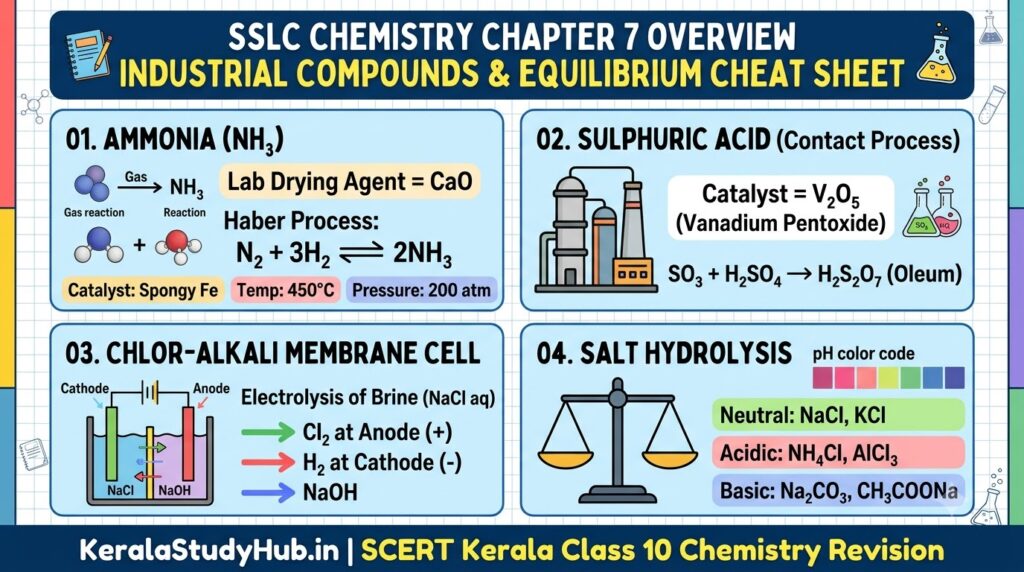
CHAPTER 7 AT A GLANCE: CLASS 10 CHEMISTRY QUICK REVISION BLUEPRINT
- Chapter 7 Title (EM & MM): Some Compounds of Industrial Importance (വ്യാവസായിക പ്രാധാന്യമുള്ള ചില സംയുക്തങ്ങൾ)
- Expected SSLC Exam Weightage: 7 to 8 Marks (Highest weightage in Part 2 Chemistry)
- Ammonia (NH3): Lab Drying Agent = Quicklime (
CaO) | Industrial Method = Haber Process (N2 + 3H2 ⇌ 2NH3 + Heat; Catalyst: Spongy Iron;450 °C;150–300 atm) - Sulphuric Acid (H2SO4): Industrial Method = Contact Process (Catalyst:
V2O5; via OleumH2S2O7) | Strong Dehydrating, Drying & Oxidising Agent - Chlor-Alkali Process (Membrane Cell): Electrolysis of Brine (
NaCl (aq)) yieldsCl2at Anode,H2at Cathode, and Caustic Soda (NaOH) - Salt Hydrolysis Rules: Neutral Salt =
NaCl, KCl| Acidic Salt =NH4Cl, (NH4)2SO4, AlCl3| Basic Salt =Na2CO3, CH3COONa
1. Kerala SSLC Chemistry Chapter 7 Notes: Ammonia (NH3) Lab Preparation, Fountain Experiment & Haber Process
Ammonia (NH3) is one of the most important industrial chemicals used for manufacturing nitrogenous fertilizers (such as Urea, Ammonium sulphate, and Ammonium phosphate), nitric acid (by Ostwald’s process), synthetic fibres (Nylon and Rayon), and refrigerants. In Kerala SSLC Chemistry Chapter 7 Notes, both the laboratory preparation and industrial manufacture of ammonia are guaranteed exam topics:
A. Laboratory Preparation, Drying Agent (CaO) and Collection of Ammonia
In the school chemistry laboratory, Ammonia gas is prepared by heating a mixture of Ammonium chloride (NH4Cl) and Calcium hydroxide (Ca(OH)2, slaked lime) or Sodium hydroxide (NaOH):
2NH4Cl + Ca(OH)2 —(Heat)→ CaCl2 + 2H2O + 2NH3 ↑
- Why Quicklime (Calcium Oxide,
CaO) is used as the Drying Agent: The ammonia gas evolved contains water vapour as moisture. It is passed through a drying tower packed with Quicklime (CaO), which absorbs the moisture without reacting with basic ammonia. - Why Concentrated Sulphuric Acid (
H2SO4) CANNOT be used to dry Ammonia (Sure 2-Mark Question): Ammonia is a basic gas. If passed through acidic ConcentratedH2SO4, ammonia reacts immediately to form Ammonium sulphate salt:
2NH3 + H2SO4 → (NH4)2SO4 - Why the Gas Jar for Collecting Ammonia is Kept Inverted: Ammonia is less dense (lighter) than air, so it rises upward and is collected by the downward displacement of air in an inverted gas jar. It cannot be collected over water because ammonia is extremely soluble in water.
- Identification Test for Ammonia: Ammonia is a colourless gas with a pungent smell. It turns moist red litmus paper blue (showing basic nature) and produces dense white fumes of Ammonium chloride (
NH4Cl) when a glass rod dipped in concentratedHClis held near the mouth of the jar (NH3 + HCl → NH4Cl).
B. Fountain Experiment of Ammonia (ജലധാര പരീക്ഷണം)
When a few drops of water are injected via a syringe into an inverted round-bottom flask filled with dry Ammonia gas, the ammonia dissolves rapidly in those few drops of water. This creates a partial vacuum (sudden drop in pressure) inside the flask, causing water containing phenolphthalein from the lower trough to rush up through the jet tube as a dramatic pink fountain:
- Two Inferences from the Fountain Experiment: (1) Ammonia is extremely soluble in water, and (2) The aqueous solution of ammonia (Ammonium hydroxide,
NH4OH:NH3 + H2O → NH4OH) is alkaline (basic) in nature, turning colourless phenolphthalein pink. - Liquor Ammonia vs Liquid Ammonia: A concentrated aqueous solution of ammonia in water is called Liquor Ammonia, whereas ammonia gas liquefied by applying high pressure is called Liquid Ammonia.
2. Chemical Equilibrium, Le Chatelier’s Principle & Haber Process Class 10 Questions
In a Reversible Reaction (ഉഭയദിശാ പ്രവർത്തനം) carried out in a Closed System, the stage at which the rate of the forward reaction becomes exactly equal to the rate of the backward reaction is called Chemical Equilibrium (രാസസംതുലനം). Because both forward and backward reactions continue to occur at equal rates at the molecular level without any net change in concentrations, chemical equilibrium is a Dynamic Equilibrium (ഗതിക സംതുലനം).
Le Chatelier’s Principle (ലെ ഷാറ്റ്ലിയർ തത്വം):
When a system at equilibrium is subjected to a change in any of the factors governing equilibrium—such as concentration, pressure, or temperature—the system readjusts itself in the direction that nullifies or counteracts the effect of that change and attains a new state of equilibrium.
Application of Le Chatelier’s Principle to the Haber Process (N2(g) + 3H2(g) ⇌ 2NH3(g) + Heat)
| Factor Changed | Effect According to Le Chatelier’s Principle | Condition Chosen in Haber Process |
|---|---|---|
| 1. Concentration | Increasing reactant concentration (N2 or H2) or continuously removing product (NH3) accelerates the forward reaction. |
High concentration of N2 and H2; formed NH3 is liquefied and removed continuously. |
| 2. Pressure | Increasing pressure favours the direction where the number of gaseous moles decreases (here, 4 moles → 2 moles in forward reaction). |
High pressure of 150 to 300 atm is applied to maximize ammonia yield. |
| 3. Temperature | Since forward reaction is exothermic, low temperature favours forward reaction; however, at very low temperature, reaction rate is too slow. | An optimum temperature of 450 °C is maintained. |
| 4. Catalyst | A catalyst has no effect on equilibrium position, but speeds up both forward and backward reactions equally to reach equilibrium quickly. | Spongy Iron (Finely divided Iron) is used as the catalyst. |
Exam Alert — When Pressure Has ZERO Effect on Equilibrium: In a gaseous reversible reaction where the total number of moles of reactants equals the total number of moles of products—such as H2(g) + I2(g) ⇌ 2HI(g) (1 + 1 = 2 moles on left; 2 moles on right)—there is no change in volume, so changing pressure has no effect on the equilibrium!
3. Sulphuric Acid (H2SO4): Contact Process, Dehydrating, Drying & Oxidising Properties
Sulphuric Acid (H2SO4) is known as the King of Chemicals because a nation’s industrial progress is measured by the quantity of sulphuric acid it consumes (used in fertilizers, paints, pigments, batteries, detergents, and petroleum refining). Industrially, it is manufactured by the Contact Process (സമ്പർക്ക പ്രക്രിയ) in four steps:
- Step 1 (Formation of Sulphur Dioxide): Burning sulphur or roasting sulphide ores in air:
S + O2 → SO2 - Step 2 (Catalytic Oxidation of
SO2toSO3): CombiningSO2with oxygen in the presence of Vanadium Pentoxide (V2O5) catalyst at450 °Cand2 atmpressure:
2SO2(g) + O2(g) ⇌ 2SO3(g) + Heat - Step 3 (Absorption of
SO3in ConcentratedH2SO4to Form Oleum): Sulphur trioxide (SO3) is NOT dissolved directly in water because the reaction is violently exothermic and forms a dense acid mist (smog) of fine droplets that resists further dissolution. Instead,SO3is absorbed in 98% concentratedH2SO4to form Oleum (Pyrosulphuric acid,H2S2O7):
SO3 + H2SO4 → H2S2O7 (Oleum) - Step 4 (Dilution of Oleum): Diluting Oleum with the calculated quantity of water gives 100% pure Sulphuric acid:
H2S2O7 + H2O → 2H2SO4
Key Chemical Properties of Concentrated Sulphuric Acid (Exam Questions)
- Precaution During Dilution of
H2SO4: Dilution of concentrated sulphuric acid with water is highly exothermic. Always add concentrated acid slowly in small drops to water with constant stirring. If water is poured into concentrated acid, the sudden heat vaporizes water into steam instantaneously, causing the corrosive acid to splash out and cause severe burns. - Dehydrating Property (നിർജലീകരണ ഗുണം): Concentrated
H2SO4absorbs chemically combined hydrogen and oxygen from compounds in the2 : 1ratio of water:
– Charring of Sugar / Glucose: Adding drops of conc.H2SO4to white cane sugar (C12H22O11) or glucose (C6H12O6) turns it into a black porous mass of pure carbon (C12H22O11 → 12C + 11H2O).
– Action on Blue Copper Sulphate: Blue hydrated copper sulphate crystals (CuSO4·5H2O) lose their water of crystallization and turn into white anhydrousCuSO4powder. - Drying Property (ശോഷകാരക ഗുണം): Absorbs free moisture from wet gases like
Cl2, HCl, SO2,andCO2. - Oxidising Property (ഓക്സീകരണ ഗുണം): Hot concentrated
H2SO4oxidises both metals (like Copper) and non-metals (like Carbon and Sulphur) while getting reduced toSO2:
–C + 2H2SO4 → CO2 + 2SO2 + 2H2O(Oxidation state of Carbon increases from0to+4)
–Cu + 2H2SO4 → CuSO4 + SO2 + 2H2O(Oxidation state of Copper increases from0to+2)
4. Chlor-Alkali Process (NaOH), HCl Manufacture, Salt Hydrolysis & NPK Fertilizers (New Syllabus Topics)
A. Arrhenius Acids, Basicity of Acids (H3PO4) and Alkalis
According to Arrhenius Theory, substances that liberate H+ (or H3O+) ions in aqueous solution are Acids, and substances that liberate OH– ions in aqueous solution are Bases (water-soluble bases like NaOH, KOH, Ca(OH)2, NH4OH are called Alkalis). The number of replaceable hydrogen ions (H+) furnished by one molecule of an acid is called its Basicity:
- Monobasic Acids (Basicity = 1):
HCl, HNO3, HBr, HF(e.g.,HCl → H+ + Cl–). - Dibasic Acids (Basicity = 2):
H2SO4, H2CO3, H2C2O4(e.g.,H2SO4 → 2H+ + SO42–). - Tribasic Acid (Basicity = 3): Phosphoric Acid (
H3PO4 → 3H+ + PO43–). WhenH3PO4reacts withNaOHin three steps, it forms three different salts: (1)NaH2PO4(Sodium dihydrogen phosphate), (2)Na2HPO4(Disodium hydrogen phosphate), and (3)Na3PO4(Trisodium phosphate).
B. Chlor-Alkali Process (Membrane Cell Manufacture of Caustic Soda / NaOH) & HCl Manufacture
Sodium Hydroxide (NaOH — Caustic Soda) is manufactured industrially by the electrolysis of concentrated aqueous sodium chloride solution (Brine) in a Membrane Cell. This industrial process is called the Chlor-Alkali Process (ക്ലോർ-ആൽക്കലി പ്രക്രിയ):
- Left Compartment (Anode
+): Chloride ions (Cl–) undergo oxidation to liberate Chlorine gas (Cl2):2Cl– → Cl2 + 2e–. PositiveNa+ions pass through the selective membrane into the right compartment. - Right Compartment (Cathode
–): Water molecules undergo reduction to liberate Hydrogen gas (H2) and hydroxide ions:2H2O + 2e– → H2 + 2OH–. TheNa+ions combine withOH–ions to form pure Sodium Hydroxide (NaOH). - Major Uses of
NaOH: Manufacture of soaps and detergents, manufacture of paper and rayon (artificial silk), and leaching of Bauxite in aluminium extraction. - Industrial Manufacture of Hydrochloric Acid (
HCl): Hydrogen and Chlorine gases (obtained as by-products of the Chlor-Alkali process) are burned together in an HCl Oven / Burner (H2 + Cl2 → 2HCl), and the resultingHClgas is dissolved in Deionised Water to produce pure Hydrochloric Acid.
C. Salt Hydrolysis (ലവണ ഹൈഡ്രോളിസിസ്): Neutral, Acidic and Basic Salts
When a salt dissolves in water, its cation or anion may react with water to produce an acidic or basic solution; this phenomenon is called Salt Hydrolysis:
| Type of Salt | Parent Acid & Base Combination | Litmus Change & Nature | Textbook Examples |
|---|---|---|---|
| 1. Neutral Salts | Strong Acid + Strong Base (Does not undergo hydrolysis) | No change in Blue or Red litmus (Neutral, pH = 7) |
NaCl, KCl, KNO3, Na2SO4 |
| 2. Acidic Salts | Strong Acid + Weak Base (Undergoes hydrolysis to give acidic solution) | Turns Blue litmus Red (Acidic, pH < 7) |
NH4Cl, (NH4)2SO4, AlCl3, CuSO4 |
| 3. Basic Salts | Weak Acid + Strong Base (Undergoes hydrolysis to give basic solution) | Turns Red litmus Blue (Basic, pH > 7) |
Na2CO3, CH3COONa, NaHCO3 |
D. Plant Nutrients and Chemical Fertilizers (NPK Fertilizers)
- Natural Nutrients: Carbon (
C), Hydrogen (H), and Oxygen (O) absorbed naturally from air and water. - Primary Nutrients (
N, P, K— Required in Large Quantities):– Nitrogen (N) Fertilizers (e.g., Urea, Ammonium sulphate, Sodium nitrate): Accelerate rapid vegetative growth of plants and foliage.– Phosphorus (
P) Fertilizers (e.g., Ammonium phosphate, Triple superphosphate): Promote root development and increase crop yield/productivity.– Potassium (
K) Fertilizers / Potash (e.g., Potassium chloride [Muriate of Potash], Potassium sulphate): Increase the disease resistance and overall health of plants. - Secondary Nutrients: Calcium (
Ca), Magnesium (Mg), and Sulphur (S) required in moderate quantities.
5. Class 10 Chemistry Chapter 7 Let Us Assess Questions and Answers (SCERT Textbook Solutions)
Q1. Chemical formulas of four salts are given: KCl, (NH4)2SO4, AlCl3, CH3COONa. Identify which of the following statements are correct and which are incorrect:
(i) KCl does not undergo salt hydrolysis.
(ii) (NH4)2SO4 is an acidic salt.
(iii) AlCl3 is a basic salt.
(iv) CH3COONa can be used to increase the basicity of an aqueous solution.
Answer:
(i) Correct (KCl is a neutral salt of strong acid HCl and strong base KOH).
(ii) Correct ((NH4)2SO4 is formed from strong acid H2SO4 and weak base NH4OH).
(iii) Incorrect (AlCl3 is an acidic salt, not a basic salt).
(iv) Correct (CH3COONa is a basic salt of weak acid CH3COOH and strong base NaOH).
Q2. Consider the exothermic reversible reaction: 2NO(g) + O2(g) ⇌ 2NO2(g) + Heat. How should we change the following factors to increase the yield of NO2? (Increase / Decrease): (a) Temperature, (b) Pressure, (c) Amount of Oxygen, (d) Amount of NO.
Answer:
(a) Temperature: Decrease (since the forward reaction is exothermic).
(b) Pressure: Increase (since 3 moles of reactant gases form 2 moles of product gas, reducing volume).
(c) Amount of Oxygen: Increase (increasing reactant concentration favours forward reaction).
(d) Amount of NO: Increase.
Q3. Match the following chemical fertilizers with their specific functions in plants: Urea, Sodium nitrate, Ammonium phosphate, Potassium chloride.
Answer:
– To accelerate vegetative growth of plants (Nitrogen): Urea, Sodium nitrate.
– To increase productivity / yield (Phosphorus): Ammonium phosphate.
– To increase disease resistance in plants (Potassium): Potassium chloride.
6. Class 10 Chemistry Chapter 7 Malayalam Medium Notes (വ്യാവസായിക പ്രാധാന്യമുള്ള ചില സംയുക്തങ്ങൾ – ചോദ്യോത്തരങ്ങൾ)
പത്താം ക്ലാസ് രസതന്ത്രം അദ്ധ്യായം 7: വ്യാവസായിക പ്രാധാന്യമുള്ള ചില സംയുക്തങ്ങൾ (മലയാളം മീഡിയം നോട്ടുകൾ)
- അമോണിയയുടെ നിർമ്മാണം: പരീക്ഷണശാലയിൽ അമോണിയം ക്ലോറൈഡും (
NH4Cl) കാൽസ്യം ഹൈഡ്രോക്സൈഡും (Ca(OH)2) ചൂടാക്കി അമോണിയ നിർമ്മിക്കുന്നു. ഈർപ്പം നീക്കാൻ ശോഷകാരകമായി നീറ്റുകക്ക (CaO) ഉപയോഗിക്കുന്നു (ഗാഢH2SO4ഉപയോഗിച്ചാൽ അമോണിയയുമായി പ്രവർത്തിച്ച് അമോണിയം സൾഫേറ്റ് ഉണ്ടാകും). വ്യാവസായികമായി ഹേബർ പ്രക്രിയ (Haber Process) വഴിയാണ് അമോണിയ നിർമ്മിക്കുന്നത് (ഉൽപ്രേരകം: സ്പോഞ്ച് അയൺ, അനുകൂല താപനില:450 °C). - ലെ-ഷാറ്റ്ലിയർ തത്വം (Le Chatelier’s Principle): സംതുലനാവസ്ഥയിലുള്ള ഒരു വ്യൂഹത്തിൽ ഗാഢത, മർദ്ദം, താപനില എന്നിവയിൽ ഏതെങ്കിലും ഒന്നിന് മാറ്റം വരുത്തിയാൽ വ്യൂഹം ആ മാറ്റത്തിന്റെ ഫലം ഇല്ലായ്മ ചെയ്യത്തക്കവിധം സ്വയം പുനഃക്രമീകരിച്ച് പുതിയ സംതുലനാവസ്ഥ കൈവരിക്കുന്നു.
- സൾഫ്യൂരിക് ആസിഡ് നിർമ്മാണം (സമ്പർക്ക പ്രക്രിയ / Contact Process): ഉൽപ്രേരകമായി വനേഡിയം പെന്റോക്സൈഡ് (
V2O5) ഉപയോഗിക്കുന്നു.SO3ഗാഢH2SO4-ൽ ലയിപ്പിച്ച് ഒലിയം (H2S2O7) ഉണ്ടാക്കി ജലം ചേർത്ത് നേർപ്പിച്ചാണ് സൾഫ്യൂരിക് ആസിഡ് നിർമ്മിക്കുന്നത്. ഗാഢH2SO4മികച്ച ഒരു നിർജലീകാരിയും (Dehydrating agent), ശോഷകാരകവും (Drying agent), ഓക്സീകാരിയും (Oxidising agent) ആണ്. - ക്ലോർ-ആൽക്കലി പ്രക്രിയയും (NaOH) ലവണ ഹൈഡ്രോളിസിസും: സ്തരസെല്ലിൽ (Membrane cell) സോഡിയം ക്ലോറൈഡ് ജലീയ ലായനി വൈദ്യുതവിശ്ലേഷണം ചെയ്ത് കാസ്റ്റിക് സോഡ (
NaOH) നിർമ്മിക്കുന്നു.- ന്യൂട്രൽ ലവണങ്ങൾ (ഹൈഡ്രോളിസിസിന് വിധേയമാകുന്നില്ല):NaCl, KCl– അസിഡിക് ലവണങ്ങൾ:
NH4Cl, (NH4)2SO4, AlCl3– ബേസിക് ലവണങ്ങൾ:
Na2CO3, CH3COONa - രാസവളങ്ങൾ (NPK Fertilizers): സസ്യങ്ങളുടെ വളർച്ച ത്വരിതപ്പെടുത്താൻ യൂറിയ, സോഡിയം നൈട്രേറ്റ് (നൈട്രജൻ വളങ്ങൾ); ഉൽപ്പാദനക്ഷമത കൂട്ടാൻ അമോണിയം ഫോസ്ഫേറ്റ്; രോഗപ്രതിരോധശേഷി കൂട്ടാൻ പൊട്ടാസ്യം ക്ലോറൈഡ് എന്നിവ ഉപയോഗിക്കുന്നു.