

Kerala SSLC Maths Chapter 10 Notes on Circles and Lines (Malayalam Medium: വൃത്തങ്ങളും വരകളും) welcome you to the tenth chapter of the newly revised Class 10 (Std 10) Mathematics textbook published by the State Council of Educational Research and Training (SCERT Kerala). In my classroom, when we start this new chapter (split out from the old Circles & Tangents chapters so students can master chord and secant lengths effortlessly), I ask my students: “Whether two chords AB and CD cross each other inside a circle at P or are extended to meet outside the circle at P, why does the product PA × PB always equal PC × PD? And how does this let us construct a line of length √15 cm or a square of area equal to any given rectangle?”
- 1. The Four Power-of-a-Point Theorems & Geometric Area Constructions
- 2. Complete Textbook Solutions & Extra Exam Questions (16 Fully Solved Q&As)
- Part A: SCERT Kerala Textbook Exercise Problems (Step-by-Step Solutions)
- Part B: Additional High-Weightage SSLC Exam Questions & Answers
- 3. Malayalam Medium Quick Revision Notes (വൃത്തങ്ങളും വരകളും – മലയാളം നോട്ടുകൾ)
Prepared strictly for the Kerala Pareeksha Bhavan SSLC Public Examination (carrying 7 marks and directly linked with Chapter 2 and Chapter 8), this complete classroom study guide covers the Intersecting Chords Theorem (PA × PB = PC × PD), the Semicircle Altitude Theorem (PC2 = PA × PB) & Square Area Construction, the Intersecting Secants Theorem (Outside the Circle), the Tangent-Secant Theorem (PC2 = PA × PB), and 16 Step-by-Step Solved Textbook & Exam Questions and Answers.
Quick SSLC Mathematics Navigation: SSLC Maths All 13 Chapters Master Hub | Previous: Chapter 9: Polynomials and Equations | Next: Chapter 11: Geometry and Algebra | Related: Chapter 2: Circles and Angles & Chapter 8: Tangents.
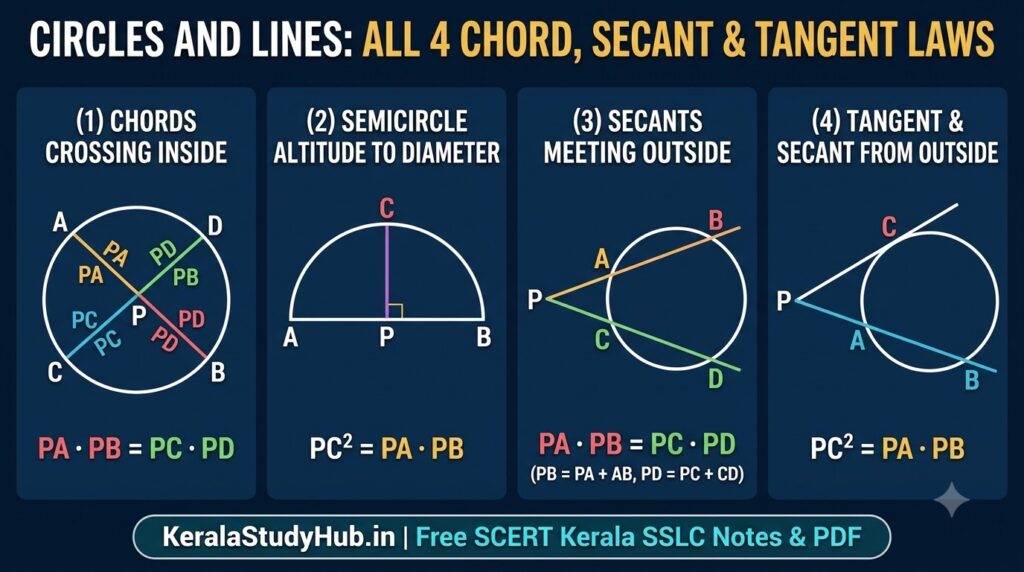
CHAPTER 10 AT A GLANCE: CLASS 10 MATHS (CIRCLES AND LINES) THEOREM & FORMULA BLUEPRINT
- Theorem 1 (Intersecting Chords Inside a Circle): If two chords
ABandCDintersect at a pointPinside a circle, then:PA × PB = PC × PD(the area of the rectangle with sidesPA, PBequals the area of the rectangle with sidesPC, PD). - Theorem 2 (Semicircle Altitude & Square Construction): If
ABis a diameter of a circle andPCis perpendicular toABmeeting the semicircle atC, then:PC2 = PA × PB⇒PC = √(PA × PB)(so a square drawn on sidePChas the exact same area as a rectangle of sidesPAandPB!). - Theorem 3 (Intersecting Secants Outside a Circle): If two chords
ABandCDextended meet at a pointPoutside the circle, then:PA × PB = PC × PD(Always measure both distances from the outside intersection pointP:Outside × Whole = Outside × Whole!). - Theorem 4 (Tangent-Secant Theorem): From an external point
P, if a secant line intersects a circle atAandBand a tangent touches the circle atC, then:PC2 = PA × PB(Square of the tangent equals the product of the external partPAand the whole secantPB!).
1. The Four Power-of-a-Point Theorems & Geometric Area Constructions
| Circle & Line Configuration | Formula (Measured from Point P) |
Common Classroom Mistake to Avoid! |
|---|---|---|
1. Two Chords AB & CD Intersecting Inside at P |
PA × PB = PC × PD |
If total chord CD is given, remember PD = CD − PC. |
2. Diameter AB Perpendicular to Chord at P (Semicircle Altitude PC) |
PC2 = PA × PB |
Since diameter AB bisects perpendicular chord CD, PC = PD, giving PC2 = PA × PB. |
3. Two Chords AB & CD Extended to Meet Outside at P (Secants) |
PA × PB = PC × PD |
Never write PA × AB! Always use the full secant from P: PB = PA + AB! |
4. Secant PAB and Tangent PC from External Point P |
PC2 = PA × PB |
Again, PB is the entire secant length PA + AB from outside point P! |
2. Complete Textbook Solutions & Extra Exam Questions (16 Fully Solved Q&As)
Part A: SCERT Kerala Textbook Exercise Problems (Step-by-Step Solutions)
Q1 (Textbook Problem — Intersecting Chords Inside a Circle): Chords AB and CD intersect at a point P inside a circle. Given PA = 6 cm, PB = 4 cm, and PC = 3 cm, find the length of PD and the total length of chord CD.
Answer:
• By the Intersecting Chords Theorem: PA × PB = PC × PD.
• Substituting the given lengths:
6 × 4 = 3 × PD ⇒ 24 = 3 × PD ⇒ PD = 24 / 3 = 8 cm.
• Total length of chord CD = PC + PD = 3 + 8 = 11 cm.
Q2 (Textbook Problem — Chord Bisected by Another Chord): In a circle, two chords AB and CD intersect at P. If PA = 9 cm, PB = 4 cm, and P is the midpoint of chord CD, find the length of chord CD.
Answer:
• Since P is the midpoint of CD, we have PC = PD = x.
• By the Intersecting Chords Theorem:
PC × PD = PA × PB ⇒ x2 = 9 × 4 = 36 ⇒ x = √36 = 6 cm.
• Therefore, total length of chord CD = 2x = 2 × 6 = 12 cm.
Q3 (Textbook Problem — Constructing a Square Equal in Area to a Rectangle): Explain how to construct a square of area equal to a rectangle of length 5 cm and breadth 3 cm (i.e., area 15 cm2) using a semicircle. What is the length of the side of the square?
Answer:
• Step 1: Draw a line segment AB of total length 5 + 3 = 8 cm, and mark point P on it such that PA = 5 cm and PB = 3 cm.
• Step 2: Draw the perpendicular bisector of AB to find its midpoint O (at 4 cm), and draw a semicircle with AB as diameter.
• Step 3: Draw a line through P perpendicular to AB meeting the semicircle at C.
• Step 4: By the Semicircle Altitude Theorem, PC2 = PA × PB = 5 × 3 = 15 cm2, so PC = √15 cm!
• Step 5: Construct a square with side equal to PC; its area is (√15)2 = 15 cm2.
Q4 (Textbook Problem — Constructing a Square of Area Equal to a Triangle): How can you construct a square whose area is equal to the area of a triangle with base 6 cm and height 5 cm?
Answer:
• Area of the triangle = (1 / 2) × base × height = (1 / 2) × 6 × 5 = 3 × 5 = 15 cm2.
• Notice that the area of a triangle with base b and height h is equal to the area of a rectangle with sides (b / 2) and h (here 3 cm and 5 cm)!
• Therefore, draw a line AB of length 3 + 5 = 8 cm with PA = 3 cm and PB = 5 cm, draw the semicircle on diameter AB, erect perpendicular PC to the semicircle (PC = √15 cm), and draw the square on side PC!
Q5 (Textbook Problem — Two Chords Extended to Intersect Outside a Circle): Two chords AB and CD of a circle are extended to meet at a point P outside the circle (with A between P and B, and C between P and D). If PA = 4 cm, AB = 5 cm, and PC = 3 cm, find the length of PD and the chord CD.
Answer:
• First find the total secant length PB from the external point P:
PB = PA + AB = 4 + 5 = 9 cm.
• By the Intersecting Secants Theorem: PA × PB = PC × PD:
4 × 9 = 3 × PD ⇒ 36 = 3 × PD ⇒ PD = 36 / 3 = 12 cm.
• Therefore, the length of chord CD = PD − PC = 12 − 3 = 9 cm!
Q6 (Textbook Problem — Tangent-Secant Theorem Proof & Calculation): From a point P outside a circle, a secant line cuts the circle at A and B, and a tangent touches the circle at C. Prove that PC2 = PA × PB. If PA = 4 cm and AB = 5 cm, find the length of tangent PC.
Answer:
• Proof: Join AC and BC to form ΔPAC and ΔPCB. By the Alternate Segment Theorem, the angle between tangent PC and chord AC equals the angle in the alternate segment: ∠PCA = ∠PBC. Also ∠P is common to both triangles. Thus ΔPAC and ΔPCB are similar:
PC / PB = PA / PC ⇒ PC2 = PA × PB!
• Calculation: Given PA = 4 cm and AB = 5 cm, whole secant PB = 4 + 5 = 9 cm.
PC2 = 4 × 9 = 36 ⇒ PC = 6 cm.
Q7 (Textbook Problem — Recovering Equal Tangents from Tangent-Secant Law): Use the Tangent-Secant Theorem (PC2 = PA × PB) to prove that the two tangents PC and PD drawn to a circle from an external point P are equal in length!
Answer:
• Draw any secant line from P intersecting the circle at A and B.
• By the Tangent-Secant Theorem applied to tangent PC: PC2 = PA × PB.
• By the Tangent-Secant Theorem applied to tangent PD: PD2 = PA × PB.
• Therefore, PC2 = PD2 ⇒ PC = PD!
Q8 (Textbook Problem — Finding Chord Length Using Tangent & Second-Degree Equation): From an external point P, a tangent PC of length 6 cm is drawn to a circle, and a secant line PAB cuts the circle at A and B such that chord AB = 5 cm. Find the length of PA.
Answer:
• Let PA = x cm. Then the total secant length is PB = PA + AB = (x + 5) cm.
• By the Tangent-Secant Theorem: PA × PB = PC2:
x(x + 5) = 62 = 36 ⇒ x2 + 5x − 36 = 0.
• Factoring (from Chapter 9!): (x + 9)(x − 4) = 0.
• Taking the positive length, PA = 4 cm.
Q9 (Textbook Problem — Finding the Radius of a Circle from Secant/Chord Segments): In a circle, a chord AB of length 8 cm is perpendicular to a diameter CD at point P. If the shorter segment of the diameter is CP = 2 cm, find the diameter and radius of the circle.
Answer:
• Since diameter CD is perpendicular to chord AB (8 cm), it bisects AB into PA = PB = 4 cm.
• By the Intersecting Chords Theorem:
PC × PD = PA × PB ⇒ 2 × PD = 4 × 4 = 16 ⇒ PD = 8 cm.
• Therefore, Diameter CD = CP + PD = 2 + 8 = 10 cm, and Radius r = 10 / 2 = 5 cm!
Q10 (Textbook Problem — Two Intersecting Circles & Equal Tangents from Extended Common Chord): Two circles intersect at two points A and B. From any point P on the extended common chord AB, tangents PC and PD are drawn to the two circles. Prove that PC = PD!
Answer:
• Line PAB is a secant to both circles.
• Applying the Tangent-Secant Theorem to the first circle (with tangent PC and secant PAB):
PC2 = PA × PB.
• Applying the Tangent-Secant Theorem to the second circle (with tangent PD and the same secant PAB):
PD2 = PA × PB.
• Therefore, PC2 = PD2 ⇒ PC = PD!
Part B: Additional High-Weightage SSLC Exam Questions & Answers
Q11 (Extra Exam Question — Common Chord Bisects the Common Tangent of Two Intersecting Circles): Two circles intersect at A and B, and a direct common tangent touches the two circles at C and D. Prove that the extended common chord AB bisects the common tangent CD!
Answer:
• Let the extended common chord AB intersect the common tangent CD at point P.
• By the Tangent-Secant Theorem on the first circle: PC2 = PA × PB.
• By the Tangent-Secant Theorem on the second circle: PD2 = PA × PB.
• Therefore, PC2 = PD2 ⇒ PC = PD, which means P is the midpoint of CD (the extended common chord AB bisects the common tangent CD!).
Q12 (Extra Exam Question — Power of a Point Inside a Circle in Terms of Radius r and Distance d): Prove that for any chord AB passing through a point P at a distance d inside a circle of radius r, the product PA × PB is always equal to r2 − d2!
Answer:
• Draw the diameter CD passing through center O and point P (where OP = d).
• Then the two segments of the diameter at P are PC = r − d and PD = r + d.
• By the Intersecting Chords Theorem:
PA × PB = PC × PD = (r − d)(r + d) = r2 − d2!
Q13 (Extra Exam Question — Power of an External Point in Terms of d and r): From an external point P at a distance of 10 cm from the center O of a circle of radius 6 cm, a secant line PAB is drawn cutting the circle at A and B. Find the product PA × PB.
Answer:
• If the line through P and center O meets the circle at C and D, then PC = d − r = 10 − 6 = 4 cm and PD = d + r = 10 + 6 = 16 cm.
• By the Intersecting Secants Theorem:
PA × PB = PC × PD = (d − r)(d + r) = d2 − r2 = 102 − 62 = 100 − 36 = 64 cm2!
Q14 (Extra Exam Question — Constructing a Line Segment of Length √12 cm or √21 cm): Describe two different ways to draw a line segment of length √21 cm using circles and chords.
Answer:
• Method 1 (Semicircle Altitude Method): Write 21 = 7 × 3. Draw a line AB = 7 + 3 = 10 cm, mark P at 7 cm from A, draw the semicircle on diameter AB, and erect perpendicular PC meeting the semicircle at C. Then PC = √(7 × 3) = √21 cm.
• Method 2 (Tangent-Secant Method): Draw a circle with chord AB = 4 cm extended to P such that PA = 3 cm (so PB = 3 + 4 = 7 cm). Draw tangent PC from P to the circle; then PC = √(PA × PB) = √(3 × 7) = √21 cm.
Q15 (Extra Exam Question — Converse of Intersecting Chords / Four Points on a Circle): Two line segments AB and CD intersect at P such that PA = 3 cm, PB = 8 cm, PC = 4 cm, and PD = 6 cm. Does the circle passing through A, B, C also pass through D? Why?
Answer:
• Calculate PA × PB = 3 × 8 = 24 and PC × PD = 4 × 6 = 24.
• Since PA × PB = PC × PD = 24, by the Converse of the Intersecting Chords Theorem, all four endpoints A, B, C, D are concyclic—so the circle through A, B, C MUST pass through D!
Q16 (Extra Exam Question — Constructing a Rectangle of Given Side & Area Equal to Another Rectangle): How do you construct a rectangle of one side 4 cm whose area is equal to the area of a rectangle of sides 6 cm and 2 cm?
Answer:
• Since PA × PB = PC × PD, if PA = 6 cm, PB = 2 cm, and PC = 4 cm, then the fourth segment PD satisfies 4 × PD = 6 × 2 = 12 ⇒ PD = 3 cm.
• Geometric Construction: Draw line segment AB = 6 + 2 = 8 cm with PA = 6 cm and PB = 2 cm. Through P, draw another line at any angle and mark PC = 4 cm. Draw the circumcircle of ΔABC (using perpendicular bisectors of AB and AC) and extend CP to meet the circle at D. Then PD = 3 cm, and the rectangle with sides PC (4 cm) and PD (3 cm) has the exact same area (12 cm2) as the rectangle with sides 6 cm and 2 cm!
3. Malayalam Medium Quick Revision Notes (വൃത്തങ്ങളും വരകളും – മലയാളം നോട്ടുകൾ)
- വൃത്തത്തിനുള്ളിൽ ഖണ്ഡിക്കുന്ന ഞാണുകൾ (Intersecting Chords Inside a Circle): ഒരു വൃത്തത്തിലെ
AB,CDഎന്നീ രണ്ട് ഞാണുകൾ വൃത്തത്തിനുള്ളിലെPഎന്ന ബിന്ദുവിൽ മുറിച്ചുകടന്നാൽ:
PA × PB = PC × PD. - വ്യാസവും ലംബമായ ഞാണും (Semicircle Altitude Rule):
ABഎന്ന വ്യാസത്തിന് ലംബമായിP-യിലൂടെ വരയ്ക്കുന്ന വര അർദ്ധവൃത്തത്തെC-യിൽ മുട്ടുന്നുവെങ്കിൽ:
PC2 = PA × PB⇒PC = √(PA × PB)(ചതുരത്തിന് തുല്യ പരപ്പളവുള്ള സമചതുരം വരയ്ക്കാൻ ഈ തത്വം ഉപയോഗിക്കുന്നു). - വൃത്തത്തിന് പുറത്ത് കൂട്ടിമുട്ടുന്ന ഞാണുകൾ (Intersecting Secants Outside a Circle):
AB,CDഎന്നീ ഞാണുകൾ നീട്ടി വൃത്തത്തിന് പുറത്തുള്ളPഎന്ന ബിന്ദുവിൽ കൂട്ടിമുട്ടിയാൽ:
PA × PB = PC × PD(ഇവിടെPB = PA + ABആണെന്ന് പ്രത്യേകം ശ്രദ്ധിക്കുക!). - തൊടുവരയും ഛേദകവരയും (Tangent-Secant Theorem): വൃത്തത്തിന് പുറത്തുള്ള
Pഎന്ന ബിന്ദുവിൽ നിന്നുള്ളPABഎന്ന വര വൃത്തത്തെA, Bഎന്നീ ബിന്ദുക്കളിൽ മുറിച്ചുകടക്കുകയും,PCഎന്ന തൊടുവര വൃത്തത്തെC-യിൽ തൊടുകയും ചെയ്താൽ:
PC2 = PA × PB.
Teacher’s Classroom Note & Student Discussion Question:
In every problem where lines meet outside the circle at P, students lose marks by multiplying PA × AB instead of PA × PB! Always remember our classroom chant: “Outside Part × Whole Line = Tangent Squared (PA × PB = PC2)”!
Quick Challenge for You (Drop Your Answer in the Comments Below!): From an external point P, a secant line PAB is drawn to a circle with PA = 3 cm and chord AB = 9 cm. What is the length of the tangent PC drawn from P to the circle? Comment your answer below!



Latest SCERT & DHSE Kerala Study Notes
- Kerala Class 9 Physics Chapter 2 Notes: Equations of Motion (ചലനസമവാക്യങ്ങൾ) Std 9 Let Us Assess Questions and Answers PDF
- Kerala SSLC Christmas Exam Question Paper 2025-27: All Subjects Second Term & Model Question Papers with Solved Answer Keys PDF (New SCERT Syllabus)
- Kerala SSLC English Christmas Exam Question Paper 2025-27: Second Term & Model Solved 80-Mark Answer Key, Discourses & Grammar PDF
- Kerala SSLC Social Science Christmas Exam Question Paper 2025-27: Second Term & Model Solved 80-Mark Answer Key, Weightage & Map Study PDF
- Kerala SSLC Maths Christmas Exam Question Paper 2025-27: Second Term & Model Solved Answer Key, Weightage & Formula Sheet PDF (New SCERT Syllabus)
- Kerala SSLC Biology Christmas Exam Question Paper 2025-27: Second Term & Model Solved Answer Key, Weightage & Flowcharts PDF (New SCERT Syllabus)
- Kerala SSLC Chemistry Christmas Exam Question Paper 2025-27: Second Term & Model Solved Answer Key, Weightage & Sure A+ Questions PDF (New SCERT Syllabus)
- Kerala SSLC Physics Christmas Exam Question Paper 2025-27: Second Term & Model Solved Answer Key, Weightage & Formula Sheet PDF (New SCERT Syllabus)