

Kerala SSLC Maths Chapter 2 Notes on Circles and Angles (Malayalam Medium: വൃത്തങ്ങളും കോണുകളും) welcome you to the second chapter of the newly revised Class 10 (Std 10) Mathematics textbook published by the State Council of Educational Research and Training (SCERT Kerala). In my classroom, when we draw our first circle on the board, I always ask my students: “Why does every angle drawn inside a semicircle equal exactly 90°, no matter where you place the vertex on the arc? And how can you tell immediately whether a circle can be drawn passing through all four vertices of a given quadrilateral?”
- 1. Angle in a Semicircle (അർദ്ധവൃത്തത്തിലെ കോൺ) & Point Position Rule
- 2. Central Angle, Alternate Arc & Cyclic Quadrilateral (ചക്രീയ ചതുർഭുജം)
- 3. Complete Textbook Solutions & Extra Exam Questions (16 Fully Solved Q&As)
- Part A: SCERT Kerala Textbook Exercise Problems (Step-by-Step Solutions)
- Part B: Additional High-Weightage SSLC Exam Questions & Answers
- 4. Malayalam Medium Quick Revision Notes (വൃത്തങ്ങളും കോണുകളും – മലയാളം നോട്ടുകൾ)
Carrying a massive 11 marks in the Kerala Pareeksha Bhavan SSLC Public Examination (and paired later with Chapter 10: Circles and Lines), this complete classroom study guide covers the Semicircle Right-Angle Theorem, the Central Angle & Alternate Arc Theorem, Angles in the Same Segment, Cyclic Quadrilaterals (ചക്രീയ ചതുർഭുജം), Rectangle-to-Square Area Constructions, and 16 Step-by-Step Solved Textbook & Exam Questions and Answers.
Quick SSLC Mathematics Navigation: SSLC Maths All 13 Chapters Master Hub | Previous: Chapter 1: Arithmetic Sequences | Next: Chapter 3: Arithmetic Sequences and Algebra.
CHAPTER 2 AT A GLANCE: CLASS 10 MATHS (CIRCLES AND ANGLES) THEOREM BLUEPRINT
- Theorem 1 (Semicircle Theorem): Joining the ends of a diameter
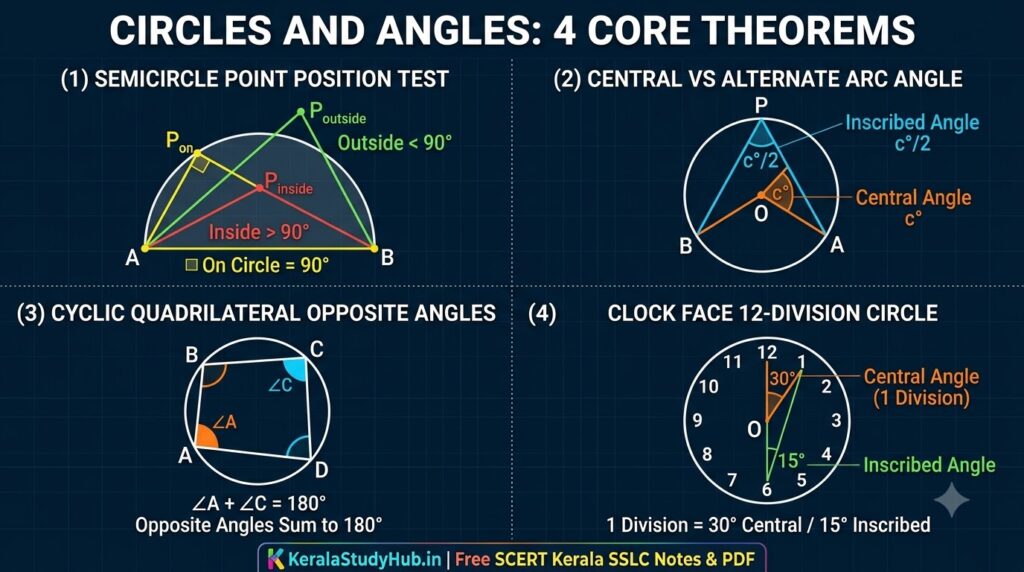
ABto any pointPon the semicircle gives a right angle (∠APB = 90°). Position rule:Pinside semicircle ⇒∠APB > 90°(obtuse);Poutside semicircle ⇒∠APB < 90°(acute). - Theorem 2 (Central Angle & Alternate Arc): The angle made by an arc at any point on the alternate arc (മറുഖണ്ഡം) is half the central angle of the arc: if central angle =
c°, then angle on alternate arc =c° / 2, and angle on the arc itself =180° − (c° / 2). - Theorem 3 (Same Arc / Segment Theorem): All angles made by an arc at points on its alternate arc are equal. Also, supplementary central angles (
x + y = 360°) halve to supplementary inscribed angles (x/2 + y/2 = 180°). - Theorem 4 (Cyclic Quadrilateral — ചക്രീയ ചതുർഭുജം): If all four vertices of a quadrilateral lie on a circle, the sum of its opposite angles is
180°(∠A + ∠C = 180°,∠B + ∠D = 180°). Also, any exterior angle equals the interior opposite angle. - Special Cyclic Shapes: Every rectangle, square, and isosceles trapezium is a cyclic quadrilateral!
1. Angle in a Semicircle (അർദ്ധവൃത്തത്തിലെ കോൺ) & Point Position Rule
Let AB be the diameter of a circle with center O, and let C be any point on the circle. Drawing radius OC splits ΔABC into two isosceles triangles (ΔOAC and ΔOBC) because OA = OB = OC (radii). If ∠OAC = ∠OCA = x and ∠OBC = ∠OCB = y, then in ΔABC, 2x + 2y = 180° ⇒ x + y = 90°. Thus ∠ACB = 90°!
Position of Point P Relative to Circle with Diameter AB |
Measure of Angle ∠APB |
Converse Geometric Test (Where Does Vertex Lie?) |
|---|---|---|
1. Point P lies ON the circle (semicircle) |
∠APB = 90° (Right Angle) |
If ∠APB = 90°, the circle with diameter AB passes directly through P. |
2. Point P lies INSIDE the circle |
∠APB > 90° (Obtuse Angle) |
If ∠APB > 90°, point P lies strictly inside the circle with diameter AB. |
3. Point P lies OUTSIDE the circle |
∠APB < 90° (Acute Angle) |
If ∠APB < 90°, point P lies strictly outside the circle with diameter AB. |
2. Central Angle, Alternate Arc & Cyclic Quadrilateral (ചക്രീയ ചതുർഭുജം)
- Central Angle & Alternate Arc Theorem (കേന്ദ്രകോണും മറുഖണ്ഡത്തിലെ കോണും):
- Any two points
AandBon a circle divide it into two arcs: a smaller minor arc and a larger major arc. Each arc is called the alternate arc (complement / മറുഖണ്ഡം) of the other. - Theorem: The angle made by any arc of a circle on the alternate arc is half the angle made at the center:
If Central Angle∠AOB = c°, then:
• Angle on the Alternate (Major) Arc∠APB = c° / 2
• Angle on the Arc Itself (Minor Arc)∠AQB = 180° − (c° / 2) - Angles in the Same Segment: All angles made by an arc on its alternate arc are equal (
∠APB = ∠AQB = ∠ARB).
- Any two points
- Cyclic Quadrilaterals (ചക്രീയ ചതുർഭുജം):
- Definition & Theorem: A quadrilateral whose all four vertices lie on a circle is called a Cyclic Quadrilateral. In any cyclic quadrilateral
ABCD, the sum of each pair of opposite angles is180°(supplementary):
∠A + ∠C = 180°and∠B + ∠D = 180°. - Converse Theorem: If the opposite angles of a quadrilateral are supplementary (add up to
180°), then a circle can be drawn passing through all four of its vertices (it is a cyclic quadrilateral). - Exterior Angle Property of a Cyclic Quadrilateral: If one side of a cyclic quadrilateral is extended, the resulting exterior angle is equal to the interior opposite angle.
- Which Quadrilaterals Are Always Cyclic? Every Square (സമചതുരം), Rectangle (ചതുരം), and Isosceles Trapezium (സമപാർശ്വ ലംബകം) is always cyclic! A non-rectangular parallelogram or a non-square rhombus is NOT cyclic.
- Definition & Theorem: A quadrilateral whose all four vertices lie on a circle is called a Cyclic Quadrilateral. In any cyclic quadrilateral
3. Complete Textbook Solutions & Extra Exam Questions (16 Fully Solved Q&As)
Part A: SCERT Kerala Textbook Exercise Problems (Step-by-Step Solutions)
Q1 (Textbook Problem — Semicircle Circle Test on a Triangle): In ΔABC, ∠A = 30° and ∠B = 60°. If we draw a circle with AB as diameter, does it pass through C? Why?
Answer:
• In ΔABC, the sum of angles is 180°.
• Given ∠A = 30° and ∠B = 60°, the third angle is:
∠C = 180° − (30° + 60°) = 180° − 90° = 90°.
• Since ∠ACB = 90°, by the Converse of the Semicircle Theorem, the circle drawn with hypotenuse AB as diameter MUST pass directly through vertex C.
Q2 (Textbook Problem — Position of Fourth Vertex of a Quadrilateral): In quadrilateral ABCD, AB is drawn as the diameter of a circle. Given ∠ADB = 90° and ∠ACB = 75°, determine the positions of vertices D and C with respect to the circle. What if ∠ACB = 110°?
Answer:
• Since AB is the diameter of the circle:
1. Because ∠ADB = 90°, vertex D lies ON the circle.
2. Because ∠ACB = 75° < 90° (acute angle), vertex C lies OUTSIDE the circle.
3. If ∠ACB = 110° > 90° (obtuse angle), vertex C lies INSIDE the circle.
Q3 (Textbook Problem — Intersecting Semicircles on Two Sides of a Triangle): Two circles are drawn with the two sides AB and AC of a triangle ABC as diameters. Prove that their second point of intersection D lies on the third side BC.
Answer:
• Join the common chord AD linking the two intersection points A and D.
• In the first circle with diameter AB, the angle in the semicircle is ∠ADB = 90°.
• In the second circle with diameter AC, the angle in the semicircle is ∠ADC = 90°.
• Adding these two adjacent angles at point D:
∠ADB + ∠ADC = 90° + 90° = 180° (a straight angle / linear pair).
• Therefore, B, D, C are collinear (lie on a straight line), meaning the intersection point D lies on side BC (and AD ⊥ BC).
Q4 (Textbook Problem — Central Angle, Alternate Arc & Minor Arc Angles): In a circle with center O, chord AB makes a central angle ∠AOB = 110°. Find: (a) the angle ∠APB on the major (alternate) arc, (b) the angle ∠AQB on the minor arc, and (c) the angles of isosceles triangle ΔOAB.
Answer:
• (a) Angle on the alternate (major) arc (∠APB):
∠APB = (1/2) × ∠AOB = 110° / 2 = 55°.
• (b) Angle on the minor arc (∠AQB):
∠AQB = 180° − ∠APB = 180° − 55° = 125°.
• (c) Angles of ΔOAB: Since OA = OB (radii), ΔOAB is isosceles with vertex angle 110°. Therefore:
∠OAB = ∠OBA = (180° − 110°) / 2 = 70° / 2 = 35°.
Q5 (Textbook Problem — Circumcircle & Angles of a Triangle): A triangle ABC is inscribed in a circle with center O such that ∠A = 50° and ∠B = 70°. Find the third angle ∠C and the three central angles ∠BOC, ∠AOC, and ∠AOB.
Answer:
• Third angle of ΔABC: ∠C = 180° − (50° + 70°) = 60°.
• By the Central Angle Theorem (central angle is twice the angle on the alternate arc):
– ∠BOC = 2 × ∠A = 2 × 50° = 100°
– ∠AOC = 2 × ∠B = 2 × 70° = 140°
– ∠AOB = 2 × ∠C = 2 × 60° = 120°
• Verification: 100° + 140° + 120° = 360° (full angle around center O).
Q6 (Textbook Problem — Dividing a Circle into Equal Arcs / Clock Face Geometry): The numbers 1 to 12 on a clock face divide the circle into 12 equal arcs. Find the angles of the triangle formed by joining the numbers: (a) 1, 4, and 8; and (b) 2, 5, and 11.
Answer:
• Since 12 equal divisions make 360° at the center, 1 clock division = 360° / 12 = 30° central angle (and therefore 15° inscribed angle on the alternate arc!).
• (a) Triangle joining 1, 4, and 8:
– Arc from 1 to 4 = 3 divisions ⇒ Central angle = 90° ⇒ Opposite angle at 8 = 90° / 2 = 45°.
– Arc from 4 to 8 = 4 divisions ⇒ Central angle = 120° ⇒ Opposite angle at 1 = 120° / 2 = 60°.
– Arc from 8 to 1 (via 12) = 5 divisions ⇒ Central angle = 150° ⇒ Opposite angle at 4 = 150° / 2 = 75°.
So the angles are 45°, 60°, 75°.
• (b) Triangle joining 2, 5, and 11:
– Arc 2 to 5 = 3 divisions ⇒ Angle at 11 = 3 × 15° = 45°.
– Arc 5 to 11 = 6 divisions (semicircle!) ⇒ Angle at 2 = 6 × 15° = 90°.
– Arc 11 to 2 = 3 divisions ⇒ Angle at 5 = 3 × 15° = 45°.
So it is an isosceles right triangle (45°, 45°, 90°)!
Q7 (Textbook Problem — Cyclic Quadrilateral Diagonals & Angles): In cyclic quadrilateral ABCD, diagonals AC and BD intersect at P. Given ∠DBC = 40°, ∠BAC = 30°, and ∠BCD = 100°, find all angles of the cyclic quadrilateral (∠A, ∠B, ∠C, ∠D) and ∠CAD.
Answer:
• Step 1 (Same Arc Angles): Angles on the same arc CD are equal: ∠BDC = ∠BAC = 30°. Angles on the same arc DC/BC: ∠DAC = ∠DBC = 40°.
• Step 2 (Angle ∠A = ∠DAB): ∠DAB = ∠BAC + ∠CAD = 30° + 40° = 70°.
• Step 3 (Angle ∠C = ∠BCD): In a cyclic quadrilateral, opposite angles sum to 180°:
∠BCD = 180° − ∠DAB = 180° − 70° = 110° (or if ∠BCD = 100° is given instead of ∠DBC = 40°, then ∠DAB = 180° − 100° = 80° and ∠CAD = 80° − 30° = 50°).
• Step 4 (In ΔBCD): With ∠DBC = 40° and ∠BDC = 30°, ∠BCD = 180° − (40° + 30°) = 110°.
Q8 (Textbook Problem — Why Every Isosceles Trapezium Is Cyclic): Prove that any isosceles trapezium is a cyclic quadrilateral.
Answer:
• Let ABCD be an isosceles trapezium in which AB ∥ CD and non-parallel sides AD = BC.
• Because it is an isosceles trapezium, the base angles on the same parallel side are equal: ∠A = ∠B and ∠D = ∠C.
• Since AB ∥ CD, the co-interior angles between parallel lines sum to 180°:
∠A + ∠D = 180°.
• Replacing ∠D with ∠C (since ∠D = ∠C), we get:
∠A + ∠C = 180° (and similarly ∠B + ∠D = 180°).
• Since the opposite angles of the isosceles trapezium are supplementary (180°), every isosceles trapezium is a cyclic quadrilateral.
Q9 (Textbook Problem — Cyclic Parallelogram Is a Rectangle): Prove that any cyclic parallelogram must be a rectangle.
Answer:
• Let ABCD be a cyclic parallelogram.
• Since ABCD is a parallelogram, its opposite angles are equal: ∠A = ∠C and ∠B = ∠D.
• Since ABCD is also cyclic, its opposite angles add up to 180°:
∠A + ∠C = 180°.
• Since ∠A = ∠C, we have 2∠A = 180° ⇒ ∠A = ∠C = 90° (and similarly ∠B = ∠D = 90°).
• A parallelogram with all four angles equal to 90° is a rectangle. Hence proved!
Q10 (Textbook Problem — Intersecting Chords Inside & Outside a Circle): Two chords AB and CD intersect at a point P inside a circle. Prove that PA × PB = PC × PD using equal angles in the same segment (and hence construct a square of area equal to a rectangle of sides 6 cm and 3 cm).
Answer:
• Join AC and BD to form ΔPAC and ΔPDB.
• Angles in the same segment on arc BC: ∠CAP = ∠BDP.
• Vertically opposite angles at P: ∠APC = ∠DPB.
• Therefore, ΔPAC and ΔPDB are similar triangles, which means the ratio of sides opposite equal angles is constant:
PA / PD = PC / PB ⇒ PA × PB = PC × PD.
• Square Construction (Semicircle Altitude Rule): If AB is a diameter separated at P into PA = 6 cm and PB = 3 cm, and PC is drawn perpendicular to AB meeting the semicircle at C, then PC2 = PA × PB = 6 × 3 = 18 cm2 (so a square drawn on side PC = √18 cm has area 18 cm2!).
Part B: Additional High-Weightage SSLC Exam Questions & Answers
Q11 (Extra Exam Question — Orthocentre & Three Cyclic Quadrilaterals in a Triangle): In an acute-angled triangle ABC, altitudes AD, BE, and CF intersect at the orthocentre H. Write down the names of 6 cyclic quadrilaterals formed inside this figure and state why they are cyclic.
Answer:
• Since AD ⊥ BC, BE ⊥ AC, and CF ⊥ AB, right angles (90°) are formed at D, E, F.
• 3 Quadrilaterals with Opposite Right Angles Summing to 180°:
1. AFHE (since ∠AFH + ∠AEH = 90° + 90° = 180°, circle with diameter AH)
2. BFHD (since ∠BFH + ∠BDH = 90° + 90° = 180°, circle with diameter BH)
3. CEHD (since ∠CEH + ∠CDH = 90° + 90° = 180°, circle with diameter CH)
• 3 Quadrilaterals with Angles on the Same Base Equal to 90° (Semicircle on Side):
4. BFEC (since ∠BFC = ∠BEC = 90° on diameter BC)
5. ACDF (since ∠ADC = ∠AFC = 90° on diameter AC)
6. ABDE (since ∠ADB = ∠AEB = 90° on diameter AB).
Q12 (Extra Exam Question — Angle Bisectors of a Cyclic Quadrilateral): Prove that the quadrilateral formed by the internal angle bisectors of any quadrilateral is ALWAYS a cyclic quadrilateral!
Answer:
• Let the angle bisectors of quadrilateral ABCD enclose an inner quadrilateral PQRS.
• In ΔAPB (formed by the bisectors of ∠A and ∠B):
∠APB = 180° − (1/2)(∠A + ∠B).
• Similarly, in ΔCRD (formed by the bisectors of ∠C and ∠D):
∠CRD = 180° − (1/2)(∠C + ∠D).
• Adding these two opposite angles of PQRS:
∠P + ∠R = 360° − (1/2)(∠A + ∠B + ∠C + ∠D) = 360° − (1/2)(360°) = 360° − 180° = 180°.
• Since opposite angles sum to 180°, the inner quadrilateral PQRS is always cyclic!
Q13 (Extra Exam Question — Chord Equal to Radius): The length of a chord AB of a circle is equal to the radius of the circle. Find: (a) the central angle made by AB, (b) the angle made by AB on the major arc, and (c) the angle made by AB on the minor arc.
Answer:
• (a) Central angle ∠AOB: Since chord AB = OA = OB = r (radius), ΔOAB is an equilateral triangle. Therefore, the central angle is ∠AOB = 60°.
• (b) Angle on the major (alternate) arc: ∠APB = 60° / 2 = 30°.
• (c) Angle on the minor arc: ∠AQB = 180° − 30° = 150°.
Q14 (Extra Exam Question — Algebraic Angles in a Cyclic Quadrilateral): The four angles of a cyclic quadrilateral ABCD in order are (2x + 10)°, (3y − 5)°, (3x − 30)°, and (y + 25)°. Find x, y, and all four angles.
Answer:
• In cyclic quadrilateral ABCD, opposite angles sum to 180°:
• Pair 1 (∠A + ∠C = 180°):
(2x + 10) + (3x − 30) = 180 ⇒ 5x − 20 = 180 ⇒ 5x = 200 ⇒ x = 40.
So ∠A = 2(40) + 10 = 90° and ∠C = 3(40) − 30 = 90°.
• Pair 2 (∠B + ∠D = 180°):
(3y − 5) + (y + 25) = 180 ⇒ 4y + 20 = 180 ⇒ 4y = 160 ⇒ y = 40.
So ∠B = 3(40) − 5 = 115° and ∠D = 40 + 25 = 65°.
Q15 (Extra Exam Question — Exterior Angle of a Cyclic Quadrilateral): Side AB of a cyclic quadrilateral ABCD is extended to E. If the exterior angle ∠CBE = 85° and ∠ADB = 35°, find ∠ADC and ∠BDC.
Answer:
• Since ∠CBE is the exterior angle at vertex B, the interior angle ∠ABC = 180° − 85° = 95°.
• In cyclic quadrilateral ABCD, the interior opposite angle ∠ADC equals the exterior angle ∠CBE:
∠ADC = 180° − 95° = 85°.
• Since ∠ADC = ∠ADB + ∠BDC = 85° and ∠ADB = 35°:
∠BDC = 85° − 35° = 50°.
Q16 (Extra Exam Question — OACB Rhombus Inside a Circle): O is the center of a circle and A, B, C are three points on the circle such that OACB is a rhombus. Find ∠ACB and ∠AOB.
Answer:
• Since OACB is a rhombus, all four of its sides are equal: OA = OB = AC = BC.
• Also, OA, OB, and OC are all radii of the circle, so OA = OB = OC = AC = BC.
• Therefore, both ΔOAC and ΔOBC are equilateral triangles (each angle is 60°)!
• Hence, ∠AOB = 60° + 60° = 120° and ∠ACB = 60° + 60° = 120°. (Or by alternate arc rule: reflex central angle = 2 × ∠ACB and opposite angles of rhombus are equal, so x + 2x = 360° ⇒ x = 120°).
4. Malayalam Medium Quick Revision Notes (വൃത്തങ്ങളും കോണുകളും – മലയാളം നോട്ടുകൾ)
- അർദ്ധവൃത്തത്തിലെ കോൺ (Angle in a Semicircle): അർദ്ധവൃത്തത്തിലെ ഏതൊരു കോണും മട്ടകോൺ (
90°) ആയിരിക്കും. വ്യാസത്തിന്റെ അറ്റങ്ങൾ യോജിപ്പിക്കുന്ന ബിന്ദു വൃത്തത്തിനുള്ളിലാണെങ്കിൽ കോൺ90°-ൽ കൂടുതലും (ബൃഹത് കോൺ), വൃത്തത്തിന് പുറത്താണെങ്കിൽ90°-ൽ കുറവും (ന്യൂനകോൺ) ആയിരിക്കും. - കേന്ദ്രകോണും മറുഖണ്ഡത്തിലെ കോണും (Central Angle & Alternate Arc): ഒരു വൃത്തചാപം (Arc) മറുഖണ്ഡത്തിലുണ്ടാക്കുന്ന കോൺ, ആ ചാപത്തിന്റെ കേന്ദ്രകോണിന്റെ പകുതിയായിരിക്കും (
c° / 2). ആ ചാപത്തിൽ തന്നെയുള്ള കോൺ180° − (c° / 2)ആയിരിക്കും. - ഒരേ വൃത്തഖണ്ഡത്തിലെ കോണുകൾ: ഒരു വൃത്തചാപം മറുഖണ്ഡത്തിലുണ്ടാക്കുന്ന എല്ലാ കോണുകളും തുല്യമായിരിക്കും.
- ചക്രീയ ചതുർഭുജം (Cyclic Quadrilateral): നാല് മൂലകളും ഒരു വൃത്തത്തിൽ വരുന്ന ചതുർഭുജമാണ് ചക്രീയ ചതുർഭുജം. ഇതിന്റെ എതിർകോണുകളുടെ തുക
180°ആയിരിക്കും (∠A + ∠C = 180°,∠B + ∠D = 180°). - പ്രത്യേക ചക്രീയ ചതുർഭുജങ്ങൾ: എല്ലാ ചതുരങ്ങളും (Rectangles), സമചതുരങ്ങളും (Squares), സമപാർശ്വ ലംബകങ്ങളും (Isosceles Trapeziums) ചക്രീയ ചതുർഭുജങ്ങളാണ്.
Teacher’s Classroom Note & Student Discussion Question:
In construction and geometry questions from Chapter 2, always look for hidden 90° angles first—whenever a diameter is drawn in a circle, immediately mark the angle subtended by it on the circumference as 90°!
Quick Challenge for You (Drop Your Answer in the Comments Below!): If an arc of a circle has a central angle of 140°, what is the angle it makes on the alternate arc, and what is the angle on the arc itself? Share your two answers in the comments!


Latest SCERT & DHSE Kerala Study Notes
- Kerala Class 9 Physics Chapter 2 Notes: Equations of Motion (ചലനസമവാക്യങ്ങൾ) Std 9 Let Us Assess Questions and Answers PDF
- Kerala SSLC Christmas Exam Question Paper 2025-27: All Subjects Second Term & Model Question Papers with Solved Answer Keys PDF (New SCERT Syllabus)
- Kerala SSLC English Christmas Exam Question Paper 2025-27: Second Term & Model Solved 80-Mark Answer Key, Discourses & Grammar PDF
- Kerala SSLC Social Science Christmas Exam Question Paper 2025-27: Second Term & Model Solved 80-Mark Answer Key, Weightage & Map Study PDF
- Kerala SSLC Maths Christmas Exam Question Paper 2025-27: Second Term & Model Solved Answer Key, Weightage & Formula Sheet PDF (New SCERT Syllabus)
- Kerala SSLC Biology Christmas Exam Question Paper 2025-27: Second Term & Model Solved Answer Key, Weightage & Flowcharts PDF (New SCERT Syllabus)
- Kerala SSLC Chemistry Christmas Exam Question Paper 2025-27: Second Term & Model Solved Answer Key, Weightage & Sure A+ Questions PDF (New SCERT Syllabus)
- Kerala SSLC Physics Christmas Exam Question Paper 2025-27: Second Term & Model Solved Answer Key, Weightage & Formula Sheet PDF (New SCERT Syllabus)