

Kerala SSLC Maths Chapter 3 Notes on Arithmetic Sequences and Algebra (Malayalam Medium: സമാന്തരശ്രേണിയും ബീജഗണിതവും) welcome you to the third chapter of the newly revised Class 10 (Std 10) Mathematics textbook published by the State Council of Educational Research and Training (SCERT Kerala). In my classroom, when we transition from Chapter 1 to Chapter 3, I ask my students: “In Chapter 1, we found individual terms and sums by jumping step by step. Now, how can we write a single algebraic formula xn = an + b that generates any term of an arithmetic sequence instantly, and why does the sum formula of every arithmetic sequence look like Sn = pn2 + qn with no constant term?”
- 1. Algebraic Form of an Arithmetic Sequence (xn = dn + (f − d) = an + b)
- 2. Algebraic Form of the Sum of an Arithmetic Sequence (Sn = pn2 + qn)
- 3. Complete Textbook Solutions & Extra Exam Questions (16 Fully Solved Q&As)
- Part A: SCERT Kerala Textbook Exercise Problems (Step-by-Step Solutions)
- Part B: Additional High-Weightage SSLC Exam Questions & Answers
- 4. Malayalam Medium Quick Revision Notes (സമാന്തരശ്രേണിയും ബീജഗണിതവും – മലയാളം നോട്ടുകൾ)
Prepared strictly for the Kerala Pareeksha Bhavan SSLC Public Examination (carrying 6 marks and directly extending Chapter 1), this complete classroom study guide covers the Algebraic Form of an Arithmetic Sequence (xn = dn + (f − d) = an + b), the Algebraic Form of the Sum of an Arithmetic Sequence (Sn = pn2 + qn), Shortcut Rules to Recover the Sequence from xn or Sn, and 16 Step-by-Step Solved Textbook & Exam Questions and Answers in both English and Malayalam Medium.
Quick SSLC Mathematics Navigation: SSLC Maths All 13 Chapters Master Hub | Previous: Chapter 1: Arithmetic Sequences & Chapter 2: Circles and Angles | Next: Chapter 4: Mathematics of Chance.
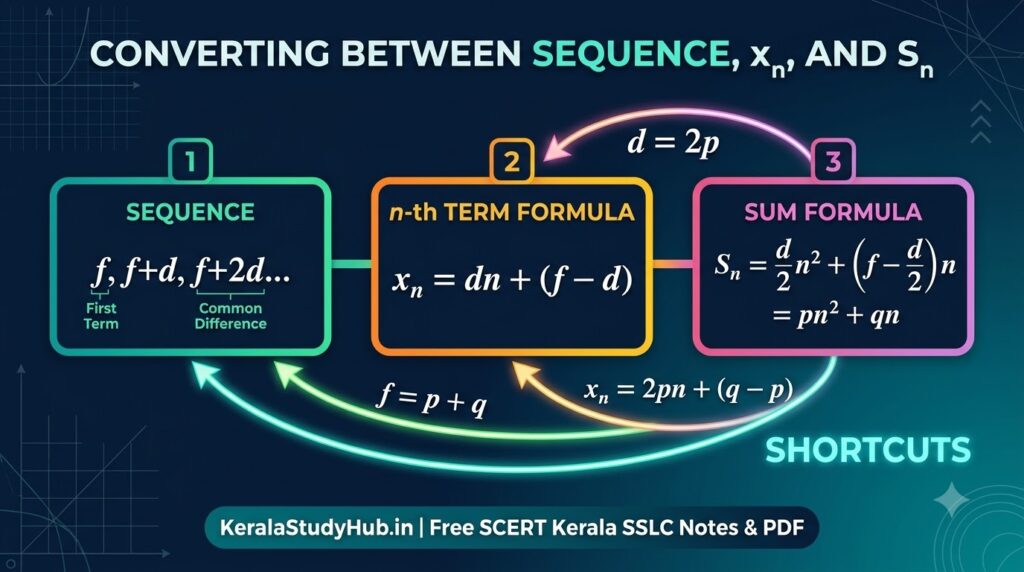
CHAPTER 3 AT A GLANCE: CLASS 10 MATHS (ARITHMETIC SEQUENCES & ALGEBRA) FORMULA BLUEPRINT
- Algebraic Form of
nth Term (ബീജഗണിത രൂപം):xn = f + (n − 1)d = dn + (f − d), which always has the linear formxn = an + b, where:• Common Difference
d = a(the coefficient ofn)• First Term
f = x1 = a + b(sum of coefficients). - Derivation of Sum Formula from
xn = an + b:Sn = a × [n(n + 1) / 2] + bn = (a / 2)n2 + [b + (a / 2)]n. - Standard Sum Form (
Sn = pn2 + qn): The sum of the firstnterms of any arithmetic sequence is always a second-degree expression innwith NO constant term:• First Term
f = x1 = S1 = p + q(sum of coefficients ofn2andn)• Common Difference
d = 2p(twice the coefficient ofn2)• Algebraic Form of
nth Term fromSn:xn = 2pn + (q − p).
1. Algebraic Form of an Arithmetic Sequence (xn = dn + (f − d) = an + b)
In any arithmetic sequence with first term f (or x1) and common difference d, the nth term is obtained by adding (n − 1) times the common difference d to the first term f:
xn = f + (n − 1)d = f + dn − d = dn + (f − d)Writing a = d and b = f − d, we see that the algebraic form of every arithmetic sequence is a first-degree (linear) expression in n of the form xn = an + b. Conversely, any sequence whose nth term is of the form xn = an + b is an arithmetic sequence!
| Arithmetic Sequence | First Term (f) & Common Difference (d) |
Algebraic Form xn = dn + (f − d) |
|---|---|---|
1. Even numbers: 2, 4, 6, 8, ... |
f = 2, d = 2 |
xn = 2n + (2 − 2) = 2n |
2. Odd numbers: 1, 3, 5, 7, ... |
f = 1, d = 2 |
xn = 2n + (1 − 2) = 2n − 1 |
3. Numbers leaving remainder 1 on division by 3: 4, 7, 10, 13, ... |
f = 4, d = 3 |
xn = 3n + (4 − 3) = 3n + 1 |
4. Decreasing sequence: 50, 46, 42, 38, ... |
f = 50, d = −4 |
xn = −4n + (50 − (−4)) = −4n + 54 (or 54 − 4n) |
5. Fraction sequence: 1/2, 3/4, 1, 5/4, ... |
f = 1/2 = 2/4, d = 1/4 |
xn = (1/4)n + (2/4 − 1/4) = (n + 1) / 4 |
2. Algebraic Form of the Sum of an Arithmetic Sequence (Sn = pn2 + qn)
Suppose the algebraic form of an arithmetic sequence is xn = an + b. Then its first n terms are:
x1 = a(1) + b, x2 = a(2) + b, x3 = a(3) + b, …, xn = a(n) + b.
Adding all n terms together:
Sn = a(1 + 2 + 3 + ... + n) + (b + b + ... + b [n times])Sn = a × [n(n + 1) / 2] + bn = (a / 2)n2 + [b + (a / 2)]n- Key Structural Property of
Sn = pn2 + qn:- The coefficient of
n2(which isp = a / 2 = d / 2) is always half the common difference! Therefore,Common Difference d = 2p. - Putting
n = 1gives the sum of the first 1 term, which is simply the first term itself:First Term f = x1 = S1 = p(1)2 + q(1) = p + q. - Notice that
Sn = pn2 + qnhas NO constant term (if a constant term like+ 5is present inpn2 + qn + cwithc ≠ 0, it is NOT the sum of an arithmetic sequence from the first term!). - Instant Exam Shortcut (
Sn → xn): IfSn = pn2 + qn, thend = 2pandf = p + q, so:
xn = dn + (f − d) = 2pn + (q − p).
- The coefficient of
3. Complete Textbook Solutions & Extra Exam Questions (16 Fully Solved Q&As)
Part A: SCERT Kerala Textbook Exercise Problems (Step-by-Step Solutions)
Q1 (Textbook Problem — Writing Algebraic Forms of Sequences): Write the algebraic form (xn) of each of the following arithmetic sequences:
(i) 1, 6, 11, 16, ... | (ii) 10, 22, 34, 46, ... | (iii) 25, 21, 17, 13, ... | (iv) 1/3, 2/3, 1, 4/3, ...
Answer: Using xn = dn + (f − d):
• (i) 1, 6, 11, 16, ...: Here f = 1, d = 6 − 1 = 5.
xn = 5n + (1 − 5) = 5n − 4.
• (ii) 10, 22, 34, 46, ...: Here f = 10, d = 22 − 10 = 12.
xn = 12n + (10 − 12) = 12n − 2.
• (iii) 25, 21, 17, 13, ...: Here f = 25, d = 21 − 25 = −4.
xn = −4n + (25 − (−4)) = −4n + 29 (or 29 − 4n).
• (iv) 1/3, 2/3, 1, 4/3, ...: Here f = 1/3, d = 2/3 − 1/3 = 1/3.
xn = (1/3)n + (1/3 − 1/3) = n / 3.
Q2 (Textbook Problem — Algebraic Form from Two Given Terms): The 8th term of an arithmetic sequence is 12 and its 12th term is 8. What is the algebraic expression for this sequence? What is its 20th term?
Answer:
• Given: x8 = 12 and x12 = 8.
• Common difference d = (x12 − x8) / (12 − 8) = (8 − 12) / 4 = −4 / 4 = −1.
• First term f = x8 − 7d = 12 − 7(−1) = 12 + 7 = 19.
• Algebraic form: xn = dn + (f − d) = −1n + (19 − (−1)) = 20 − n (or −n + 20).
• Its 20th term: x20 = 20 − 20 = 0.
Q3 (Textbook Problem — Proving No Perfect Squares in a Sequence): Prove that the arithmetic sequence 5, 8, 11, 14, ... contains NO perfect squares!
Answer:
• In the sequence 5, 8, 11, 14, ..., the first term is f = 5 and common difference is d = 3.
• Every term of this sequence leaves a remainder of 2 when divided by 3 (its algebraic form is xn = 3n + 2).
• Now consider any natural number k:
1. If k = 3m (a multiple of 3), then k2 = 9m2 = 3(3m2), which leaves remainder 0 when divided by 3.
2. If k = 3m + 1 (remainder 1), then k2 = 9m2 + 6m + 1 = 3(3m2 + 2m) + 1, which leaves remainder 1 when divided by 3.
3. If k = 3m + 2 (remainder 2), then k2 = 9m2 + 12m + 4 = 3(3m2 + 4m + 1) + 1, which also leaves remainder 1 when divided by 3.
• Thus, when any perfect square is divided by 3, the remainder can ONLY be 0 or 1—it can never be 2! Therefore, the sequence 5, 8, 11, 14, ... (3n + 2) contains no perfect squares.
Q4 (Textbook Problem — Proving Infinitely Many Squares in 1, 4, 7, 10, ...): Show that the square of any term of the arithmetic sequence 1, 4, 7, 10, ... is also a term of the same sequence.
Answer:
• For the sequence 1, 4, 7, 10, ..., first term f = 1 and common difference d = 3.
• Algebraic form: xn = 3n − 2 (or numbers of the form 3k + 1, leaving remainder 1 when divided by 3).
• Taking the square of any term (3k + 1):
(3k + 1)2 = 9k2 + 6k + 1 = 3(3k2 + 2k) + 1.
• Since 3(3k2 + 2k) + 1 is 1 more than a multiple of 3 (leaves remainder 1 on division by 3), the square of every term of this sequence is also a term of the same sequence!
Q5 (Textbook Problem — Algebraic Expression of Sum from Sequence): Find the sum of the first n terms (Sn) of the arithmetic sequence 4, 11, 18, 25, ... in algebraic form. Also find the sum of its first 20 terms.
Answer:
• Given sequence: 4, 11, 18, 25, ... with f = 4 and d = 11 − 4 = 7.
• Step 1 (Algebraic form of nth term):
xn = dn + (f − d) = 7n + (4 − 7) = 7n − 3.
• Step 2 (Algebraic form of sum Sn):
Sn = 7 × [n(n + 1) / 2] − 3n = (7n2 + 7n − 6n) / 2 = (7n2 + n) / 2 (or (7/2)n2 + (1/2)n).
• Step 3 (Sum of first 20 terms, n = 20):
S20 = [7(20)2 + 20] / 2 = (7 × 400 + 20) / 2 = 2820 / 2 = 1410.
Q6 (Textbook Problem — Recovering Sequence from Sum Formula Sn): The sum of the first n terms of an arithmetic sequence is Sn = 3n2 + 2n. Find: (a) its first term, (b) its common difference, (c) the algebraic form of its nth term, and (d) write the sequence.
Answer: Given Sn = 3n2 + 2n (so p = 3 and q = 2):
• (a) First term (f = x1): Put n = 1:
f = S1 = 3(1)2 + 2(1) = 3 + 2 = 5.
• (b) Common difference (d): Twice the coefficient of n2:
d = 2p = 2 × 3 = 6.
• (c) Algebraic form of nth term (xn):
xn = dn + (f − d) = 6n + (5 − 6) = 6n − 1.
• (d) The Arithmetic Sequence: Putting n = 1, 2, 3, 4... gives 5, 11, 17, 23, ...
Q7 (Textbook Problem — Sum of Terms Given for Two Values of n): The sum of the first 6 terms of an arithmetic sequence is 90 and the sum of the first 10 terms is 230. Find the algebraic form of the sum of the first n terms (Sn) and the algebraic form of the sequence (xn).
Answer:
• We know the sum of the first n terms of any arithmetic sequence has the form Sn = pn2 + qn.
• For n = 6: 36p + 6q = 90 ⇒ dividing by 6 gives 6p + q = 15 — (Equation 1)
• For n = 10: 100p + 10q = 230 ⇒ dividing by 10 gives 10p + q = 23 — (Equation 2)
• Subtracting Equation 1 from Equation 2:
(10p − 6p) = 23 − 15 ⇒ 4p = 8 ⇒ p = 2.
• Substituting p = 2 into Equation 1: 6(2) + q = 15 ⇒ 12 + q = 15 ⇒ q = 3.
• Therefore, the algebraic form of the sum is Sn = 2n2 + 3n.
• First term f = p + q = 2 + 3 = 5; Common difference d = 2p = 4.
• Algebraic form of the sequence: xn = 4n + (5 − 4) = 4n + 1.
Q8 (Textbook Problem — Equal Sums of First m and First n Terms): If the sum of the first 12 terms of an arithmetic sequence is equal to the sum of its first 18 terms (S12 = S18), prove that the sum of its first 30 terms is 0 (S30 = 0)!
Answer:
• Let the sum of the first n terms be Sn = pn2 + qn.
• Given S12 = S18:
p(12)2 + 12q = p(18)2 + 18q
144p + 12q = 324p + 18q
−6q = 324p − 144p = 180p ⇒ q = −30p.
• Therefore, Sn = pn2 − 30pn = pn(n − 30).
• Putting n = 30 gives:
S30 = p(30)(30 − 30) = 30p × 0 = 0! Hence proved.
• General Classroom Rule: Whenever Sm = Sn (with m ≠ n) in an arithmetic sequence, the sum of the first (m + n) terms is ALWAYS zero: Sm+n = 0!
Q9 (Textbook Problem — Matchstick Grid Pattern & Algebra): Look at a sequence of grid squares: a 1×1 square uses 4 matchsticks, a 1×2 grid of 2 squares uses 7 matchsticks, a 1×3 grid of 3 squares uses 10 matchsticks, and so on. Write the algebraic form for the number of matchsticks needed to make n squares in a row. Can we make an exact grid of squares using all 100 matchsticks?
Answer:
• Sequence of matchsticks: 4, 7, 10, 13, ... with f = 4 and d = 3.
• Algebraic form for n squares: xn = 3n + (4 − 3) = 3n + 1.
• To check whether 100 matchsticks can make an exact number of squares, set 3n + 1 = 100:
3n = 99 ⇒ n = 99 / 3 = 33 squares.
• Since n = 33 is a whole natural number, yes, we can make exactly 33 connected squares using all 100 matchsticks!
Q10 (Textbook Problem — Sum of Consecutive Terms Starting from Any Term): The algebraic form of an arithmetic sequence is xn = 4n + 3. Find: (a) the sum of its first 15 terms, and (b) the sum of the 10 consecutive terms from the 16th term to the 25th term.
Answer:
• (a) Sum of first 15 terms (S15):
S15 = 4 × [15 × 16 / 2] + 3(15) = (4 × 120) + 45 = 480 + 45 = 525.
• (b) Sum from 16th term to 25th term:
– Method 1: x16 = 4(16) + 3 = 67 and x25 = 4(25) + 3 = 103. For these 10 terms:
Sum = (10 / 2) × (67 + 103) = 5 × 170 = 850.
– Method 2: S25 − S15 = [4(25 × 26 / 2) + 3(25)] − 525 = (1300 + 75) − 525 = 1375 − 525 = 850.
Part B: Additional High-Weightage SSLC Exam Questions & Answers
Q11 (Extra Exam Question — Modifying Sn to Get Another Sequence): The sum of the first n terms of an arithmetic sequence is 4n2 + 3n. What is its common difference? What is the algebraic expression for the sum of the first n terms of another arithmetic sequence having the SAME common difference, but starting with first term 10?
Answer:
• Given Sn = 4n2 + 3n (p = 4, q = 3).
• Common difference d = 2p = 2 × 4 = 8.
• Any arithmetic sequence with the same common difference d = 8 must have the same n2 coefficient p = d / 2 = 4 in its sum formula: S'n = 4n2 + q'n.
• Since the new first term is f' = 10, we must have p + q' = 10 ⇒ 4 + q' = 10 ⇒ q' = 6.
• Therefore, the sum of the first n terms of the new sequence is S'n = 4n2 + 6n.
Q12 (Extra Exam Question — Testing Whether pn2 + qn + c Can Be an Arithmetic Sequence Sum): Can 2n2 + 5n + 3 be the algebraic form of the sum of the first n terms of an arithmetic sequence? Explain why or why not.
Answer:
• No! The algebraic form of the sum of the first n terms of any arithmetic sequence is always of the form Sn = pn2 + qn, which has no non-zero constant term (because when n = 1, x1 = S1 and for n ≥ 2, xn = Sn − Sn−1).
• If Sn = 2n2 + 5n + 3, then:
– x1 = S1 = 2(1) + 5(1) + 3 = 10
– S2 = 2(4) + 5(2) + 3 = 21 ⇒ x2 = S2 − S1 = 21 − 10 = 11
– S3 = 2(9) + 5(3) + 3 = 36 ⇒ x3 = S3 − S2 = 36 − 21 = 15
• The terms are 10, 11, 15, ... where x2 − x1 = 1 but x3 − x2 = 4. Because of the extra constant + 3, the first term breaks the pattern, so it is not an arithmetic sequence.
Q13 (Extra Exam Question — Ratio of Sums of Two Arithmetic Sequences): The ratio of the sums of the first n terms of two arithmetic sequences is (2n + 1) : (2n − 1). Find the ratio of their 10th terms.
Answer:
• Given: Sn / S'n = (2n + 1) / (2n − 1) = (2n2 + n) / (2n2 − n) (multiplying numerator and denominator by n).
• For Sequence 1 (Sn = 2n2 + n): f = 2 + 1 = 3, d = 2(2) = 4 ⇒ xn = 4n − 1.
• For Sequence 2 (S'n = 2n2 − n): f' = 2 − 1 = 1, d' = 2(2) = 4 ⇒ x'n = 4n − 3.
• Putting n = 10 (or using the middle-term rule for 2(10) − 1 = 19 terms):
x10 / x'10 = [4(10) − 1] / [4(10) − 3] = 39 / 37 (i.e., 39 : 37).
Q14 (Extra Exam Question — Sum of Multiples of 3 Plus 2): Write the algebraic expression for the sum of the first n terms of the sequence of natural numbers which leave a remainder of 2 when divided by 5 (starting with 2).
Answer:
• Sequence: 2, 7, 12, 17, ... with f = 2 and d = 5.
• Algebraic form of nth term: xn = 5n + (2 − 5) = 5n − 3.
• Algebraic form of sum of first n terms:
Sn = 5 × [n(n + 1) / 2] − 3n = (5n2 + 5n − 6n) / 2 = (5n2 − n) / 2.
Q15 (Extra Exam Question — Finding Which Term Equals a Given Number): In the arithmetic sequence with algebraic form xn = 8n − 5, which term is 235? Also find the sum of all terms up to 235.
Answer:
• Set xn = 8n − 5 = 235:
8n = 235 + 5 = 240 ⇒ n = 240 / 8 = 30th term.
• First term x1 = 8(1) − 5 = 3; 30th term x30 = 235.
• Sum of the first 30 terms:
S30 = (30 / 2) × (3 + 235) = 15 × 238 = 3570.
Q16 (Extra Exam Question — Proving S3n = 3(S2n − Sn)): For any arithmetic sequence, prove that the sum of the first 3n terms is three times the difference between the sum of the first 2n terms and the sum of the first n terms: S3n = 3(S2n − Sn).
Answer:
• Let Sk = pk2 + qk.
• Then:
– Sn = pn2 + qn
– S2n = p(2n)2 + q(2n) = 4pn2 + 2qn
– S3n = p(3n)2 + q(3n) = 9pn2 + 3qn
• Now compute the right-hand side 3(S2n − Sn):
3 × [(4pn2 + 2qn) − (pn2 + qn)] = 3 × (3pn2 + qn) = 9pn2 + 3qn = S3n. Hence proved!
4. Malayalam Medium Quick Revision Notes (സമാന്തരശ്രേണിയും ബീജഗണിതവും – മലയാളം നോട്ടുകൾ)
- സമാന്തരശ്രേണിയുടെ ബീജഗണിത രൂപം (Algebraic Form of
nth Term): ആദ്യപദംf-ഉം പൊതുവ്യത്യാസംd-യും ആയ സമാന്തരശ്രേണിയുടെn-ാം പദം:
xn = f + (n − 1)d = dn + (f − d).
ഇതിനെ പൊതുവായിxn = an + bഎന്ന് എഴുതാം. ഇവിടെn-ന്റെ ഗുണോത്തരം (Coefficient ofn) ആയa= പൊതുവ്യത്യാസം (d) ആണ്; കൂടാതെ ആദ്യപദംf = a + bആയിരിക്കും. - തുകയുടെ ബീജഗണിത രൂപം (Algebraic Form of Sum
Sn): ഏതൊരു സമാന്തരശ്രേണിയുടെയും ആദ്യത്തെnപദങ്ങളുടെ തുകSn = pn2 + qnഎന്ന രൂപത്തിലായിരിക്കും (ഇതിൽ സ്ഥിരസംഖ്യ / Constant term ഉണ്ടായിരിക്കില്ല).- ആദ്യപദം (First Term
f = x1):f = p + q(ഗുണോത്തരങ്ങളുടെ തുക) - പൊതുവ്യത്യാസം (Common Difference
d):d = 2p(n2-ന്റെ ഗുണോത്തരത്തിന്റെ ഇരട്ടി) n-ാം പദം (xn):xn = 2pn + (q − p).
- ആദ്യപദം (First Term
Teacher’s Classroom Note & Student Discussion Question:
In your SSLC Public Exam, you can solve any Sn = pn2 + qn question in 5 seconds flat using our classroom shortcut: double the n2 coefficient to get d = 2p, and add the two coefficients to get the first term f = p + q!
Quick Challenge for You (Drop Your Answer in the Comments Below!): If the sum of the first n terms of an arithmetic sequence is Sn = 5n2 + 4n, what is its first term (f) and what is its common difference (d)? Write your answers in the comments!





Latest SCERT & DHSE Kerala Study Notes
- Kerala Class 9 Physics Chapter 2 Notes: Equations of Motion (ചലനസമവാക്യങ്ങൾ) Std 9 Let Us Assess Questions and Answers PDF
- Kerala SSLC Christmas Exam Question Paper 2025-27: All Subjects Second Term & Model Question Papers with Solved Answer Keys PDF (New SCERT Syllabus)
- Kerala SSLC English Christmas Exam Question Paper 2025-27: Second Term & Model Solved 80-Mark Answer Key, Discourses & Grammar PDF
- Kerala SSLC Social Science Christmas Exam Question Paper 2025-27: Second Term & Model Solved 80-Mark Answer Key, Weightage & Map Study PDF
- Kerala SSLC Maths Christmas Exam Question Paper 2025-27: Second Term & Model Solved Answer Key, Weightage & Formula Sheet PDF (New SCERT Syllabus)
- Kerala SSLC Biology Christmas Exam Question Paper 2025-27: Second Term & Model Solved Answer Key, Weightage & Flowcharts PDF (New SCERT Syllabus)
- Kerala SSLC Chemistry Christmas Exam Question Paper 2025-27: Second Term & Model Solved Answer Key, Weightage & Sure A+ Questions PDF (New SCERT Syllabus)
- Kerala SSLC Physics Christmas Exam Question Paper 2025-27: Second Term & Model Solved Answer Key, Weightage & Formula Sheet PDF (New SCERT Syllabus)