

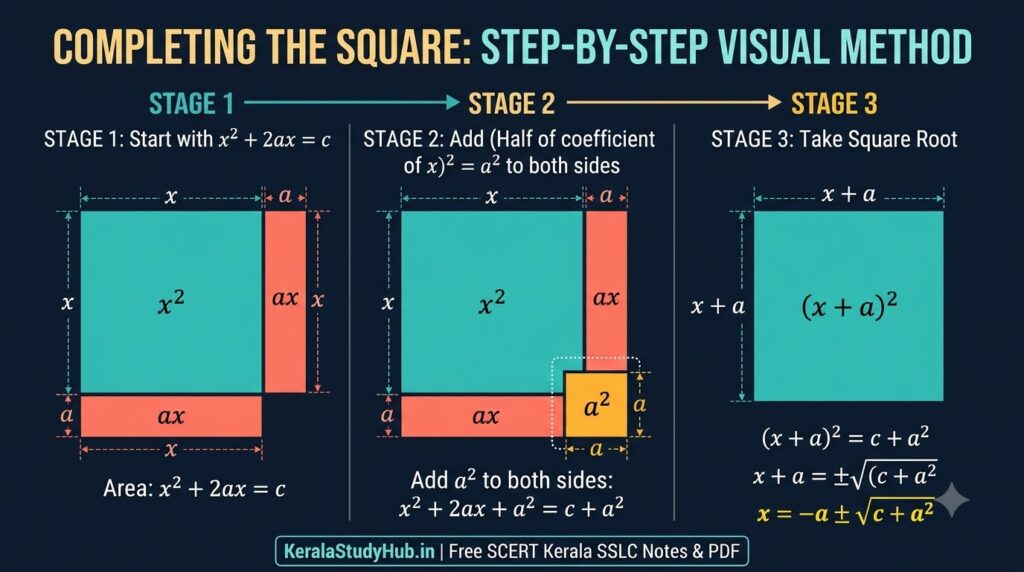
Kerala SSLC Maths Chapter 5 Notes on Second Degree Equations (Malayalam Medium: രണ്ടാംകൃതി സമവാക്യങ്ങൾ) welcome you to the fifth chapter of the newly revised Class 10 (Std 10) Mathematics textbook published by the State Council of Educational Research and Training (SCERT Kerala). In my classroom, when we begin this chapter, I draw a square of side x extended by two rectangles of width a on the blackboard and ask my students: “To turn the L-shaped region x2 + 2ax into a complete larger square of side (x + a), what small corner piece is missing? It is a small square of area a2! And why does the new 2025 textbook teach ‘Completing the Square’ here in Chapter 5, while saving the general quadratic formula for Chapter 9?”
- 1. Completing the Square Method (വർഗ്ഗം തികയ്ക്കൽ രീതി) & Standard Word-Problem Models
- 2. Complete Textbook Solutions & Extra Exam Questions (16 Fully Solved Q&As)
- Part A: SCERT Kerala Textbook Exercise Problems (Step-by-Step Solutions)
- Part B: Additional High-Weightage SSLC Exam Questions & Answers
- 3. Malayalam Medium Quick Revision Notes (രണ്ടാംകൃതി സമവാക്യങ്ങൾ – മലയാളം നോട്ടുകൾ)
Prepared strictly for the Kerala Pareeksha Bhavan SSLC Public Examination (carrying 7 marks in Chapter 5, plus 4 marks in Chapter 9: Polynomials and Equations), this complete classroom study guide covers the Completing the Square Method (വർഗ്ഗം തികയ്ക്കൽ രീതി), Rectangle Perimeter & Area Word Problems, Right-Triangle & Frame Problems, Number & Age Problems, Arithmetic Sequence Sum Problems, and 16 Step-by-Step Solved Textbook & Exam Questions and Answers.
Quick SSLC Mathematics Navigation: SSLC Maths All 13 Chapters Master Hub | Previous: Chapter 4: Mathematics of Chance | Next: Chapter 6: Trigonometry | Related: Chapter 9: Polynomials and Equations.
CHAPTER 5 AT A GLANCE: CLASS 10 MATHS (SECOND DEGREE EQUATIONS) FORMULA BLUEPRINT
- Completing the Square Identity (വർഗ്ഗം തികയ്ക്കൽ):
•
x2 + 2ax + a2 = (x + a)2andx2 − 2ax + a2 = (x − a)2.• Golden Rule: To make
x2 + bxa perfect square, add the square of half the coefficient ofx, which is(b / 2)2:x2 + bx + (b / 2)2 = [x + (b / 2)]2. - Two Square Roots of a Positive Number: Every positive number
khas two square roots:+√kand−√k. For geometric lengths, sides, or counts of natural numbers, we take only the positive solution; for pure algebraic or integer problems, we check both solutions! - Rectangle Perimeter & Area Shortcut:
•
Perimeter = 2(Length + Breadth)⇒Length + Breadth = Perimeter / 2(Half of perimeter!).• If
Length − Breadth = 2d, take the sides as(x + d)and(x − d)so their product is immediately(x + d)(x − d) = x2 − d2! - Number of Diagonals of an
n-Sided Polygon:D = n(n − 3) / 2.
1. Completing the Square Method (വർഗ്ഗം തികയ്ക്കൽ രീതി) & Standard Word-Problem Models
In the new SCERT Class 10 syllabus, Chapter 5 focuses on translating real-life geometric and numerical problems into a second-degree equation of the form x2 + 2ax = c (or x2 − 2ax = c) and solving it by adding a2 to both sides to complete the square:
| Problem Type | How to Choose Variable x (Smart Classroom Choice) |
Resulting Equation |
|---|---|---|
1. Product of two numbers differing by 2a is P |
Let the numbers be (x − a) and (x + a) (or x and x + 2a) |
(x + a)(x − a) = x2 − a2 = P (or x2 + 2ax = P) |
2. Rectangle of given Perimeter 2S and Area A |
Length + Breadth = S. Take sides as x and (S − x), or centered at average m = S / 2 as (m + x) and (m − x) |
x(S − x) = A or m2 − x2 = A ⇒ x2 = m2 − A |
3. Uniform strip / path of width x around a rectangle of dimensions L × B |
Outer length = L + 2x; Outer breadth = B + 2x |
(L + 2x)(B + 2x) = Total Outer Area |
4. Right-angled triangle with given hypotenuse H and side difference/sum |
Let perpendicular sides be x and (x + d) |
By Pythagoras Theorem: x2 + (x + d)2 = H2 |
5. Sum of first n terms of an Arithmetic Sequence equals S |
Use Sn = pn2 + qn = S, divide by p, and complete the square in n |
n2 + (q / p)n = S / p |
2. Complete Textbook Solutions & Extra Exam Questions (16 Fully Solved Q&As)
Part A: SCERT Kerala Textbook Exercise Problems (Step-by-Step Solutions)
Q1 (Textbook Problem — Square Extended on One Side): When each side of a square was reduced by 2 metres, the area became 49 square metres. What was the length of a side of the original square? What if 1 metre is added to one side of a square and 1 metre is subtracted from the adjacent side to form a rectangle of area 48 square metres?
Answer:
• Part 1 (Square reduced by 2 m on each side): Let the original side be x metres. Then:
(x − 2)2 = 49 ⇒ x − 2 = √49 = 7 (taking positive length).
Therefore, original side x = 7 + 2 = 9 metres.
• Part 2 (Sides x + 1 and x − 1 with area 48 m2):
(x + 1)(x − 1) = 48 ⇒ x2 − 1 = 48 ⇒ x2 = 49 ⇒ x = 7 metres.
Q2 (Textbook Problem — Uniform Strip Added to a Square): A 2-metre wide strip is added along two adjacent sides of a square (and the small 2×2 corner square is filled in), increasing the total area by 44 square metres. Find the side of the original square. What if the total area of the new square is 144 square metres?
Answer:
• Let the side of the original square be x metres. Then the side of the enlarged square is (x + 2) metres.
• Case 1 (Area increases by 44 m2):
(x + 2)2 − x2 = 44 ⇒ (x2 + 4x + 4) − x2 = 44 ⇒ 4x + 4 = 44 ⇒ 4x = 40 ⇒ x = 10 metres.
• Case 2 (Total new area is 144 m2):
(x + 2)2 = 144 ⇒ x + 2 = 12 ⇒ x = 10 metres.
Q3 (Textbook Problem — Completing the Square in Rectangle Area): One side of a rectangle is 6 metres longer than the other side, and its area is 216 square metres. Find the lengths of its sides by completing the square.
Answer:
• Method 1 (Completing the Square): Let the shorter side be x metres; then the longer side is (x + 6) metres.
x(x + 6) = 216 ⇒ x2 + 6x = 216.
Add the square of half the coefficient of x, i.e. (6 / 2)2 = 32 = 9, to both sides:
x2 + 6x + 9 = 216 + 9
(x + 3)2 = 225 ⇒ x + 3 = √225 = 15 ⇒ x = 15 − 3 = 12 metres.
Longer side = 12 + 6 = 18 metres.
• Method 2 (Symmetric Midpoint Trick): Let the sides be (y − 3) and (y + 3). Then y2 − 9 = 216 ⇒ y2 = 225 ⇒ y = 15. Sides are 15 − 3 = 12 m and 15 + 3 = 18 m!
Q4 (Textbook Problem — Two Solutions for Integer / Number Problems): A number multiplied by 8 more than itself gives 105. What are all such possible numbers (both positive and negative)?
Answer:
• Let the number be x. Then the other number is (x + 8).
• Given: x(x + 8) = 105 ⇒ x2 + 8x = 105.
• Adding (8 / 2)2 = 42 = 16 to both sides to complete the square:
x2 + 8x + 16 = 105 + 16
(x + 4)2 = 121.
• Since the question asks for a general number (not a geometric length), we take both square roots (+11 and −11):
1. If x + 4 = 11, then x = 11 − 4 = 7 (and x + 8 = 15; check: 7 × 15 = 105).
2. If x + 4 = −11, then x = −11 − 4 = −15 (and x + 8 = −7; check: (−15) × (−7) = 105).
• Thus, the required number can be 7 or −15!
Q5 (Textbook Problem — Product of Two Consecutive Odd / Even Numbers): The product of two consecutive odd numbers is 323. Find the numbers (consider both positive and negative odd integers).
Answer:
• Two consecutive odd numbers differ by 2, so they lie on either side of the even number x between them: let the numbers be (x − 1) and (x + 1).
• Product: (x − 1)(x + 1) = 323 ⇒ x2 − 1 = 323 ⇒ x2 = 324.
• Taking square roots: x = +18 or x = −18.
– When x = 18, the odd numbers are 17 and 19.
– When x = −18, the odd numbers are −19 and −17.
• Answer: 17, 19 or −19, −17.
Q6 (Textbook Problem — Rectangle with Given Perimeter and Area): The perimeter of a rectangle is 40 centimetres and its area is 96 square centimetres. Find the lengths of its sides. Can a rectangle of perimeter 40 cm have an area of 105 cm2? Why?
Answer:
• Given: Perimeter = 2(Length + Breadth) = 40 cm ⇒ Length + Breadth = 20 cm.
• Half of 20 is 10. So let the length be (10 + x) and the breadth be (10 − x).
• Part 1 (Area = 96 cm2):
(10 + x)(10 − x) = 96 ⇒ 100 − x2 = 96 ⇒ x2 = 100 − 96 = 4 ⇒ x = 2.
Therefore, the sides of the rectangle are 10 + 2 = 12 cm and 10 − 2 = 8 cm.
• Part 2 (Can Area = 105 cm2?):
Since Area = 100 − x2 and x2 ≥ 0, the maximum possible area for perimeter 40 cm is 100 cm2 (when x = 0, a square of side 10 cm!). Setting 100 − x2 = 105 gives x2 = −5, which is impossible for a real number x. So no such rectangle exists.
Q7 (Textbook Problem — Uniform Path Around a Rectangular Pond / Garden): A rectangular pond has length 20 metres and breadth 12 metres. A path of uniform width is built all around it, and the total area of the pond and the path together is 560 square metres. Find the width of the path.
Answer:
• Let the width of the path be x metres.
• Since the path runs on both ends of the length and both ends of the breadth:
Outer Length = 20 + 2x and Outer Breadth = 12 + 2x.
• Given total outer area = 560 m2:
(20 + 2x)(12 + 2x) = 560
2(10 + x) × 2(6 + x) = 560 ⇒ 4(x + 10)(x + 6) = 560.
• Dividing both sides by 4:
(x + 10)(x + 6) = 140 ⇒ x2 + 16x + 60 = 140 ⇒ x2 + 16x = 80.
• Completing the square by adding (16 / 2)2 = 82 = 64 to both sides:
x2 + 16x + 64 = 80 + 64 = 144
(x + 8)2 = 144 ⇒ x + 8 = 12 ⇒ x = 12 − 8 = 4 metres.
• Therefore, the width of the path is 4 metres.
Q8 (Textbook Problem — Right-Angled Triangle Pythagoras Equation): The hypotenuse of a right-angled triangle is 13 cm, and the difference between its other two perpendicular sides is 7 cm. Find the lengths of the two perpendicular sides.
Answer:
• Let the shorter perpendicular side be x cm; then the longer perpendicular side is (x + 7) cm.
• By Pythagoras Theorem: Base2 + Altitude2 = Hypotenuse2:
x2 + (x + 7)2 = 132
x2 + x2 + 14x + 49 = 169
2x2 + 14x = 120.
• Dividing both sides by 2:
x2 + 7x = 60 (or multiply by 4 to avoid fractions: 4x2 + 28x = 240 ⇒ (2x + 7)2 = 240 + 49 = 289 ⇒ 2x + 7 = 17 ⇒ 2x = 10 ⇒ x = 5).
• Therefore, the two perpendicular sides are 5 cm and 5 + 7 = 12 cm.
Q9 (Textbook Problem — How Many Terms of an Arithmetic Sequence Give a Specified Sum?): How many consecutive terms of the arithmetic sequence 5, 9, 13, 17, ... starting from the first term must be added to get a sum of 275?
Answer:
• For the sequence 5, 9, 13, 17, ..., first term f = 5 and common difference d = 4.
• Using our Chapter 3 sum formula Sn = pn2 + qn where p = d / 2 = 2 and q = f − p = 5 − 2 = 3:
Sn = 2n2 + 3n = 275.
• Multiply both sides by 8 (which is 4p = 4 × 2, a neat classroom trick to complete the square without fractions!):
16n2 + 24n = 2200
(4n)2 + 2(4n)(3) + 32 = 2200 + 9 = 2209
(4n + 3)2 = 2209 ⇒ 4n + 3 = √2209 = 47.
• Therefore, 4n = 47 − 3 = 44 ⇒ n = 44 / 4 = 11 terms!
Q10 (Textbook Problem — Cutting Four Squares from Corners to Make an Open Box): From the four corners of a rectangular sheet of tin of length 24 cm and breadth 18 cm, four equal squares of side x cm are cut off and the flaps are folded up to make an open rectangular box. If the base area of the box is 280 cm2, find the side x of the cut-out squares.
Answer:
• When a square of side x cm is cut from each corner, both the length and breadth of the base decrease by 2x:
Base Length = 24 − 2x and Base Breadth = 18 − 2x.
• Given Base Area = 280 cm2:
(24 − 2x)(18 − 2x) = 280
4(12 − x)(9 − x) = 280 ⇒ (12 − x)(9 − x) = 70.
• Expanding: 108 − 21x + x2 = 70 ⇒ x2 − 21x = −38.
• Multiplying by 4 to complete the square cleanly: 4x2 − 84x = −152.
• Adding 212 = 441 to both sides:
(2x − 21)2 = 441 − 152 = 289 ⇒ 2x − 21 = ±17.
• Thus 2x = 21 + 17 = 38 ⇒ x = 19 (impossible, since breadth is only 18 cm!) or 2x = 21 − 17 = 4 ⇒ x = 2 cm.
• Therefore, the side of each cut-out corner square is 2 cm.
Part B: Additional High-Weightage SSLC Exam Questions & Answers
Q11 (Extra Exam Question — Number of Diagonals of a Polygon): How many sides does a polygon have if it has 54 diagonals?
Answer:
• The number of diagonals of an n-sided polygon is n(n − 3) / 2.
• Given: n(n − 3) / 2 = 54 ⇒ n2 − 3n = 108.
• Multiplying by 4 and adding 32 = 9 to complete the square:
4n2 − 12n + 9 = 432 + 9 = 441
(2n − 3)2 = 441 ⇒ 2n − 3 = √441 = 21 ⇒ 2n = 24 ⇒ n = 12 sides.
Q12 (Extra Exam Question — Sum of a Number and Its Reciprocal): The sum of a positive number and its reciprocal is 25 / 12. Find the number.
Answer:
• Let the number be x. Given: x + (1 / x) = 25 / 12.
• Multiplying throughout by 12x:
12x2 + 12 = 25x ⇒ 12x2 − 25x = −12.
• Divide by 12 (or multiply by 4 × 12 = 48):
(24x − 25)2 = 252 − 48(12) = 625 − 576 = 49 ⇒ 24x − 25 = ±7.
• Thus 24x = 25 + 7 = 32 ⇒ x = 32 / 24 = 4 / 3, or 24x = 25 − 7 = 18 ⇒ x = 18 / 24 = 3 / 4.
Q13 (Extra Exam Question — Father & Son Age Problem): The product of the ages of a person 5 years ago and 5 years from now is 75. Find his present age.
Answer:
• Let his present age be x years.
• Age 5 years ago = (x − 5); Age 5 years from now = (x + 5).
• Given: (x − 5)(x + 5) = 75 ⇒ x2 − 25 = 75 ⇒ x2 = 100 ⇒ x = 10 years.
Q14 (Extra Exam Question — Cross-Roads Inside a Rectangular Park): A rectangular park has length 30 m and breadth 20 m. Two crossroads of uniform width x metres run parallel to its sides through the center. If the remaining lawn area is 504 m2, find the width x of the roads.
Answer:
• Shifting the two crossroads to the edges leaves a single rectangular lawn of length (30 − x) m and breadth (20 − x) m!
• Therefore, (30 − x)(20 − x) = 504
600 − 50x + x2 = 504 ⇒ x2 − 50x = −96.
• Completing the square by adding 252 = 625 to both sides:
x2 − 50x + 625 = 625 − 96 = 529
(x − 25)2 = 529 ⇒ x − 25 = ±23.
• Since x < 20, we take x − 25 = −23 ⇒ x = 25 − 23 = 2 metres!
Q15 (Extra Exam Question — Chord Intersection & Second Degree Equation): In a circle, two chords AB and CD intersect at P. Given PA = 8 cm, PB = 6 cm, and total length of chord CD = 16 cm, find the lengths of PC and PD.
Answer:
• Since PC + PD = 16 cm, let PC = 8 + x and PD = 8 − x.
• By the Intersecting Chords Theorem (PC × PD = PA × PB):
(8 + x)(8 − x) = 8 × 6 = 48
64 − x2 = 48 ⇒ x2 = 64 − 48 = 16 ⇒ x = 4.
• Therefore, the two parts of chord CD are 8 + 4 = 12 cm and 8 − 4 = 4 cm!
Q16 (Extra Exam Question — Fencing a Rectangular Plot Along a Compound Wall): A person uses 36 metres of wire netting to fence three sides of a rectangular garden, using an existing straight compound wall as the fourth side. If the area of the garden is 160 square metres, find the dimensions of the garden.
Answer:
• Let each of the two sides perpendicular to the wall be x metres. Then the side parallel to the wall is (36 − 2x) metres.
• Area: x(36 − 2x) = 160 ⇒ 36x − 2x2 = 160 ⇒ x2 − 18x = −80.
• Adding 92 = 81 to both sides:
x2 − 18x + 81 = 81 − 80 = 1 ⇒ (x − 9)2 = 1 ⇒ x − 9 = ±1.
• Thus x = 10 m (giving parallel side 36 − 20 = 16 m) or x = 8 m (giving parallel side 36 − 16 = 20 m).
• Dimensions: 16 m × 10 m or 20 m × 8 m.
3. Malayalam Medium Quick Revision Notes (രണ്ടാംകൃതി സമവാക്യങ്ങൾ – മലയാളം നോട്ടുകൾ)
- വർഗ്ഗം തികയ്ക്കൽ രീതി (Completing the Square Method):
x2 + 2axഎന്ന ബീജഗണിത രൂപത്തിനോട്x-ന്റെ ഗുണോത്തരത്തിന്റെ പകുതിയുടെ വർഗ്ഗമായa2കൂട്ടിയാൽ അതൊരു പൂർണ്ണവർഗ്ഗമായി മാറുന്നു:
x2 + 2ax + a2 = (x + a)2|x2 − 2ax + a2 = (x − a)2. - ചതുരത്തിന്റെ ചുറ്റളവും പരപ്പളവും (Rectangle Perimeter & Area):
ചുറ്റളവ് (Perimeter) = 2 × (നീളം + വീതി)⇒നീളം + വീതി = ചുറ്റളവിന്റെ പകുതി.- രണ്ടു സംഖ്യകളുടെ തുക
2mആയാൽ സംഖ്യകളെ(m + x),(m − x)എന്ന് എടുക്കാം. രണ്ടു സംഖ്യകളുടെ വ്യത്യാസം2dആയാൽ സംഖ്യകളെ(x + d),(x − d)എന്ന് എടുക്കാം; അപ്പോൾ ഗുണനഫലംx2 − d2ആയിരിക്കും!
- ബഹുഭുജത്തിലെ വികർണ്ണങ്ങളുടെ എണ്ണം (Diagonals of a Polygon):
nവശങ്ങളുള്ള ഒരു ബഹുഭുജത്തിലെ ആകെ വികർണ്ണങ്ങളുടെ എണ്ണം =n(n − 3) / 2.
Teacher’s Classroom Note & Student Discussion Question:
When a question says “The perimeter of a rectangle is 60 cm”, never write x and 60 − x as its sides! Always divide the perimeter by 2 first: Length + Breadth = 60 / 2 = 30 cm, and then use (15 + x) and (15 − x)!
Quick Challenge for You (Drop Your Answer in the Comments Below!): What number must be added to x2 + 10x to make it a perfect square? Write the number and the resulting squared expression in the comments!


Latest SCERT & DHSE Kerala Study Notes
- Kerala Class 9 Physics Chapter 2 Notes: Equations of Motion (ചലനസമവാക്യങ്ങൾ) Std 9 Let Us Assess Questions and Answers PDF
- Kerala SSLC Christmas Exam Question Paper 2025-27: All Subjects Second Term & Model Question Papers with Solved Answer Keys PDF (New SCERT Syllabus)
- Kerala SSLC English Christmas Exam Question Paper 2025-27: Second Term & Model Solved 80-Mark Answer Key, Discourses & Grammar PDF
- Kerala SSLC Social Science Christmas Exam Question Paper 2025-27: Second Term & Model Solved 80-Mark Answer Key, Weightage & Map Study PDF
- Kerala SSLC Maths Christmas Exam Question Paper 2025-27: Second Term & Model Solved Answer Key, Weightage & Formula Sheet PDF (New SCERT Syllabus)
- Kerala SSLC Biology Christmas Exam Question Paper 2025-27: Second Term & Model Solved Answer Key, Weightage & Flowcharts PDF (New SCERT Syllabus)
- Kerala SSLC Chemistry Christmas Exam Question Paper 2025-27: Second Term & Model Solved Answer Key, Weightage & Sure A+ Questions PDF (New SCERT Syllabus)
- Kerala SSLC Physics Christmas Exam Question Paper 2025-27: Second Term & Model Solved Answer Key, Weightage & Formula Sheet PDF (New SCERT Syllabus)