
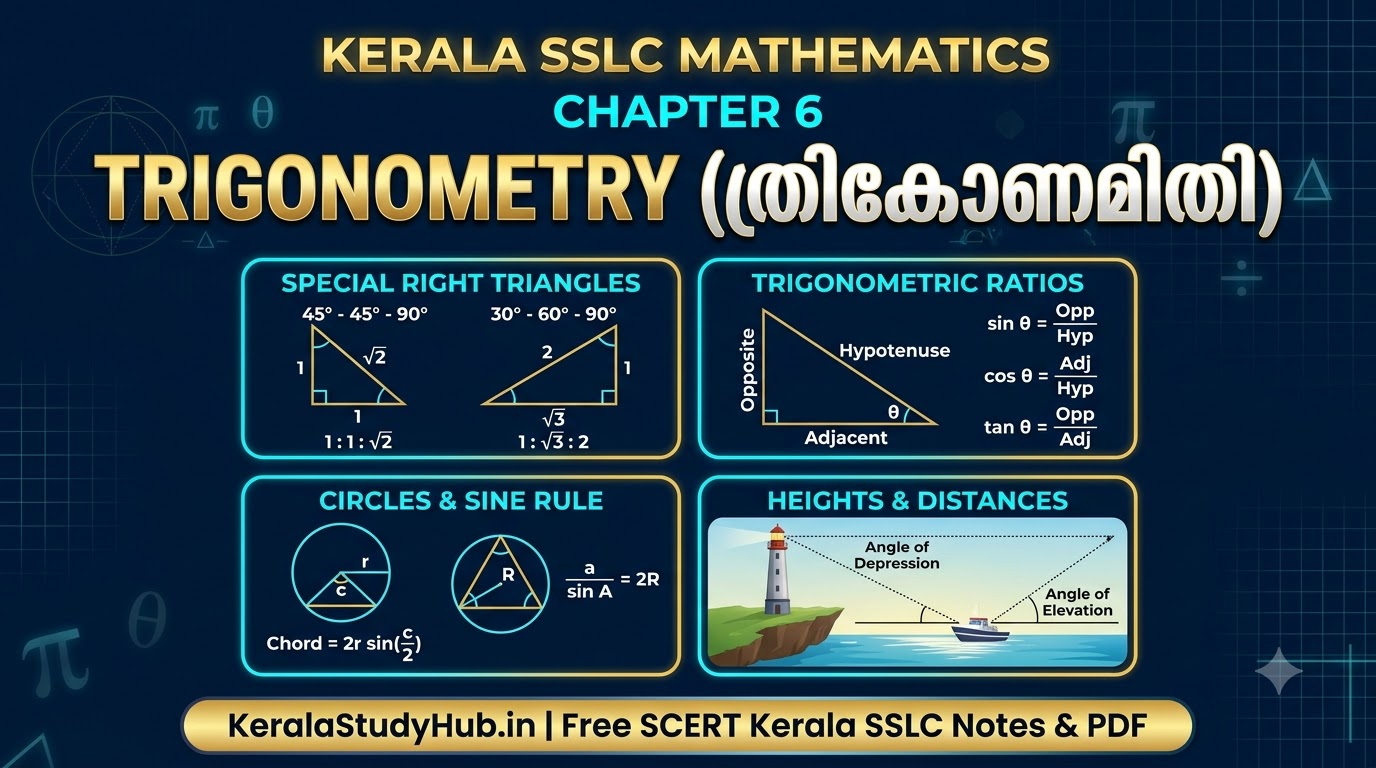
Kerala SSLC Maths Chapter 6 Notes on Trigonometry (Malayalam Medium: ത്രികോണമിതി) welcome you to the sixth chapter of the newly revised Class 10 (Std 10) Mathematics textbook published by the State Council of Educational Research and Training (SCERT Kerala). In my classroom, when we start Trigonometry, I hold up the two set-squares from a student’s geometry box and ask: “Why do all 45°–45°–90° triangles—whether tiny on your notebook or huge on a playground—have their sides in the exact ratio 1 : 1 : √2, and why do all 30°–60°–90° triangles have their sides in the ratio 1 : √3 : 2?”
- 1. Special Right-Triangle Ratios & Standard Trigonometric Values Table
- 2. Triangle Area, Chord Length, Circumradius & Heights and Distances
- 3. Complete Textbook Solutions & Extra Exam Questions (16 Fully Solved Q&As)
- Part A: SCERT Kerala Textbook Exercise Problems (Step-by-Step Solutions)
- Part B: Additional High-Weightage SSLC Exam Questions & Answers
- 4. Malayalam Medium Quick Revision Notes (ത്രികോണമിതി – മലയാളം നോട്ടുകൾ)
Prepared strictly for the Kerala Pareeksha Bhavan SSLC Public Examination, this complete classroom study guide covers the Special Right Triangle Side Ratios (45°–45°–90° and 30°–60°–90°), the Definitions & Table of sin, cos, tan, the Triangle Area Formula ((1/2)ab sin C), Chord Length (2r sin(c/2)) & Sine Rule (a / sin A = 2R), Heights and Distances (Angle of Elevation & Depression), and 16 Step-by-Step Solved Textbook & Exam Questions and Answers.
Quick SSLC Mathematics Navigation: SSLC Maths All 13 Chapters Master Hub | Previous: Chapter 5: Second Degree Equations | Next: Chapter 7: Coordinates.
CHAPTER 6 AT A GLANCE: CLASS 10 MATHS (TRIGONOMETRY) FORMULA BLUEPRINT
- Special Triangle Side Ratios:
•
45° : 45° : 90°Triangle: Sides are in the ratio1 : 1 : √2.•
30° : 60° : 90°Triangle: Sides are in the ratio1 : √3 : 2(side opposite30°is half the hypotenuse!). - Trigonometric Ratios in a Right Triangle:
•
sin A = Opposite Side / Hypotenuse•
cos A = Adjacent Side / Hypotenuse•
tan A = Opposite Side / Adjacent Side = sin A / cos A• Complementary Angle Rule:
sin(90° − A) = cos Aandcos(90° − A) = sin A; alsosin2A + cos2A = 1. - Area of Any Triangle & Parallelogram:
•
Area of ΔABC = (1 / 2) × a × b × sin C(half the product of two sides and the sine of the included angle).•
Area of Parallelogram = a × b × sin C. - Chord Length & Circumradius Law (Sine Rule):
• Length of a chord of central angle
c°in a circle of radiusr:Chord Length = 2r sin(c / 2).• In any
ΔABCwith circumradiusR:a / sin A = b / sin B = c / sin C = 2R(Diameter of circumcircle!).
1. Special Right-Triangle Ratios & Standard Trigonometric Values Table
Cutting a square of side 1 along its diagonal gives two 45°–45°–90° right triangles with sides 1 : 1 : √2. Cutting an equilateral triangle of side 2 along its altitude gives two 30°–60°–90° right triangles with sides 1 : √3 : 2. From these two geometric figures, we obtain all standard trigonometric ratios:
| Trigonometric Ratio | 30° |
45° |
60° |
Right-Triangle Ratio Definition |
|---|---|---|---|---|
sin θ |
1 / 2 |
1 / √2 |
√3 / 2 |
Opposite Side / Hypotenuse (എതിർവശം / കർണ്ണം) |
cos θ |
√3 / 2 |
1 / √2 |
1 / 2 |
Adjacent Side / Hypotenuse (സമീപവശം / കർണ്ണം) |
tan θ |
1 / √3 |
1 |
√3 |
Opposite Side / Adjacent Side (എതിർവശം / സമീപവശം) |
2. Triangle Area, Chord Length, Circumradius & Heights and Distances
- 1. Trigonometric Area of a Triangle: If two sides of a triangle are
aandband the angle between them isC, then the altitude to baseaish = b sin C. Therefore:
Area of Triangle = (1 / 2) × a × b × sin C.
Note: IfCis an obtuse angle (C > 90°), usesin(180° − C). - 2. Length of a Chord in a Circle: In a circle of radius
r, the perpendicular from the centerOto a chordABbisects both the chord and its central anglec°into two right triangles with angle(c / 2)°and hypotenuser. Therefore:
Chord Length AB = 2r sin(c / 2), andDistance from center to chord = r cos(c / 2). - 3. Circumradius & Sine Rule of a Triangle: Since a side
aof a triangle inscribed in a circle of radiusRis a chord whose central angle is2A(twice the inscribed angleA), we havea = 2R sin A:
a / sin A = b / sin B = c / sin C = 2R(whereRis the circumradius and2Ris the diameter of the circumcircle!). - 4. Angle of Elevation (മേൽക്കോൺ) & Angle of Depression (കീഴ്ക്കോൺ):
- Angle of Elevation (മേൽക്കോൺ): The angle between the horizontal eye-level line and the line of sight when looking upward at a tall object.
- Angle of Depression (കീഴ്ക്കോൺ): The angle between the horizontal eye-level line and the line of sight when looking downward from a height at an object on the ground. Because horizontal lines are parallel,
Angle of Depression = Angle of Elevation(alternate interior angles).

3. Complete Textbook Solutions & Extra Exam Questions (16 Fully Solved Q&As)
Part A: SCERT Kerala Textbook Exercise Problems (Step-by-Step Solutions)
Q1 (Textbook Problem — 30°–60°–90° & 45°–45°–90° Triangle Sides):
(a) In right triangle ABC, ∠B = 90°, ∠A = 30°, and hypotenuse AC = 12 cm. Find BC and AB.
(b) In right triangle PQR, ∠Q = 90°, ∠P = 45°, and hypotenuse PR = 10 cm. Find PQ, QR, and its area.
Answer:
• (a) 30°–60°–90° Triangle (ratio 1 : √3 : 2):
Since hypotenuse (opposite 90°) is AC = 12 cm:
– Side opposite 30°: BC = 12 / 2 = 6 cm.
– Side opposite 60°: AB = 6√3 cm.
• (b) 45°–45°–90° Triangle (ratio 1 : 1 : √2):
Since hypotenuse PR = 10 cm:
– PQ = QR = 10 / √2 = 5√2 cm.
– Area = (1 / 2) × 5√2 × 5√2 = (1 / 2) × 50 = 25 cm2.
Q2 (Textbook Problem — Combining Two Special Right Triangles): In ΔABC, AB = 8 cm, ∠B = 60°, and ∠C = 45°. Find: (a) the perpendicular distance from A to BC, (b) the length of side BC, (c) the length of side AC, and (d) the area of ΔABC.
Answer: Draw altitude AD ⊥ BC.
• (a) Altitude AD and segment BD (from 30°–60°–90° right triangle ΔABD):
Hypotenuse AB = 8 cm. Therefore:
– BD (opposite 30°) = 8 / 2 = 4 cm.
– AD (opposite 60°) = 4√3 cm.
• (b) Length of BC (using 45°–45°–90° right triangle ΔADC):
Since ∠C = 45°, CD = AD = 4√3 cm.
Therefore, BC = BD + CD = (4 + 4√3) cm.
• (c) Length of AC: Hypotenuse of ΔADC = AD × √2 = 4√3 × √2 = 4√6 cm.
• (d) Area of ΔABC: (1 / 2) × BC × AD = (1 / 2) × (4 + 4√3) × 4√3 = 2√3(4 + 4√3) = (24 + 8√3) cm2.
Q3 (Textbook Problem — Area of a Triangle & Parallelogram Using sin C): Two sides of a triangle are 10 cm and 8 cm, and the angle between them is 60°. Find its area. What is the area of a parallelogram with the same two adjacent sides (10 cm and 8 cm) and included angle 120°?
Answer:
• Area of Triangle:
Area = (1 / 2) × a × b × sin C = (1 / 2) × 10 × 8 × sin 60° = 40 × (√3 / 2) = 20√3 cm2.
• Area of Parallelogram (with angle 120°; note sin 120° = sin(180° − 120°) = sin 60°):
Area = a × b × sin 60° = 10 × 8 × (√3 / 2) = 40√3 cm2.
Q4 (Textbook Problem — Diagonals & Area of a Rhombus with Angle 60°): Each side of a rhombus is 6 cm and one of its angles is 60°. Find the lengths of its two diagonals and its area.
Answer:
• The diagonals of a rhombus bisect each other at right angles (90°) and also bisect the vertex angles (60° → 30° and 120° → 60°).
• Thus the rhombus is divided into four congruent 30°–60°–90° right triangles, each with hypotenuse = 6 cm.
• In each right triangle:
– Side opposite 30° (half of shorter diagonal) = 6 / 2 = 3 cm ⇒ Shorter Diagonal d1 = 6 cm.
– Side opposite 60° (half of longer diagonal) = 3√3 cm ⇒ Longer Diagonal d2 = 6√3 cm.
• Area of Rhombus: (1 / 2) × d1 × d2 = (1 / 2) × 6 × 6√3 = 18√3 cm2.
Q5 (Textbook Problem — Chord Length & Distance from Center): What is the length of a chord of central angle 120° in a circle of radius 10 cm? How far is this chord from the center of the circle?
Answer:
• Given: Radius r = 10 cm, Central angle c = 120° ⇒ c / 2 = 60°.
• Length of Chord:
Chord Length = 2r sin(c / 2) = 2 × 10 × sin 60° = 20 × (√3 / 2) = 10√3 cm.
• Distance from Center to Chord:
d = r cos(c / 2) = 10 × cos 60° = 10 × (1 / 2) = 5 cm.
Q6 (Textbook Problem — Circumradius of a Triangle Using Sine Rule): In ΔABC, side BC = 8 cm and the opposite angle ∠A = 60°. What is the circumradius of ΔABC? What if ∠A = 120°?
Answer:
• By the Circumradius / Sine Rule: 2R = a / sin A.
• For a = BC = 8 cm and ∠A = 60°:
2R = 8 / sin 60° = 8 / (√3 / 2) = 16 / √3 cm.
Therefore, Circumradius R = 8 / √3 cm (or (8√3) / 3 cm).
• If ∠A = 120° (obtuse angle on the minor arc), its supplement on the major arc is 180° − 120° = 60°, so the circumradius is the exact same: R = 8 / √3 cm!
Q7 (Textbook Problem — Ladder Leaning Against a Wall): A ladder leans against a vertical wall, making an angle of 60° with the ground. If the foot of the ladder is 3 metres away from the wall, find the length of the ladder and the height at which its top touches the wall.
Answer:
• The wall, ground, and ladder form a 30°–60°–90° right triangle where the ground distance (3 m) is opposite the 30° angle.
• In a 30°–60°–90° triangle, sides are in the ratio 1 : √3 : 2:
– Length of the ladder (Hypotenuse, opposite 90°): 2 × 3 = 6 metres.
– Height on the wall (opposite 60°): 3√3 metres (approx. 3 × 1.732 = 5.196 m).
Q8 (Textbook Problem — Two Angles of Elevation Walking Towards a Tower): A boy standing on level ground sees the top of a tower at an angle of elevation of 30°. Walking 30 metres closer towards the tower, he sees the top at an angle of elevation of 60°. Find the height of the tower (ignoring the boy’s height).
Answer:
• Let AB = h be the tower, C be the second position (∠ACB = 60°), and D be the initial position (∠ADB = 30°), with CD = 30 m.
• Step 1 (Isosceles Triangle Shortcut!): In ΔACD, exterior angle ∠ACB = 60° and ∠ADC = 30°, so ∠CAD = 60° − 30° = 30°! Thus ΔACD is isosceles with AC = CD = 30 m.
• Step 2 (In right triangle ΔABC with hypotenuse AC = 30 m and ∠ACB = 60°):
– Distance BC (opposite 30°) = 30 / 2 = 15 m.
– Height of the tower AB (opposite 60°) = 15√3 metres (15 × 1.732 = 25.98 m).
Q9 (Textbook Problem — Angles of Elevation 45° and 30° from Two Points): From a point on the ground, the top of a tree is seen at an angle of elevation of 45°. Stepping 10 metres back, the top is seen at an angle of elevation of 30°. Find the height of the tree.
Answer:
• Let the height of the tree be h metres.
• At the first point (where angle of elevation is 45°), the distance from the foot of the tree equals the height: x = h.
• At the second point (10 m further back, so distance = h + 10), the angle of elevation is 30°:
tan 30° = h / (h + 10) = 1 / √3.
• Cross-multiplying: h√3 = h + 10 ⇒ h(√3 − 1) = 10.
• Rationalizing the denominator:
h = 10 / (√3 − 1) = 10(√3 + 1) / (3 − 1) = 5(√3 + 1) metres (approx. 5 × 2.732 = 13.66 metres).
Q10 (Textbook Problem — Using Trigonometric Table Values for Non-Special Angles): In right triangle ABC with ∠B = 90°, ∠A = 40° and hypotenuse AC = 20 cm. Find the lengths of BC and AB. [Given: sin 40° ≈ 0.64, cos 40° ≈ 0.77]
Answer:
• Opposite side BC:
sin 40° = BC / AC ⇒ BC = AC × sin 40° = 20 × 0.64 = 12.8 cm.
• Adjacent side AB:
cos 40° = AB / AC ⇒ AB = AC × cos 40° = 20 × 0.77 = 15.4 cm.
Part B: Additional High-Weightage SSLC Exam Questions & Answers
Q11 (Extra Exam Question — Tree Broken by Wind Touching Ground): A vertical tree stands on level ground. Broken by the wind, its upper part bends so that the top touches the ground at a distance of 10 metres from the foot of the tree, making an angle of 30° with the ground. Find the original total height of the tree before it broke.
Answer:
• The standing stump (vertical), the broken upper part (hypotenuse), and the ground (10 m, opposite 60°) form a 30°–60°–90° right triangle.
• Since the side opposite 60° is 10 m:
– Height of standing stump (opposite 30°): 10 / √3 m.
– Length of broken upper part (hypotenuse, opposite 90°): 20 / √3 m.
• Original Total Height of the Tree:
(10 / √3) + (20 / √3) = 30 / √3 = 10√3 metres (approx. 17.32 metres).
Q12 (Extra Exam Question — Width of a River from a Bridge / Lighthouse): From the top of a lighthouse 60 metres high, the angles of depression of two boats on opposite sides of the lighthouse (in the same straight line) are 30° and 60°. Find the distance between the two boats.
Answer:
• Height of lighthouse h = 60 m.
• Boat 1 (angle of depression = elevation = 30°): In the 30°–60°–90° triangle, 60 m is opposite 30°, so horizontal distance d1 (opposite 60°) = 60√3 m.
• Boat 2 (angle of depression = elevation = 60°): Here 60 m is opposite 60°, so horizontal distance d2 (opposite 30°) = 60 / √3 = 20√3 m.
• Since the boats are on opposite sides of the lighthouse:
Total distance between boats = d1 + d2 = 60√3 + 20√3 = 80√3 metres! (If they were on the same side, the distance would be 60√3 − 20√3 = 40√3 m).
Q13 (Extra Exam Question — Finding Other Ratios When One Ratio Is Given): In a right triangle ABC with ∠B = 90°, if sin A = 3 / 5, find cos A, tan A, sin C, and cos C.
Answer:
• Given sin A = Opposite (BC) / Hypotenuse (AC) = 3 / 5. Let BC = 3k and AC = 5k.
• By Pythagoras Theorem: AB = √(52 − 32)k = √16k = 4k.
• Therefore:
– cos A = AB / AC = 4 / 5
– tan A = BC / AB = 3 / 4
– Since A + C = 90° (complementary angles): sin C = cos A = 4 / 5 and cos C = sin A = 3 / 5.
Q14 (Extra Exam Question — Prove Complementary Shadow / Tower Height Formula): The angles of elevation of the top of a tower from two points at distances a and b from its base (in the same straight line) are complementary (i.e., they add up to 90°). Prove that the height of the tower is √(ab)!
Answer:
• Let the height of the tower be h, and let the two complementary angles of elevation be θ and (90° − θ).
• From the first right triangle: tan θ = h / a.
• From the second right triangle: tan(90° − θ) = h / b.
• Since tan θ × tan(90° − θ) = (sin θ / cos θ) × (cos θ / sin θ) = 1, multiplying the two equations gives:
(h / a) × (h / b) = 1 ⇒ h2 = ab ⇒ h = √(ab). Hence proved!
Q15 (Extra Exam Question — Tall Building Seen from Top of a Shorter Building): From the top of a 10-metre high building, a man sees the top of a taller tower at an angle of elevation of 60° and the foot of the tower at an angle of depression of 45°. Find the distance between the building and the tower, and the total height of the tower.
Answer:
• Height of shorter building = 10 m.
• Since the angle of depression of the foot of the tower is 45°, in the lower 45°–45°–90° right triangle:
Horizontal distance between building and tower = 10 metres.
• In the upper 30°–60°–90° right triangle (with base 10 m and angle of elevation 60°):
Height of the tower above the 10-m building = 10 × tan 60° = 10√3 m.
• Therefore, Total Height of the Tower = 10 + 10√3 = 10(1 + √3) metres (approx. 27.32 metres).
Q16 (Extra Exam Question — Regular Pentagon / Decagon Side & Circumradius): A regular pentagon is inscribed in a circle of radius 10 cm. Find the length of one side of the pentagon and its perimeter. [Given: sin 36° ≈ 0.59]
Answer:
• A regular pentagon has 5 equal sides, so each side is a chord of the circle with central angle:
c = 360° / 5 = 72° ⇒ c / 2 = 36°.
• Length of one side = 2r sin(c / 2) = 2 × 10 × sin 36° = 20 × 0.59 = 11.8 cm.
• Perimeter of the regular pentagon = 5 × 11.8 = 59 cm.
4. Malayalam Medium Quick Revision Notes (ത്രികോണമിതി – മലയാളം നോട്ടുകൾ)
- പ്രത്യേക മട്ടത്രികോണങ്ങളിലെ വശങ്ങളുടെ അംശബന്ധം:
- കോണുകൾ
45°, 45°, 90°ആയ മട്ടത്രികോണത്തിന്റെ വശങ്ങളുടെ അംശബന്ധം =1 : 1 : √2. - കോണുകൾ
30°, 60°, 90°ആയ മട്ടത്രികോണത്തിന്റെ വശങ്ങളുടെ അംശബന്ധം =1 : √3 : 2.
- കോണുകൾ
- ത്രികോണമിതി അളവുകൾ (sin, cos, tan):
sin A = എതിർവശം (Opposite) / കർണ്ണം (Hypotenuse)cos A = സമീപവശം (Adjacent) / കർണ്ണം (Hypotenuse)tan A = എതിർവശം (Opposite) / സമീപവശം (Adjacent)
- ത്രികോണത്തിന്റെ പരപ്പളവ്: രണ്ടു വശങ്ങൾ
a, b-യും അവയ്ക്കിടയിലെ കോൺC-യും ആയാൽ:
പരപ്പളവ് = (1 / 2) × a × b × sin C. - വൃത്തത്തിലെ ഞാണിന്റെ നീളവും പരിവൃത്ത ആരവും:
rആരമുള്ള വൃത്തത്തിൽc°കേന്ദ്രകോണുള്ള ഞാണിന്റെ നീളം =2r sin(c / 2).- ഒരു ത്രികോണത്തിന്റെ ഒരു വശത്തെ (
a) അതിനെതിരെയുള്ള കോണിന്റെ സൈൻ അളവ് (sin A) കൊണ്ട് ഹരിച്ചാൽ കിട്ടുന്നത് പരിവൃത്ത വ്യാസമാണ്:a / sin A = 2R.
- മേൽക്കോണും (Angle of Elevation) കീഴ്ക്കോണും (Angle of Depression): നേർരേഖാ നോട്ടത്തിൽ നിന്നും മുകളിലേക്ക് നോക്കുമ്പോഴുള്ള കോൺ മേൽക്കോണും, താഴേക്ക് നോക്കുമ്പോഴുള്ള കോൺ കീഴ്ക്കോണും ആണ്.
Teacher’s Classroom Note & Student Discussion Question:
In Heights and Distances problems, whenever the angle of elevation of the sun or a tower is 45°, the height of the tower is equal to the length of its shadow (since tan 45° = 1)!
Quick Challenge for You (Drop Your Answer in the Comments Below!): When the sun is at an angle of elevation of 30°, the length of the shadow of a vertical pole is 12√3 metres. What is the height of the pole? Comment your answer below!



Latest SCERT & DHSE Kerala Study Notes
- Kerala Class 9 Physics Chapter 2 Notes: Equations of Motion (ചലനസമവാക്യങ്ങൾ) Std 9 Let Us Assess Questions and Answers PDF
- Kerala SSLC Christmas Exam Question Paper 2025-27: All Subjects Second Term & Model Question Papers with Solved Answer Keys PDF (New SCERT Syllabus)
- Kerala SSLC English Christmas Exam Question Paper 2025-27: Second Term & Model Solved 80-Mark Answer Key, Discourses & Grammar PDF
- Kerala SSLC Social Science Christmas Exam Question Paper 2025-27: Second Term & Model Solved 80-Mark Answer Key, Weightage & Map Study PDF
- Kerala SSLC Maths Christmas Exam Question Paper 2025-27: Second Term & Model Solved Answer Key, Weightage & Formula Sheet PDF (New SCERT Syllabus)
- Kerala SSLC Biology Christmas Exam Question Paper 2025-27: Second Term & Model Solved Answer Key, Weightage & Flowcharts PDF (New SCERT Syllabus)
- Kerala SSLC Chemistry Christmas Exam Question Paper 2025-27: Second Term & Model Solved Answer Key, Weightage & Sure A+ Questions PDF (New SCERT Syllabus)
- Kerala SSLC Physics Christmas Exam Question Paper 2025-27: Second Term & Model Solved Answer Key, Weightage & Formula Sheet PDF (New SCERT Syllabus)