
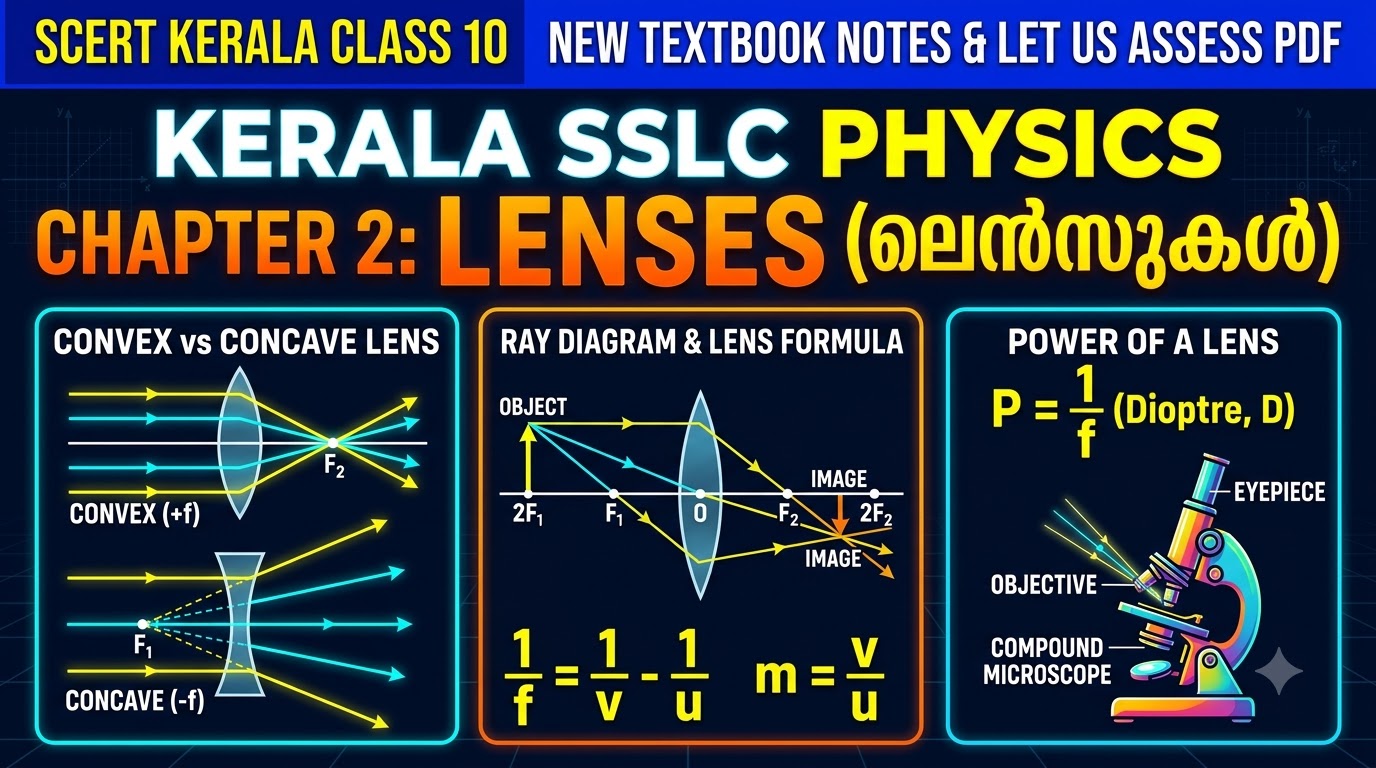
Kerala SSLC Physics Chapter 2 Notes on Lenses (Malayalam Medium: ലെൻസുകൾ) cover the second chapter of the newly revised Class 10 (Std 10) Physics textbook published by the State Council of Educational Research and Training (SCERT Kerala). In the Kerala Pareeksha Bhavan SSLC Physics examination, this chapter carries 6 to 7 guaranteed marks—testing convex and concave lens ray diagrams, the New Cartesian Sign Convention, numerical problems on the Lens Formula (1/f = 1/v – 1/u), magnification (m = v/u), power of a lens in dioptres (P = 1/f), and the working of a compound microscope and telescope.
- 1. Kerala SSLC Physics Chapter 2 Notes: Convex & Concave Lenses and Image Formation Table
- 2. Lens Formula, Magnification, Power of a Lens & Compound Microscope / Telescope
- 3. Class 10 Physics Chapter 2 Let Us Assess Questions and Answers & Solved Numericals
- 4. Class 10 Physics Chapter 2 Malayalam Medium Notes (ലെൻസുകൾ – ചോദ്യോത്തരങ്ങൾ)
From my classroom teaching experience, the single biggest mistake students make in lens numericals is forgetting the sign of u, v, and f: remember that object distance u is always negative (–), focal length f of a Convex lens is positive (+), and focal length f of a Concave lens is negative (–)!
Quick Navigation Across SSLC Physics: Review Chapter 1: Sound Waves, continue to Chapter 3: The World of Colours and Vision, or visit our Kerala SSLC Physics All 7 Chapters Master Hub.
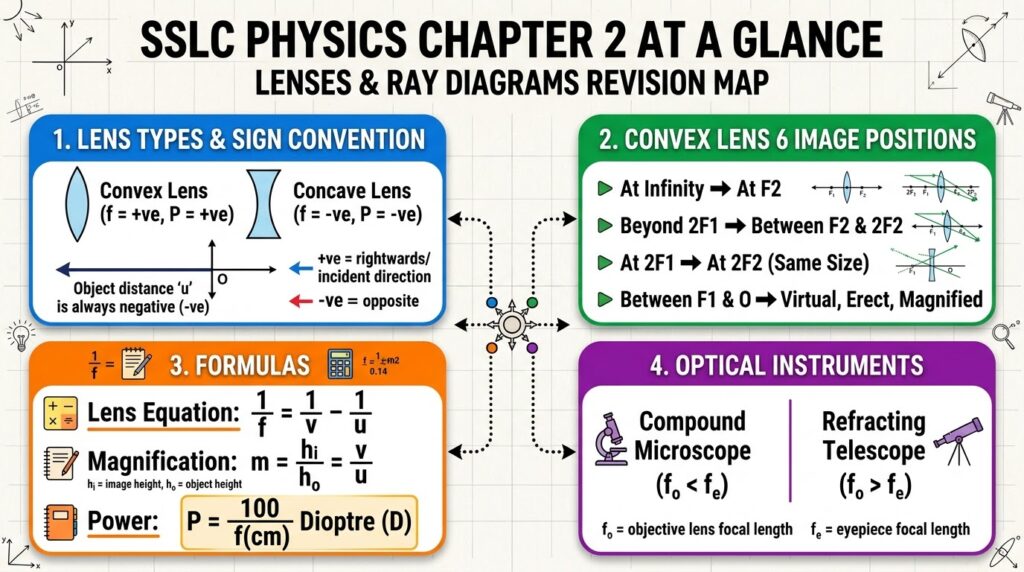
CHAPTER 2 AT A GLANCE: CLASS 10 PHYSICS QUICK REVISION BLUEPRINT
- Chapter 2 Title (EM & MM): Lenses (ലെൻസുകൾ)
- Expected SSLC Exam Weightage: 6 to 7 Marks (Ray Diagram + Lens Equation Numerical)
- Lens Equation & Magnification:
1/f = 1/v – 1/u|m = hi / ho = v / u - Power of a Lens (SI Unit = dioptre, D):
P = 1 / f(in m) = 100 / f(in cm)(Convex =+D; Concave =–D) - Sign of Magnification (m): Negative (
–m) = Real & Inverted Image | Positive (+m) = Virtual & Erect Image
1. Kerala SSLC Physics Chapter 2 Notes: Convex & Concave Lenses and Image Formation Table
A Lens is a transparent refractive medium bounded by two spherical surfaces (or one spherical and one plane surface). A Convex Lens (ഉത്തല ലെൻസ്) is thicker at the middle and thinner at the edges, converging parallel light rays to a real principal focus (Converging Lens). A Concave Lens (അവതല ലെൻസ്) is thinner at the middle and thicker at the edges, diverging parallel light rays so they appear to come from a virtual principal focus (Diverging Lens).
| Position of Object (Convex Lens) | Position of Image | Nature of Image | Size & Magnification (m) |
|---|---|---|---|
| 1. At Infinity | At F on the other side |
Real and Inverted | Highly diminished (point-sized, |m| ≪ 1) |
2. Beyond 2F |
Between F and 2F on other side |
Real and Inverted | Diminished (|m| < 1, Camera) |
3. At 2F |
At 2F on the other side |
Real and Inverted | Same size as object (m = –1) |
4. Between F and 2F |
Beyond 2F on the other side |
Real and Inverted | Magnified / Enlarged (|m| > 1, Projector) |
5. At Principal Focus F |
At Infinity | Real and Inverted | Highly magnified (Searchlight) |
6. Between Optic Centre O and F |
On the same side of the lens as the object | Virtual and Erect | Magnified (m > +1, Simple Microscope / Magnifying glass) |
| Concave Lens (Any Position) | Between O and F on the same side as object |
Always Virtual and Erect | Always Diminished (m is positive and < +1) |
2. Lens Formula, Magnification, Power of a Lens & Compound Microscope / Telescope
- Lens Equation:
1/f = 1/v – 1/u→ Rearranged forms:f = (u × v) / (u – v)andv = (u × f) / (u + f). - Linear Magnification (
m): Ratio of height of image (hi) to height of object (ho):m = hi / ho = v / u. - Power of a Lens (
P/ ലെൻസിന്റെ പവർ): Power is the reciprocal of focal length expressed in metres:P = 1 / f(in m) = 100 / f(in cm). Its SI unit is dioptre (D). Power of a convex lens is positive (+) and power of a concave lens is negative (–). - Compound Microscope vs Refracting Telescope:
– In a Compound Microscope, the Objective lens has a smaller focal length and smaller aperture than the Eyepiece lens. The object is placed just beyond the focus of the objective to form a real, inverted, magnified image, which is further magnified by the eyepiece.
– In a Refracting Telescope, the Objective lens has a larger focal length and larger aperture to gather maximum light from distant celestial bodies, while the Eyepiece has a smaller focal length.
3. Class 10 Physics Chapter 2 Let Us Assess Questions and Answers & Solved Numericals
Q1. An object of height 6 cm is placed 30 cm in front of a convex lens of focal length 20 cm. Calculate (a) the image distance (v), (b) the magnification (m), and (c) the height and nature of the image formed.
Answer:
By New Cartesian Sign Convention: u = –30 cm, f = +20 cm (convex lens), ho = +6 cm.
(a) From 1/v – 1/u = 1/f → 1/v = 1/f + 1/u = 1/20 + 1/(–30) = (3 – 2) / 60 = 1/60 → v = +60 cm.
(b) Magnification m = v / u = +60 / (–30) = –2.
(c) Height of image hi = m × ho = –2 × 6 cm = –12 cm. The negative sign shows the image is Real, Inverted, and Magnified (12 cm tall).
Q2. A doctor prescribes a spectacle lens of power +2.0 D to a patient. What is the focal length of the lens, and what type of lens is it?
Answer: Focal length f = 1 / P = 1 / (+2.0) = +0.5 m = +50 cm. Since the power and focal length are positive, it is a Convex Lens.
4. Class 10 Physics Chapter 2 Malayalam Medium Notes (ലെൻസുകൾ – ചോദ്യോത്തരങ്ങൾ)
പത്താം ക്ലാസ് ഫിസിക്സ് അദ്ധ്യായം 2: ലെൻസുകൾ (മലയാളം മീഡിയം നോട്ടുകൾ)
- കോൺവെക്സ് ലെൻസും കോൺകേവ് ലെൻസും: പ്രകാശരശ്മികളെ സംവ്രജിപ്പിക്കുന്ന (Converging) ലെൻസാണ് കോൺവെക്സ് ലെൻസ് (ഫോക്കസ് ദൂരവും പവറും പോസിറ്റീവ്
+). പ്രകാശരശ്മികളെ അപവ്രജിപ്പിക്കുന്ന (Diverging) ലെൻസാണ് കോൺകേവ് ലെൻസ് (ഫോക്കസ് ദൂരവും പവറും നെഗറ്റീവ്–; എപ്പോഴും ചെറുതും നിവർന്നതുമായ മിഥ്യാ പ്രതിബിംബം രൂപീകരിക്കുന്നു). - ലെൻസ് സമവാക്യവും ആവർധനവും:
1/f = 1/v – 1/u. ആവർധനംm = hi / ho = v / u(mനെഗറ്റീവ് ആണെങ്കിൽ യഥാർത്ഥവും തലകീഴായതുമായ പ്രതിബിംബം;mപോസിറ്റീവ് ആണെങ്കിൽ മിഥ്യയും നിവർന്നതുമായ പ്രതിബിംബം). - ലെൻസിന്റെ പവർ (Power of a Lens): ഫോക്കസ് ദൂരത്തിന്റെ (മീറ്ററിൽ) വ്യുൽക്രമമാണ് ലെൻസിന്റെ പവർ:
P = 1 / f(m) = 100 / f(cm). യൂണിറ്റ്: ഡയോപ്റ്റർ (Dioptre – D).
Teacher’s Classroom Note & Student Discussion Question:
Dear SSLC Students, make sure you practise all 6 convex lens ray diagrams with pencil and scale—especially when the object is placed between F and 2F, and between O and F! Quick Question for You: If the magnification of a lens is +0.4, identify the type of lens and the nature of the image formed. Comment your answer below!



Latest SCERT & DHSE Kerala Study Notes
- Kerala Class 9 Physics Chapter 2 Notes: Equations of Motion (ചലനസമവാക്യങ്ങൾ) Std 9 Let Us Assess Questions and Answers PDF
- Kerala SSLC Christmas Exam Question Paper 2025-27: All Subjects Second Term & Model Question Papers with Solved Answer Keys PDF (New SCERT Syllabus)
- Kerala SSLC English Christmas Exam Question Paper 2025-27: Second Term & Model Solved 80-Mark Answer Key, Discourses & Grammar PDF
- Kerala SSLC Social Science Christmas Exam Question Paper 2025-27: Second Term & Model Solved 80-Mark Answer Key, Weightage & Map Study PDF
- Kerala SSLC Maths Christmas Exam Question Paper 2025-27: Second Term & Model Solved Answer Key, Weightage & Formula Sheet PDF (New SCERT Syllabus)
- Kerala SSLC Biology Christmas Exam Question Paper 2025-27: Second Term & Model Solved Answer Key, Weightage & Flowcharts PDF (New SCERT Syllabus)
- Kerala SSLC Chemistry Christmas Exam Question Paper 2025-27: Second Term & Model Solved Answer Key, Weightage & Sure A+ Questions PDF (New SCERT Syllabus)
- Kerala SSLC Physics Christmas Exam Question Paper 2025-27: Second Term & Model Solved Answer Key, Weightage & Formula Sheet PDF (New SCERT Syllabus)
