
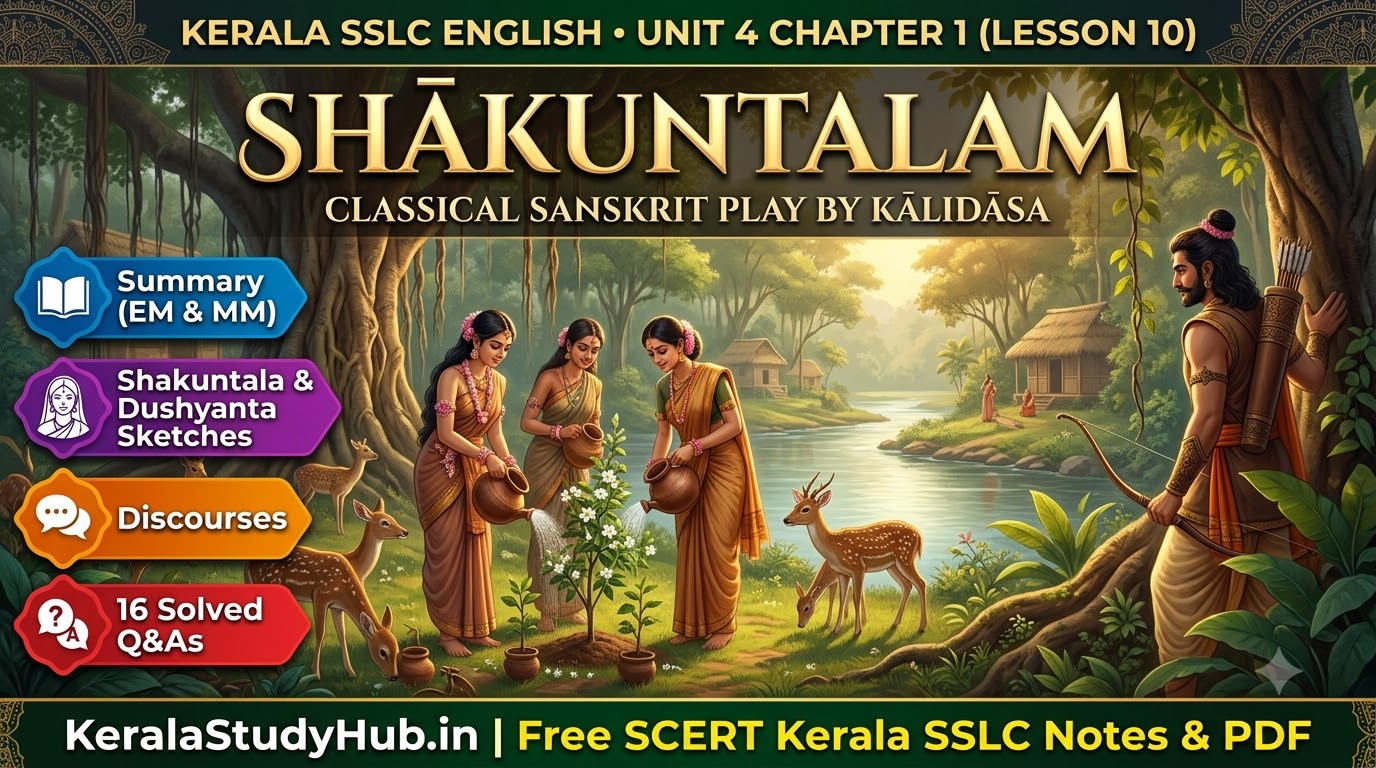
Kerala SSLC English Chapter 10 Notes on the immortal classical Sanskrit drama Shākuntalam (Abhijñānaśākuntalam) by India’s greatest classical poet and playwright Kālidāsa welcome you to the opening lesson of Unit IV (Woodland Whispers) in the newly revised Class 10 (Std 10) Kerala Reader English textbook published by the State Council of Educational Research and Training (SCERT Kerala). In my classroom, when we enact this opening scene from Act I of Abhijñānaśākuntalam, I ask my students: “Notice how King Dushyanta enters the forest on a speeding war chariot with his bow drawn to kill a fleeing deer, yet the moment a hermit raises his hand and says the deer belongs to the sacred hermitage of Sage Kanva, the mighty king lowers his bow in humility! And how does Shakuntala treat the trees, creepers, and fawns of the forest—not as resources to exploit, but as her own brothers and sisters?”
- 1. Detailed Scene-by-Scene Play Summary (English & Malayalam)
- 2. Exam-Ready Character Sketches (6-Mark SSLC Questions)
- 1. Character Sketch of Shakuntala (High-Priority 6-Mark Question!)
- 2. Character Sketch of King Dushyanta (6 Marks)
- 3. Solved Exam Discourses (King Dushyanta’s Diary Entry & Speech on Ecological Harmony)
- Discourse 1: Diary Entry of King Dushyanta on the Evening He Visited Sage Kanva’s Hermitage (5 Marks)
- Discourse 2: Speech on “Lessons of Environmental Conservation and Harmony in Kālidāsa’s Shākuntalam” (6 Marks)
- 4. Complete Textbook Solutions & Extra Exam Questions (16 Fully Solved Q&As)
Prepared strictly for the Kerala Pareeksha Bhavan SSLC Public Examination, this complete classroom guide covers the Scene-by-Scene Play Summary (English & Malayalam), Character Sketches of Shakuntala and King Dushyanta, Theme of Ecological Harmony & Non-Violence (Ahimsa), Solved Discourses (King Dushyanta’s Diary Entry, Conversation Between Shakuntala, Anasuya & Priyamvada, and Speech on Nature Conservation), and 16 Solved Textbook & Exam Questions and Answers.
Quick SSLC English Navigation: SSLC English All 15 Chapters Master Hub | Previous: Chapter 9: A Piece of String | Next: Chapter 11: Trills and Thrills: Birdwatching in India (Salim Ali).
CHAPTER 10 AT A GLANCE: SHĀKUNTALAM BY KĀLIDĀSA (DRAMATIC & EXAM BLUEPRINT)
- Play & Playwright: Shākuntalam (excerpted from Act I of Abhijñānaśākuntalam) by Mahākavi Kālidāsa (c. 4th–5th century CE), India’s greatest classical Sanskrit poet and dramatist (also author of Meghadūtam, Raghuvamśam, and Kumārasambhavam).
- Setting: The tranquil, sacred woodland hermitage (Tapovana / Ashrama) of Sage Kanva (Kashyapa) on the banks of the Malini River at the foothills of the Himalayas.
- Main Characters:
• Shakuntala: The foster daughter of Sage Kanva (daughter of celestial nymph Menaka and sage Vishwamitra); a symbol of natural purity, innocence, and deep kinship with trees, creepers (Vanajyotsna), and animals.
• King Dushyanta: The noble, righteous king of the Puru dynasty (Hastinapura) who respects ascetic rules, spares the hermitage deer, and removes his royal ornaments before entering the holy grove.
• Anasuya & Priyamvada: Shakuntala’s two affectionate, playful hermitage companions.
• Vaikhanasa (Hermit) & the Charioteer (Suta): The ascetic who stops the hunt, and the king’s charioteer.
- Central Theme (Unit IV — Woodland Whispers): Deep ecological harmony between human beings and nature, reverence for all living creatures, and the contrast between aggressive royal power and peaceful forest simplicity.
1. Detailed Scene-by-Scene Play Summary (English & Malayalam)
| Dramatic Scene | Key Events & Classroom Analysis |
|---|---|
| 1. The Royal Chase & the Fleeing Deer | King Dushyanta, riding a swift war chariot driven by his charioteer, pursues a terrified blackbuck (spotted deer) with his bow and arrow drawn. Kālidāsa paints a vivid picture of the fleeing deer: turning its neck gracefully in fear to glance at the pursuing chariot, contracting its hindquarters into its chest to avoid the arrow, dropping half-chewed blades of darbha grass from its panting mouth, and bounding so high that it seems to fly through the air rather than run on the ground! |
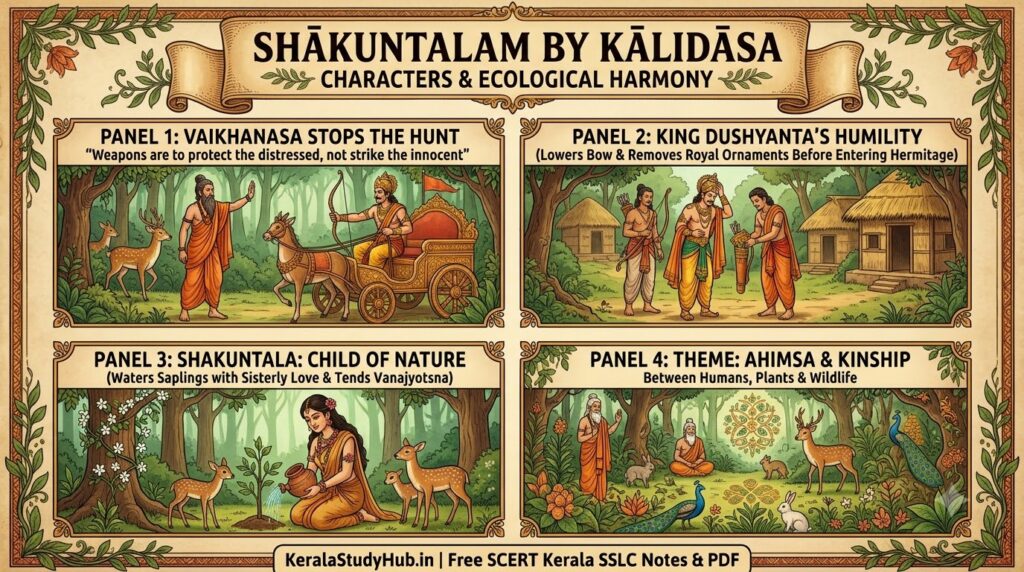
| 2. Vaikhanasa’s Intervention & the King’s Humility | Just as Dushyanta aims his lethal arrow, a hermit (Vaikhanasa) steps in front of the chariot with raised hands, pleading: “O King, this deer belongs to the hermitage! Do not kill it, do not kill it!” He reminds Dushyanta that casting a sharp arrow at the tender body of a fawn is like pouring fire on a heap of soft flowers, and that the weapons of virtuous kings of the Puru dynasty are meant to protect the distressed, not to strike the innocent. Dushyanta immediately lowers his bow and returns the arrow to his quiver, earning the hermit’s blessing that he will be blessed with a Chakravartin (emperor) son. |
| 3. Entering Sage Kanva’s Sacred Hermitage | Informed that the head of the hermitage, Sage Kanva, has gone to Somatirtha to avert an adverse fate threatening his foster daughter Shakuntala, and has entrusted her with welcoming guests, Dushyanta decides to pay homage to the holy grove. Out of deep respect for the peaceful sanctuary—where grains of wild rice lie under trees near parrots’ nests, stones are glossy from crushing ingudi oil-nuts, and trustful deer do not run away at the sound of human footsteps—the King hands his bow, royal jewels, and crown to his charioteer and enters in humble attire. |
| 4. Shakuntala and Her Friends Watering the Trees | Hearing soft voices among the trees, Dushyanta steps behind a bush and sees Shakuntala with her two companions, Anasuya and Priyamvada, carrying watering pots to water the young trees. Dushyanta marvels at Shakuntala’s pure, unadorned natural beauty (“Even wrapped in bark-garments, she shines like a lotus surrounded by moss”). Shakuntala declares that she waters the trees not merely because Father Kanva commanded it, but because she feels the affection of a sister toward them! She lovingly tends the jasmine creeper Vanajyotsna (Moonlight of the Grove), which has twined itself around a mango tree like a bride embracing her bridegroom. |
| 5. The Honeybee Episode & Dushyanta’s Entrance | As Shakuntala sprinkles water on the jasmine bush, a bee (madhukara) flies out and hovers around her face, mistaking her eyes and lips for a blooming flower. Playfully teased by Anasuya and Priyamvada, when Shakuntala calls out for protection against the persistent bee, King Dushyanta steps forward from behind the trees to introduce himself and protect her—marking the beginning of their legendary bond. |
മലയാളം സംഗ്രഹം (Malayalam Summary — “Shākuntalam” by Kālidāsa):
മഹാകവി കാളിദാസന്റെ (Kālidāsa) വിശ്വപ്രസിദ്ധമായ സംസ്കൃത നാടകം ‘അഭിജ്ഞാനശാകുന്തള’ത്തിലെ (Abhijñānaśākuntalam) ഒന്നാം അങ്കത്തിൽ നിന്നുള്ള ഭാഗമാണ് ‘Shākuntalam’. മൃഗയാവിനോദത്തിനായി (വേട്ടയാടാൻ) കാട്ടിലെത്തിയ ഹസ്തിനപുരിയിലെ രാജാവായ ദുഷ്യന്തൻ (King Dushyanta) ഒരു മാനിനെ പിന്തുടർന്ന് അമ്പെയ്യാൻ ഒരുങ്ങുമ്പോൾ, വൈഖാനസൻ (Vaikhanasa) എന്ന മുനി അവിടെയെത്തി അത് ആശ്രമത്തിലെ മാനാണെന്നും അതിനെ കൊല്ലരുതെന്നും അഭ്യർത്ഥിക്കുന്നു. രാജാക്കന്മാരുടെ ആയുധങ്ങൾ നിരപരാധികളെ ഉപദ്രവിക്കാനല്ല, മറിച്ച് ദുർബലരെ സംരക്ഷിക്കാനാണെന്ന മുനിയുടെ വാക്കുകൾ കേട്ട് ദുഷ്യന്തൻ വില്ല് താഴ്ത്തുന്നു. തുടർന്ന് കണ്വമഹർഷിയുടെ (Sage Kanva) പുണ്യാശ്രമത്തിലേക്ക് പ്രവേശിക്കുന്നതിന് മുൻപ് രാജാവ് തന്റെ രാജകീയ ആഭരണങ്ങളും ആയുധങ്ങളും തേരാളിയെ ഏൽപ്പിക്കുന്നു. ആശ്രമവനിയിൽ മരച്ചെടികളെ സ്വന്തം സഹോദരങ്ങളെപ്പോലെ സ്നേഹിച്ച് വെള്ളമൊഴിക്കുന്ന ശകുന്തളയെയും (Shakuntala) തോഴിമാരായ അനസൂയയെയും പ്രിയംവദയെയും (Anasuya & Priyamvada) രാജാവ് കാണുന്നു. ഒരു വണ്ട് (Bee) ശകുന്തളയെ ശല്യപ്പെടുത്തുമ്പോൾ അവളെ രക്ഷിക്കാനായി രാജാവ് മുന്നോട്ടുവരുന്നതോടെയാണ് ഈ നാടകഭാഗം പൂർത്തിയാകുന്നത്. മനുഷ്യനും പ്രകൃതിയും തമ്മിലുള്ള ആത്മബന്ധത്തിന്റെ മനോഹരമായ ചിത്രീകരണമാണിത്.
2. Exam-Ready Character Sketches (6-Mark SSLC Questions)
1. Character Sketch of Shakuntala (High-Priority 6-Mark Question!)
Shakuntala, the heroine of Kālidāsa’s Abhijñānaśākuntalam and the foster daughter of Sage Kanva, is the embodiment of natural beauty, innocence, humility, and ecological harmony. Raised in the tranquil woodland hermitage along the Malini River, she lives as a true child of nature. She wears simple bark-garments (valkala) with no royal ornaments, yet King Dushyanta observes that her natural grace needs no artificial decoration—just as a lotus is lovely even when covered with moss. What makes Shakuntala truly extraordinary is her deep, selfless love for plants, trees, and animals. She waters the young saplings of the hermitage not merely out of obedience to Father Kanva, but because she feels a genuine sisterly affection toward them! She treats the jasmine creeper Vanajyotsna and the mango tree as living companions, rejoices in their blossoming, and feels that the trees wave their leafy fingers in affection toward her. Gentle, soft-spoken, and playful with her companions Anasuya and Priyamvada, Shakuntala represents the ancient Indian ideal of living in loving kinship with the natural world.
2. Character Sketch of King Dushyanta (6 Marks)
King Dushyanta, the ruler of the Puru dynasty, is portrayed by Kālidāsa as an ideal, righteous monarch (Rajarshi) who combines martial valour with humility, self-restraint, and deep reverence for dharma and nature. When we first see him chasing a fleet-footed deer in his chariot, he is a fearless warrior and skilled archer. Yet the very instant the hermit Vaikhanasa informs him that the deer belongs to Sage Kanva’s sacred hermitage and reminds him that royal weapons are meant to protect the weak rather than harm the innocent, Dushyanta immediately lowers his bow without a trace of arrogance. He shows profound respect for ascetic life: before entering the peaceful hermitage, he stops his chariot at a distance so as not to disturb the woodland creatures, and removes his royal crown, jewels, and bow. Possessing the refined eye of a poet and artist, he admires the serene beauty of the hermitage and the unadorned purity of Shakuntala from afar, and steps forward chivalrously when she calls for help against the bee.
3. Solved Exam Discourses (King Dushyanta’s Diary Entry & Speech on Ecological Harmony)
Discourse 1: Diary Entry of King Dushyanta on the Evening He Visited Sage Kanva’s Hermitage (5 Marks)
Evening at the Royal Camp near the Malini River
What a transformative day this has been! This morning I set out into the forest filled with the pride of a hunter chasing a terrified deer. Had the holy hermit Vaikhanasa not stepped before my chariot and reminded me that the weapons of the Puru kings are meant to protect the distressed and never to wound the innocent, I would have stained this sacred sanctuary with blood! Leaving my royal ornaments and bow with my charioteer, I walked into Sage Kanva’s peaceful hermitage, where even the fawns trust human footsteps. And there, among the flowering trees, I beheld Shakuntala watering the saplings alongside Anasuya and Priyamvada. How pure and radiant she looked in her simple bark garment, loving the trees and the jasmine creeper Vanajyotsna like her own sisters! Truly, the peace and beauty of this woodland hermitage far surpass the splendour of my royal palace.
Discourse 2: Speech on “Lessons of Environmental Conservation and Harmony in Kālidāsa’s Shākuntalam” (6 Marks)
Respected Principal, teachers, and my dear friends,
Good morning to everyone! Today, as we explore Unit IV of our English textbook, Woodland Whispers, I would like to speak on what Mahākavi Kālidāsa’s timeless play Shākuntalam teaches us about environmental conservation.
Written more than fifteen hundred years ago, Shākuntalam presents a breathtaking vision of ecological harmony where humans, animals, and plants live together as one single family! In Sage Kanva’s hermitage, wild deer roam without fear because no one harms them. When King Dushyanta raises his bow against a hermitage fawn, the ascetic Vaikhanasa stops him with a powerful moral truth: power and weapons exist to protect the vulnerable, not to destroy innocent nature! And look at Shakuntala—she waters the young trees not out of duty alone, but because she feels a sister’s love for every tree and creeper.
In our modern age of deforestation and climate change, we urgently need Shakuntala’s sisterly love for trees and Vaikhanasa’s call for non-violence toward wildlife. Let us protect nature as our own family. Thank you!
4. Complete Textbook Solutions & Extra Exam Questions (16 Fully Solved Q&As)
Q1: How does the Charioteer describe King Dushyanta as he chases the spotted deer?
Answer: Looking at the King with bow in hand and eye fixed on the fleeing blackbuck, the Charioteer compares King Dushyanta to Lord Shiva (Pinākin) himself chasing the sacred deer in cosmic majesty.
Q2: How does Kālidāsa vividly describe the fear and flight of the pursued deer?
Answer: The terrified deer repeatedly turns its neck gracefully to glance at the speeding chariot; out of fear of the falling arrow, it draws its hindquarters into the front part of its body; it strews the forest path with half-chewed darbha grass dropping from its mouth open with exhaustion; and it bounds so high into the air that it travels more through the sky than on the earth!
Q3: Why does the hermit Vaikhanasa stop King Dushyanta from shooting the deer, and what simile does he use?
Answer: Vaikhanasa stops the King because the deer belongs to the sacred hermitage of Sage Kanva, a sanctuary of non-violence. Using a striking simile, the hermit says that shooting a cruel arrow into the tender body of a fawn is like casting fire upon a heap of soft flowers, and reminds the King that his weapon is meant to protect the distressed, not to strike the innocent!
Q4: How does King Dushyanta react to Vaikhanasa’s words, and what blessing does the hermit bestow upon him?
Answer: King Dushyanta immediately lowers his bow, removes the arrow, and puts it back into his quiver with respectful humility. Pleased by this noble conduct worthy of the Puru dynasty, Vaikhanasa blesses him to be the father of a glorious universal emperor (Chakravartin).
Q5: Where had Sage Kanva (Kashyapa) gone, and whom had he left in charge of welcoming guests at the hermitage?
Answer: Sage Kanva had gone to the holy pilgrimage site of Somatirtha to perform rituals to pacify an adverse fate threatening his foster daughter, Shakuntala. In his absence, he had entrusted Shakuntala with the duty of welcoming and offering hospitality to guests arriving at the hermitage.
Q6: What signs convince King Dushyanta that they have reached the precincts of the sacred hermitage?
Answer: Dushyanta notices four peaceful signs of ascetic life: (1) grains of wild rice (nivara) lying beneath the trees where they fell from hollow trunks containing parrots’ nests, (2) stones glossy with oil from crushing ingudi nuts, (3) fawns grazing trustfully without running away at the sound of the chariot, and (4) paths to the river marked by lines of water dripping from the washed bark-garments of hermits.
Q7: Why does King Dushyanta remove his royal ornaments and bow before entering the hermitage grove?
Answer: Dushyanta believes that a sacred penance grove (Tapovana) must be entered in humble, modest attire, free from royal pride or weapons of violence. Therefore, he hands his royal ornaments and bow to his charioteer before stepping inside on foot.
Q8: What does Shakuntala say when Anasuya remarks that Father Kanva seems to love the hermitage trees even more than he loves Shakuntala?
Answer: When Anasuya jokingly says that Father Kanva must value the trees more than Shakuntala since he assigned delicate Shakuntala to fill their basins with water, Shakuntala replies warmly: “It is not merely because Father commanded me; I too have the affection of a sister for these trees!”
Q9: How does King Dushyanta describe Shakuntala’s natural beauty in her simple bark-garment?
Answer: Dushyanta marvels that even though a rough bark-garment is unsuited to her graceful form, it cannot hide her radiance: “A lotus is lovely even when covered with moss; a dark spot only heightens the beauty of the moon; and this slender maiden is even more enchanting in her bark dress—for what is NOT an ornament to a naturally sweet form?”
Q10: What is “Vanajyotsna”, and how do Shakuntala and her friends speak of its “marriage” to the mango tree?
Answer: Vanajyotsna (“Moonlight of the Grove”) is a fragrant white jasmine creeper that Sage Kanva himself had planted and that Shakuntala calls her “sister”. Because the blooming jasmine creeper has twined itself lovingly around a nearby mango tree bearing fresh shoots, Anasuya and Priyamvada playfully say that Vanajyotsna has been united in marriage with a worthy bridegroom (the mango tree), and tease Shakuntala about when she too will meet a worthy husband!
Q11: How does Shakuntala imagine the wind-stirred Kesara (Bakula) tree is calling to her?
Answer: Seeing the branches and young shoots of the Kesara tree waving in the gentle breeze, Shakuntala poetically imagines that the tree is beckoning to her with its “leafy fingers” (Personification), so she goes over to honour and water it.
Q12: What happens when Shakuntala sprinkles water on the jasmine creeper, and how does it bring Dushyanta out of hiding?
Answer: Disturbed by the sprinkling water, a honeybee (madhukara) leaves the jasmine blossom and flies toward Shakuntala’s face, hovering near her eyes and lips. When Priyamvada and Anasuya laughingly tell her to call upon King Dushyanta for protection (since it is the King’s duty to protect the hermitage Groves), Dushyanta takes this as the perfect cue to step out from behind the trees and greet them!
Q13: Why does King Dushyanta playfully envy the honeybee?
Answer: Watching the bee touch Shakuntala’s trembling eyelids, hum softly near her ear as if whispering a secret of love, and brush against her lower lip while he stands hesitating in the bushes, Dushyanta playfully calls the bee “blessed” and envies its closeness to her.
Q14: How does the excerpt from “Shākuntalam” reflect the theme of Unit IV, “Woodland Whispers”?
Answer: Unit IV celebrates the beauty of forests, birds, and wildlife. In Shākuntalam, nature is not a silent backdrop—it is a living, breathing family where deer are protected, trees gesture with leafy fingers, creepers are cherished like sisters, and human beings live in reverent harmony with the woodland ecosystem.
Q15: Who translated Kālidāsa’s “Abhijñānaśākuntalam” into English first in 1789, introducing Sanskrit drama to Europe?
Answer: Orientalist scholar Sir William Jones published the first English translation of Shākuntalam in 1789, which won immense admiration from European literary giants such as Johann Wolfgang von Goethe.
Q16 (Grammar — Reported Speech & Figures of Speech from Chapter 10):
(a) Convert into Reported Speech:
Vaikhanasa: “O King, this deer belongs to the hermitage. Do not kill it! Please put back your arrow into the quiver.”
(b) Identify the figure of speech in: “A lotus is lovely even when covered with moss.”
Answer:
• (a) Reported Speech: Addressing the King respectfully, Vaikhanasa informed him that that deer belonged to the hermitage, forbade him from killing it, and requested him to put his arrow back into the quiver.
• (b) Figure of Speech: Simile / Metaphor (comparing Shakuntala in her rough bark-garment to a lotus surrounded by moss) and Alliteration (“lotus is lovely”).
Teacher’s Classroom Note & Student Discussion Question:
In your SSLC English exam, the Character Sketch of Shakuntala and the Character Sketch of King Dushyanta are guaranteed high-priority questions from Unit IV. Always mention Shakuntala’s sisterly bond with the trees and the jasmine creeper Vanajyotsna, and Dushyanta’s humility in sparing the hermitage deer and removing his royal ornaments!
Quick Challenge for You (Drop Your Answer in the Comments Below!): What is the Sanskrit name given by Sage Kanva and Shakuntala to the white jasmine creeper that twined around the mango tree in the hermitage? Write its name in the comments!




Latest SCERT & DHSE Kerala Study Notes
- Kerala Class 9 Physics Chapter 2 Notes: Equations of Motion (ചലനസമവാക്യങ്ങൾ) Std 9 Let Us Assess Questions and Answers PDF
- Kerala SSLC Christmas Exam Question Paper 2025-27: All Subjects Second Term & Model Question Papers with Solved Answer Keys PDF (New SCERT Syllabus)
- Kerala SSLC English Christmas Exam Question Paper 2025-27: Second Term & Model Solved 80-Mark Answer Key, Discourses & Grammar PDF
- Kerala SSLC Social Science Christmas Exam Question Paper 2025-27: Second Term & Model Solved 80-Mark Answer Key, Weightage & Map Study PDF
- Kerala SSLC Maths Christmas Exam Question Paper 2025-27: Second Term & Model Solved Answer Key, Weightage & Formula Sheet PDF (New SCERT Syllabus)
- Kerala SSLC Biology Christmas Exam Question Paper 2025-27: Second Term & Model Solved Answer Key, Weightage & Flowcharts PDF (New SCERT Syllabus)
- Kerala SSLC Chemistry Christmas Exam Question Paper 2025-27: Second Term & Model Solved Answer Key, Weightage & Sure A+ Questions PDF (New SCERT Syllabus)
- Kerala SSLC Physics Christmas Exam Question Paper 2025-27: Second Term & Model Solved Answer Key, Weightage & Formula Sheet PDF (New SCERT Syllabus)