
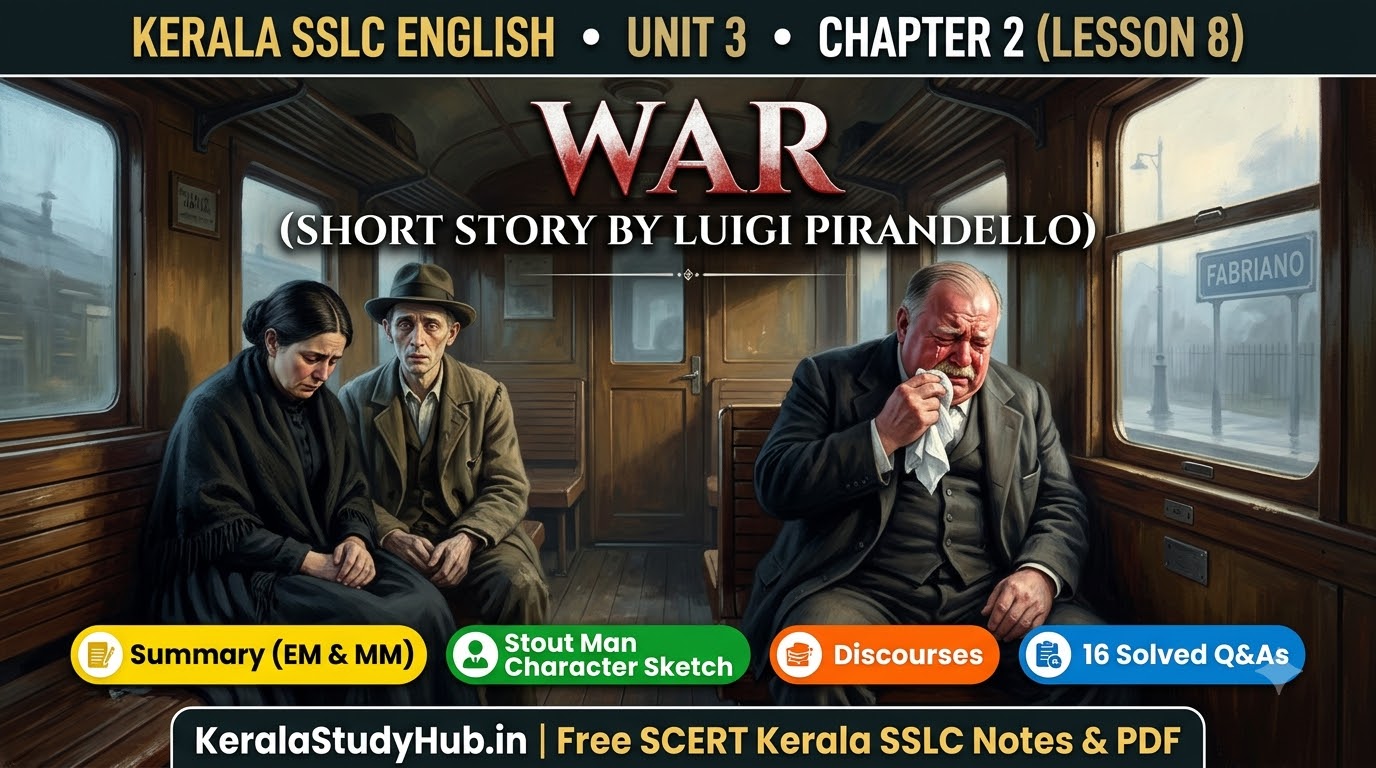
Kerala SSLC English Chapter 8 Notes on the world-famous anti-war short story War by Italian Nobel Laureate Luigi Pirandello (1867–1936) welcome you to the second lesson of Unit III (The Trumpets of Change) in the newly revised Class 10 (Std 10) Kerala Reader English textbook published by the State Council of Educational Research and Training (SCERT Kerala). In my classroom, when we read this unforgettable psychological story set inside a stuffy second-class railway carriage in Italy during World War I, I ask my students: “Why does the red-faced stout passenger—whose own only son has ALREADY died at the war front—lecture all the other grieving parents that they should not cry, but instead feel proud that their sons died happy for King and Country? And why does a single simple question from the heartbroken mother—’Then… is your son really dead?’—shatter his patriotic mask and make him burst into uncontrollable, harrowing sobs?”
- 1. Detailed Scene-by-Scene Story Summary (English & Malayalam)
- 2. Exam-Ready Character Sketches (6-Mark SSLC Questions)
- 1. Character Sketch of the Stout Man (The Fat Traveller) — High-Priority 6-Mark Question!
- 2. Character Sketch of the Grieving Mother (The Bulky Woman in Mourning)
- 3. Solved Exam Discourses (Diary Entry of the Stout Man & Anti-War Speech)
- Discourse 1: Diary Entry of the Stout Man on the Night After the Train Journey (5 Marks)
- Discourse 2: Speech on “The Futility of War and the Agony Left Behind” (6 Marks)
- 4. Complete Textbook Solutions & Extra Exam Questions (16 Fully Solved Q&As)
Prepared strictly for the Kerala Pareeksha Bhavan SSLC Public Examination, this complete classroom guide covers the Detailed Story Summary (English & Malayalam), Character Sketches of the Stout Man (Fat Traveller), the Heartbroken Woman, and Her Husband, Psychological Analysis of the Climax, Solved Discourses (Diary Entry, Conversation, Anti-War Speech & Letter), and 16 Solved Textbook & Exam Questions and Answers.
Quick SSLC English Navigation: SSLC English All 15 Chapters Master Hub | Previous: Chapter 7: Another Day in Paradise | Next: Chapter 9: A Piece of String (Guy de Maupassant).
CHAPTER 8 AT A GLANCE: WAR BY LUIGI PIRANDELLO (LITERARY & EXAM BLUEPRINT)
- Title & Author: War (Italian: Quando si comprende, 1918) by Luigi Pirandello, Italian dramatist and short-story writer who won the 1934 Nobel Prize in Literature.
- Setting: At dawn inside a stuffy, smoky second-class railway carriage stopping at the small station of Fabriano, Italy, during World War I.
- The Passengers & Their Arguments About Parental Grief:
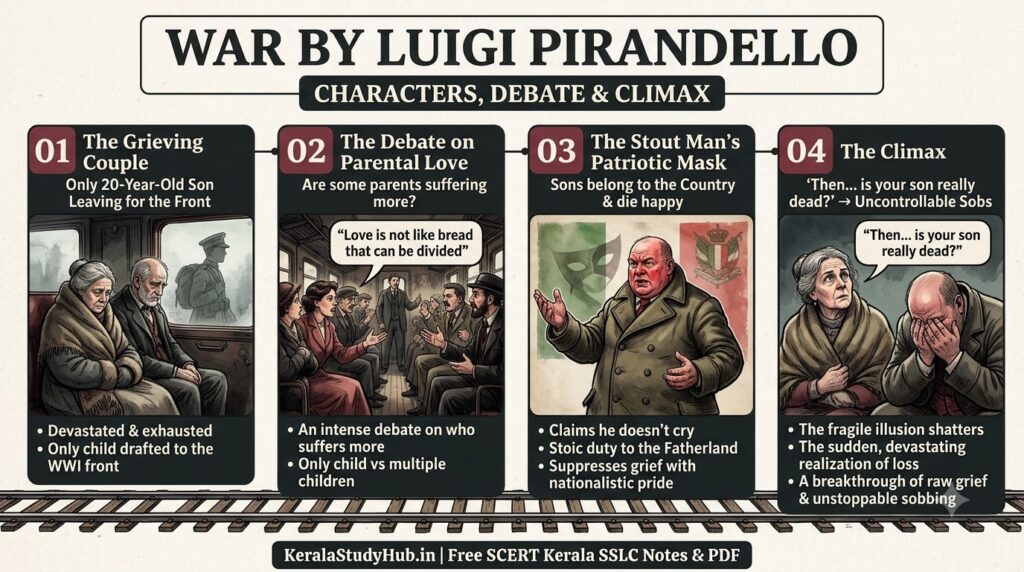
1. The Bulky Woman in Deep Mourning & Her Frail Husband: Their only 20-year-old son is being sent to the war front in three days; they are going to Sulmona to see him off.
2. Passenger 1: Says his son was sent to the front on the very first day of the war and has already come back wounded twice.
3. Passenger 2: Says he has two sons and three nephews at the front, arguing his anxiety is greater; the husband replies that a father who loses his only son loses everything and is left with no reason to live.
4. The Stout (Fat), Red-Faced Man: Dismisses all their tears as “nonsense”, arguing that our children belong to the Country, that young soldiers die happy at 20 without seeing the ugly side of life, and proudly announces that his own fallen son sent him a message saying he died happy for King and Country!
- The Shattering Climax: When the mourning mother wakes from her daze and asks the stout man, “Then… is your son really dead?”, the reality of his loss pierces his self-deception (mask of patriotic pride), and he breaks down into uncontrollable, heart-rending sobs!
1. Detailed Scene-by-Scene Story Summary (English & Malayalam)
| Story Stage | Key Events & Psychological Analysis |
|---|---|
| 1. Dawn at Fabriano Station & the Grieving Couple | Passengers who had left Rome by the night express have to wait until dawn at the small station of Fabriano to board the local train to Sulmona. Into a stuffy, smoky second-class carriage climbs a bulky woman in deep mourning, hoisted up like a shapeless bundle by her small, thin, pale husband. She pulls her coat collar over her face to hide her bitter weeping, while her husband apologetically explains to the fellow passengers that their only twenty-year-old son is leaving for the war front in three days, after they had moved to Rome specifically to stay close to him on a promise that he wouldn’t be sent to the front for six months. |
| 2. Debate Over Parental Love: One Son vs Two Sons | The other passengers—almost all of whom have sons at war—compare their sorrows rather than comforting the woman. One man says his son went to the front on day one and has returned wounded twice; another claims he suffers more because he has two sons and three nephews at the front. The pale husband replies that parental love is not like bread that can be divided into pieces—a father gives all his love to each child, whether one or ten—yet if a father of two loses one son, he must survive for the remaining son, whereas a father of an only son who dies has nothing left to live for and can die too! |
| 3. The Stout Red-Faced Man’s Patriotic Speech | A fat, red-faced man with bloodshot eyes, panting heavily from his bulky frame, interrupts them angrily: “Nonsense! Do we give life to our children for our own benefit?” He argues that at twenty, young men’s love for their Country is greater even than their love for their parents; that if they die at twenty, they die young and happy without seeing the ugly, boring, disillusioned side of life; and that parents should stop crying and instead laugh or thank God, just as he does—because his own son had sent him a last message before dying on the battlefield saying that he died happy for King and Country! Look, he boasts, he is not even wearing mourning clothes! |
| 4. The Mother’s Question & the Shattering Climax | The grieving mother, who had been listening in stunned amazement from her corner—feeling ashamed of her own tears upon hearing that a father could rejoice at his son’s heroic death—suddenly sits up and asks a simple, innocent question: “Then… is your son really dead?” Everyone stares at the stout man. He looks at the woman, tries to answer, stammers, and suddenly realizes for the very first time that his son is truly, irreversibly dead and gone forever! His patriotic intellectual mask crumbles instantly; he pulls a handkerchief from his pocket and breaks down into harrowing, uncontrollable, heart-rending sobs. |
മലയാളം സംഗ്രഹം (Malayalam Summary — “War” by Luigi Pirandello):
ഇറ്റാലിയൻ സാഹിത്യകാരനും നൊബേൽ സമ്മാന ജേതാവുമായ ലൂയിജി പിരാൻഡെല്ലോ (Luigi Pirandello) എഴുതിയ ലോകപ്രശസ്തമായ യുദ്ധവിരുദ്ധ കഥയാണ് ‘War’ (യുദ്ധം). ഒന്നാം ലോകമഹായുദ്ധകാലത്ത് റോമിൽ നിന്നുള്ള ഒരു ട്രെയിൻ യാത്രയിലാണ് കഥ നടക്കുന്നത്. തങ്ങളുടെ ഒരേയൊരു മകൻ മൂന്ന് ദിവസത്തിനുള്ളിൽ യുദ്ധമുന്നണിയിലേക്ക് പോകുന്നതിന്റെ ദുഃഖത്തിൽ കരഞ്ഞുകൊണ്ട് ഒരു അമ്മയും ഭർത്താവും കമ്പാർട്ട്മെന്റിൽ കയറുന്നു. അവിടെയുണ്ടായിരുന്ന മറ്റ് യാത്രക്കാർ തങ്ങളുടെ മക്കളും യുദ്ധത്തിലാണെന്ന് പറഞ്ഞ് തർക്കിക്കുമ്പോൾ, ചുവന്ന മുഖമുള്ള ഒരു തടിയൻ യാത്രക്കാരൻ (Stout Man) അവരെ പരിഹസിക്കുന്നു. മക്കൾ രാജ്യത്തിന് അവകാശപ്പെട്ടതാണെന്നും, ഇരുപതാം വയസ്സിൽ രാജ്യത്തിന് വേണ്ടി സന്തോഷത്തോടെ വീരമൃത്യു വരിച്ച തന്റെ മകനെയോർത്ത് താൻ കരയുകയല്ല, അഭിമാനിക്കുകയാണ് ചെയ്യുന്നതെന്നും അയാൾ വാദിക്കുന്നു! ഇത് കേട്ട് അത്ഭുതപ്പെട്ട ആ പാവം അമ്മ നിഷ്കളങ്കമായി ചോദിക്കുന്നു: “അപ്പോൾ… നിങ്ങളുടെ മകൻ ശരിക്കും മരിച്ചുപോയോ?” (“Then… is your son really dead?”). ആ ഒരൊറ്റ ചോദ്യത്തോടെ തന്റെ മകൻ ഇനി ഒരിക്കലും തിരിച്ചുവരില്ലെന്ന ഞെട്ടിക്കുന്ന സത്യം തിരിച്ചറിഞ്ഞ ആ തടിയൻ മനുഷ്യൻ, തന്റെ ദേശഭക്തിയുടെ പുറംപൂച്ച് അഴിഞ്ഞുവീണ് കൊച്ചുകുഞ്ഞിനെപ്പോലെ പൊട്ടിക്കരയുന്നു! യുദ്ധം മാതാപിതാക്കൾക്ക് നൽകുന്ന തീരാവേദനയുടെ നേർച്ചിത്രമാണ് ഈ കഥ.
2. Exam-Ready Character Sketches (6-Mark SSLC Questions)
1. Character Sketch of the Stout Man (The Fat Traveller) — High-Priority 6-Mark Question!
The stout man (fat traveller) is the most psychologically complex and unforgettable character in Luigi Pirandello’s short story War. Physically, he is bulky and red-faced, with pale, bulging, bloodshot eyes, panting heavily under the weight of his body. Having recently lost his only son on the battlefield, he tries to numb his unbearable grief behind a shield of lofty patriotic rhetoric and philosophical rationalization. When the other passengers in the carriage complain about their sons being sent to the front, he scolds them, proclaiming that children belong to the Country rather than to their parents, and that dying young at twenty for King and Country is a happy, heroic fate free from the ugliness of old age. He proudly points out that he wears no mourning clothes because his son died happy. However, his stoic bravery is only a fragile psychological mask. The moment the grieving mother innocently asks him, “Then… is your son really dead?”, the stark reality of his son’s permanent absence pierces his heart. His mask of pride shatters completely, and he breaks down into uncontrollable, heart-rending sobs—revealing that beneath hollow slogans of war lies the universal, inconsolable grief of a bereaved father.
2. Character Sketch of the Grieving Mother (The Bulky Woman in Mourning)
The bulky woman in deep mourning represents raw, unfiltered maternal love and the silent agony of mothers whose sons are claimed by war. When she is helped into the railway carriage at Fabriano by her frail husband, she is so overwhelmed by grief that she hides her face behind her coat collar and weeps bitterly because her only twenty-year-old son is being sent to the war front in three days. As the male passengers argue loudly about whose sacrifice is greater, she feels isolated and misunderstood in her anguish. However, when the stout man delivers his passionate speech claiming that parents should rejoice when their sons die heroically for the country, she stops crying and listens in stunned awe, wondering if she has failed to rise to such noble heights. Her simple, literal question—“Then… is your son really dead?”—acts as the dramatic catalyst of the story, stripping away the stout man’s self-deception and exposing the true human cost of war.
3. Solved Exam Discourses (Diary Entry of the Stout Man & Anti-War Speech)
Discourse 1: Diary Entry of the Stout Man on the Night After the Train Journey (5 Marks)
16 November
10:00 PM
Until this morning in that stuffy railway carriage, I had fooled myself into believing that I was stronger than every other grieving parent! Ever since the telegram arrived saying my beloved boy had fallen on the battlefield, I kept repeating high-sounding words about King, Country, and dying young and happy at twenty—just so I wouldn’t lose my mind with grief. In the train today, I even lectured those poor parents and boasted that I wasn’t wearing mourning clothes! And then that poor, weeping mother looked at me and asked so simply, “Then… is your son really dead?” Those five words tore away the lie I was hiding behind. Suddenly I realized that all my grand speeches cannot bring my boy’s voice, his smile, or his footsteps back to me—he is gone forever! I buried my face in my handkerchief and wept like a broken child.
Discourse 2: Speech on “The Futility of War and the Agony Left Behind” (6 Marks)
Respected Principal, teachers, and my dear friends,
Good morning to all! Today, after reading Luigi Pirandello’s heart-rending masterpiece “War”, I stand before you to speak on “The Futility of War and the Agony Left Behind.”
History books often glorify wars with medals, parades, and slogans of heroism. But Pirandello takes us inside a humble second-class railway carriage to show us the true face of war—weeping mothers and broken fathers whose twenty-year-old sons are sent away to die in the trenches. People try to console themselves with grand speeches about dying happy for the nation, just like the stout man in the story. Yet, when the simple question is asked—“Then… is your son really dead?”—every political slogan crumbles before the irreplaceable loss of a human life!
In war, there are no real victors—only grieving parents and shattered homes on both sides. Let us pledge to be ambassadors of peace, dialogue, and universal brotherhood. Thank you!
4. Complete Textbook Solutions & Extra Exam Questions (16 Fully Solved Q&As)
Q1: Describe the condition of the railway carriage and the appearance of the couple who boarded at Fabriano.
Answer: The small second-class carriage at dawn was stuffy and filled with smoke, and five passengers had spent the night in it. At Fabriano station, a bulky woman in deep mourning was hoisted in like a shapeless bundle, followed by her small, thin, weak husband whose face was deathly-white, puffing and moaning as he polite thanked the passengers who made room for her.
Q2: Why was the bulky woman weeping so bitterly, and why did she feel she had been “deceived”?
Answer: Her only twenty-year-old son, to whom she and her husband had devoted their entire lives, was being sent to the war front in three days. She felt deceived and betrayed because, when he had volunteered for the army, they had been assured he would not be sent to the front for at least six months—causing them to break up their home in Sulmona and move to Rome just to stay near him.
Q3: How did the other passengers react when the husband explained the reason for his wife’s grief?
Answer: Instead of offering true comfort, the other passengers pointed out that the woman’s plight was nothing special because their own sons were already fighting in the war: one passenger said his son had been sent to the front on the very first day and had returned wounded twice, while another boasted that he had two sons and three nephews at the front.
Q4: Explain the husband’s comparison between parental love and “bread”.
Answer: When the passenger with two sons argued that he risked more than a father with one son, the husband replied that parental love is not like bread that can be broken into pieces and split equally among children. A father gives all his love to each one of his children without discrimination, whether he has one or ten; so if one of two sons dies, the father suffers not “half”, but double, yet he is forced to survive for his remaining son—whereas a father who loses his only son has nothing left to live for!
Q5: How does the stout (fat) traveller dismiss the arguments of the other parents as “Nonsense”?
Answer: The stout traveller interrupts them to ask whether parents give life to their children for their own selfish benefit or for the children’s sake. He argues that at age twenty, young men have their own feelings and ideals, and their love for their Country is naturally greater than their love for their ageing parents.
Q6: Why does the stout man claim that parents should “laugh” or be happy if their sons die at twenty?
Answer: He argues that if a young soldier dies at twenty for his country, he dies young and happy, full of noble illusions, without ever having to experience the ugly, sordid, and disillusioning side of adult life, the boredom of routine, or the bitterness of old age.
Q7: What personal revelation does the stout man make to prove that he practices what he preaches?
Answer: With his lips trembling and eyes watery and motionless, he reveals that his own son has already fallen in battle, and had sent him a final message saying that he died happy because he was ending his life the best way he could have wished—for his King and Country! That is why, the stout man says, he does not even wear mourning clothes.
Q8: How did the grieving mother react while listening to the stout man’s patriotic speech?
Answer: For the first time, the grieving mother stopped crying, uncovered her face, and listened in stunned amazement with her large bulging eyes fixed on the stout man. She felt humbled and ashamed that she had been weeping so inconsolably when here was a father whose son had actually died, yet who spoke without shedding a single tear.
Q9: What question did the woman finally ask the stout man, and why did it shock him?
Answer: Awakening as if from a dream, the woman suddenly turned to the old man and asked: “Then… is your son really dead?” Although her question sounded incongruous and naive, it pierced straight through the stout man’s intellectual rationalization, forcing him to confront the cold, irreversible physical fact that his boy was dead and would never return.
Q10: Describe the climax at the end of the story “War”.
Answer: Confronted with the woman’s simple question, the stout man stared at her, tried to answer, and stammered disconnected words. Suddenly, to everyone’s amazement, he realized that his son was truly dead and gone forever. His contracted face contorted terribly; he snatched a handkerchief from his pocket and broke down into harrowing, heart-rending, uncontrollable sobs.
Q11: Why had the stout man not cried until that moment in the train?
Answer: Until that moment, the stout man had been living in an imaginary world of patriotic slogans (“King and Country”, “heroic death”), using philosophical arguments as a psychological shield to avoid facing the unbearable reality of his son’s death.
Q12: What is the central theme of Luigi Pirandello’s story “War”?
Answer: The central theme of War is the contrast between hollow patriotic illusions and the raw human reality of parental grief. Pirandello demonstrates that no amount of nationalistic rhetoric can erase the devastating personal pain that war inflicts on ordinary families.
Q13: Why had the grieving woman previously felt that none of the other passengers could understand her grief?
Answer: The other passengers were busy arguing and calculating their sacrifices mathematically (one son versus two sons and three nephews), treating war as an unavoidable duty, whereas she felt only the visceral terror of losing her only child.
Q14: What subtle physical clues did Pirandello give during the stout man’s speech to hint at his suppressed pain?
Answer: Even while preaching that parents should laugh and not cry, the stout man was “panting”, his eyes were “bulging, watery and motionless”, his “lip was trembling”, and his laugh sounded like a “broken rattle” that was practically a sob!
Q15: Why is the story titled simply “War” even though there is no battlefield scene in it?
Answer: By setting the entire story inside a civilian railway carriage far from the trenches, Pirandello shows that war is not fought only on the battlefield—its deepest, most lasting wounds are fought inside the broken hearts of mothers and fathers left behind at home.
Q16 (Grammar & Vocabulary — Reported Speech & Word Meanings from Chapter 8):
(a) Convert into Reported Speech:
The Woman: “Then… is your son really dead?”
The Stout Man: “Yes, my son died happy for his King and Country.”
(b) Give the meanings of: (i) Stoic, (ii) Incongruous, (iii) Harrowing, (iv) Disillusionment.
Answer:
• (a) Reported Speech: The woman hesitantly asked the stout man if his son was really dead. The stout man replied that his son had died happy for his King and Country.
• (b) Vocabulary Meanings:
– Stoic: Enduring pain or hardship without showing one’s feelings or complaining.
– Incongruous: Out of place / not in harmony with the surroundings.
– Harrowing: Acutely distressing and heart-rending.
– Disillusionment: Disappointment resulting from the discovery that something is not as good or noble as one believed it to be.
Teacher’s Classroom Note & Student Discussion Question:
The Character Sketch of the Stout Man (Fat Traveller) is one of the highest-probability 6-mark questions in the SSLC English public exam. Remember to contrast his outer mask (patriotic pride, lecturing others not to cry) with his inner reality (shattering grief triggered by the woman’s simple question)!
Quick Challenge for You (Drop Your Answer in the Comments Below!): What was the exact five-word question asked by the mourning mother that made the stout man realize the truth and burst into tears? Write it in the comments below!


Latest SCERT & DHSE Kerala Study Notes
- Kerala Class 9 Physics Chapter 2 Notes: Equations of Motion (ചലനസമവാക്യങ്ങൾ) Std 9 Let Us Assess Questions and Answers PDF
- Kerala SSLC Christmas Exam Question Paper 2025-27: All Subjects Second Term & Model Question Papers with Solved Answer Keys PDF (New SCERT Syllabus)
- Kerala SSLC English Christmas Exam Question Paper 2025-27: Second Term & Model Solved 80-Mark Answer Key, Discourses & Grammar PDF
- Kerala SSLC Social Science Christmas Exam Question Paper 2025-27: Second Term & Model Solved 80-Mark Answer Key, Weightage & Map Study PDF
- Kerala SSLC Maths Christmas Exam Question Paper 2025-27: Second Term & Model Solved Answer Key, Weightage & Formula Sheet PDF (New SCERT Syllabus)
- Kerala SSLC Biology Christmas Exam Question Paper 2025-27: Second Term & Model Solved Answer Key, Weightage & Flowcharts PDF (New SCERT Syllabus)
- Kerala SSLC Chemistry Christmas Exam Question Paper 2025-27: Second Term & Model Solved Answer Key, Weightage & Sure A+ Questions PDF (New SCERT Syllabus)
- Kerala SSLC Physics Christmas Exam Question Paper 2025-27: Second Term & Model Solved Answer Key, Weightage & Formula Sheet PDF (New SCERT Syllabus)