
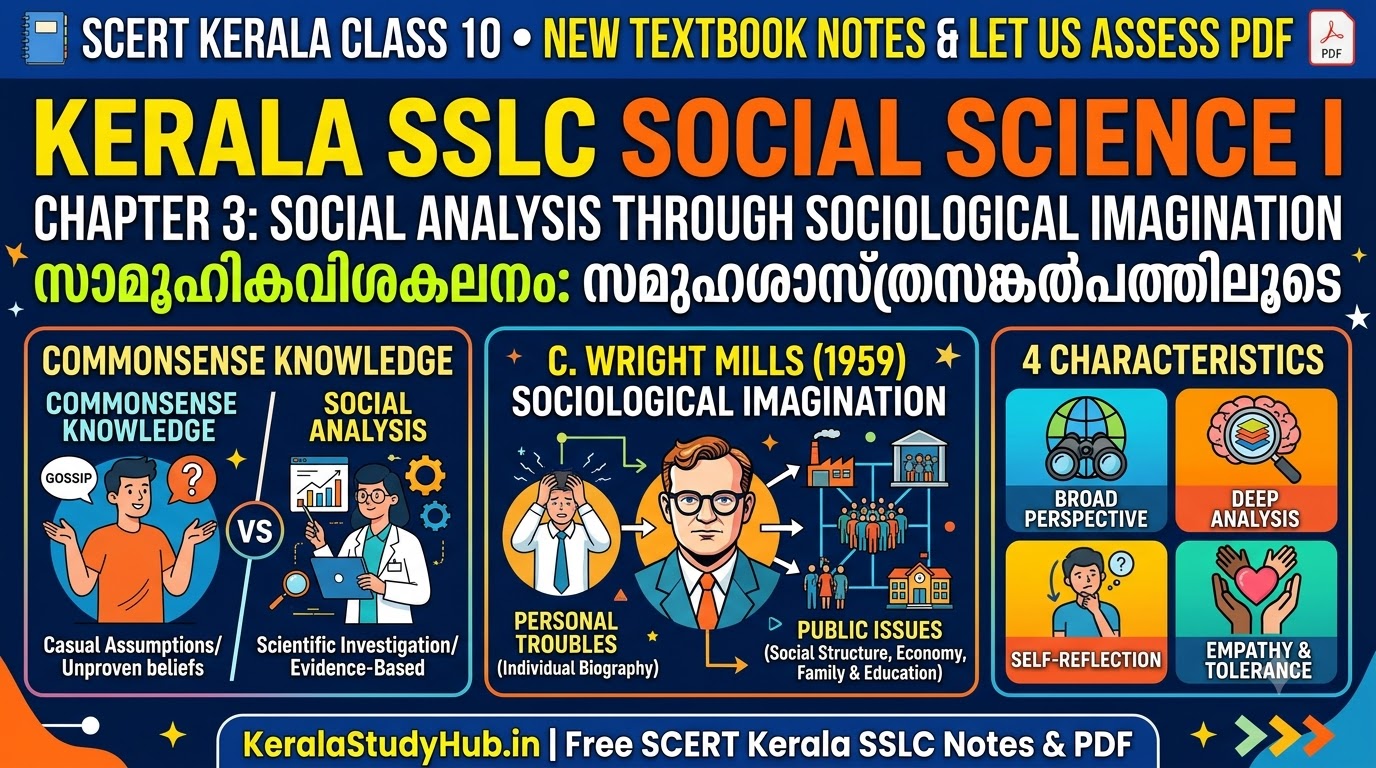
Kerala SSLC Social Science 1 Chapter 3 Notes for Social Analysis: Through Sociological Imagination (Malayalam Medium: സാമൂഹികവിശകലനം: സമൂഹശാസ്ത്രസങ്കല്പത്തിലൂടെ) cover the third unit of the newly revised Class 10 (Std 10) Social Science I textbook published by the State Council of Educational Research and Training (SCERT Kerala). In the Kerala Pareeksha Bhavan SSLC Public Examination, this sociology unit carries 5 to 6 marks, with guaranteed questions on the limitations of Commonsense Knowledge, Charles Wright Mills’s concept of Sociological Imagination (1959), and its four core characteristics.
- 1. What is Commonsense Knowledge? How It Develops & Its Limitations (സാമാന്യബോധ ജ്ഞാനവും പരിമിതികളും)
- 1.1 SCERT Textbook Case Study: Social Factors Behind Personal Problems (Anu’s Family Table)
- 2. Sociology, Social Analysis, Social Institutions & Social Structure (സാമൂഹിക വിശകലനവും സമൂഹശാസ്ത്രവും)
- 3. Sociological Imagination (C. Wright Mills, 1959) & Its 4 Characteristics (സമൂഹശാസ്ത്ര സങ്കല്പവും സവിശേഷതകളും)
- 3.1 Four Major Characteristics of Sociological Imagination with Examples (Guaranteed 4-Mark / 6-Mark Essay!)
- 3.2 Comparison: Commonsense Knowledge Approach vs Sociological Imagination Approach (4-Mark Table)
- 4. SCERT Textbook Let Us Assess Questions and Answers & Malayalam Medium Notes
As a High School Social Science teacher, I have prepared this complete bilingual English and Malayalam Medium revision guide with point-by-point comparison tables, textbook case studies (Anu’s family income, migrant workers, climate change, road accidents, and female workforce participation), and all solved Let Us Assess questions.
Quick SSLC Social Science I Navigation: Revise Chapter 1: Humanism | Chapter 2: Liberty, Equality, Fraternity | Next: Chapter 4: Wealth and the World | SSLC Biology All 6 Chapters Hub.
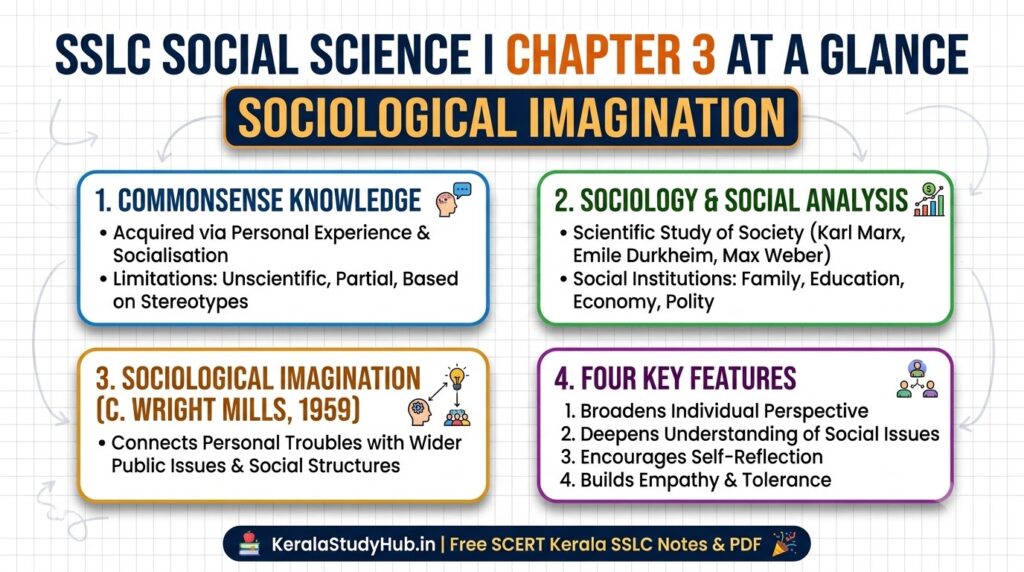
CHAPTER 3 AT A GLANCE: CLASS 10 SOCIAL SCIENCE I (SOCIOLOGY) REVISION BLUEPRINT
- Commonsense Knowledge (സാമാന്യബോധ ജ്ഞാനം): Informal everyday knowledge acquired through personal experiences, observation, socialization, and cultural assumptions. Limitations: Partial, unscientific, relies on stereotypes, and blames individuals instead of examining root social causes.
- Sociology & Early Thinkers: Scientific study of society. Early pioneers: Karl Marx, Emile Durkheim (proved through scientific study that suicide is driven by social factors more than personal ones), and Max Weber.
- Core Concepts of Social Analysis: Social Relationships, Social Institutions (Family, Marriage, Education, Religion, Economy, Polity, Judiciary), Social Structure (norms, rules, statuses, and roles), and Social Problems.
- Sociological Imagination (സമൂഹശാസ്ത്ര സങ്കല്പം): Coined by American sociologist Charles Wright Mills (C. Wright Mills) in his book The Sociological Imagination (1959); connects Personal Troubles with Public Issues (Social Structures).
- 4 Characteristics of Sociological Imagination: (1) Broadens Individual Perspective; (2) Deepens Understanding of Social Issues; (3) Encourages Self-Reflection; (4) Develops Empathy and Tolerance.
1. What is Commonsense Knowledge? How It Develops & Its Limitations (സാമാന്യബോധ ജ്ഞാനവും പരിമിതികളും)
In daily life, individuals often try to explain personal and social problems through superficial reasoning, personal experiences, social interaction, and the socialization process. This informal everyday understanding is called Commonsense Knowledge (സാമാന്യബോധ ജ്ഞാനം).
- How Commonsense Knowledge Develops: Through personal observation, everyday experiences, family upbringing, social customs, traditions, and socialization (Note: It is not formal or scientific knowledge).
- 5 Major Limitations of Commonsense Knowledge (3-Mark / 4-Mark Question):
- Not Based on Scientific Observation or Research: It relies on unverified assumptions, hearsay, and routine practices rather than empirical study.
- Relies Heavily on Stereotypes (വാർപ്പുമാതൃകകൾ): For example, assuming that “poverty is caused solely by individual laziness” or “all teenagers are rebellious” ignores deeper economic and social realities.
- Provides Only Partial and Superficial Knowledge: For example, believing that “high exam scores can be achieved only by studying for long hours” ignores scientific study methods, rest, nutrition, and mental health.
- Cannot Explain Complex Social Problems: It fails to identify the structural, economic, environmental, and administrative causes behind problems like unemployment, housing shortage, or climate change.
- Lacks Critical Thinking: It accepts prevailing social beliefs without questioning their validity.
1.1 SCERT Textbook Case Study: Social Factors Behind Personal Problems (Anu’s Family Table)
| Personal / Household Problem Observed | Underlying Social / Structural Factor |
|---|---|
| 1. Anu’s family has no steady source of income. | Financial / Economic Factor |
| 2. Household income varies sharply with the change of seasons (monsoon/drought). | Environmental / Climatic Factor |
| 3. Limited employment opportunities during the rainy season and lack of alternative livelihood schemes. | Administrative / Policy Factor |
| 4. Hardships faced by people living in remote coastal, hilly, or tribal areas. | Geographical Disparities |
2. Sociology, Social Analysis, Social Institutions & Social Structure (സാമൂഹിക വിശകലനവും സമൂഹശാസ്ത്രവും)
| Sociological Concept | Definition & Examples (നിർവ്വചനവും ഉദാഹരണങ്ങളും) |
|---|---|
| 1. Sociology (സമൂഹശാസ്ത്രം) | The scientific study of society that observes, analyses, and interprets social relationships, social institutions, and social structures. Early thinkers: Karl Marx, Emile Durkheim, Max Weber. |
| 2. Social Relationships (സാമൂഹിക ബന്ധങ്ങൾ) | The interactions and bonds individuals develop within society (e.g., care and cooperation within a family, bonds of friendship, workplace relations). |
| 3. Social Institutions (സാമൂഹിക സ്ഥാപനങ്ങൾ) | Established frameworks of rules and values that stabilize and regulate social relationships and human behaviour. Examples: Family, Marriage, Education, Religion, Economic Institutions, Political Institutions, and Judiciary. |
| 4. Social Structure (സാമൂഹിക ഘടന) | The organized pattern of statuses, roles, norms, and rules that provide order and stability to society. |
| 5. Social Problem (സാമൂഹിക പ്രശ്നം) | An undesirable condition that negatively affects a large number of people in society (e.g., poverty, unemployment, discrimination, urban housing crisis, climate change). |
| 6. Social Analysis (സാമൂഹിക വിശകലനം) | The systematic process of examining how social relationships, social institutions, social structures, and social problems affect individuals and society, helping formulate solutions for social progress. |
Emile Durkheim’s Study on Suicide (1-Mark / 2-Mark Question): While commonsense views suicide purely as an individual personal tragedy, French sociologist Emile Durkheim proved through empirical sociological analysis that people commit suicide primarily due to social reasons (such as social isolation, breakdown of social norms, and economic crises) rather than purely personal ones.
3. Sociological Imagination (C. Wright Mills, 1959) & Its 4 Characteristics (സമൂഹശാസ്ത്ര സങ്കല്പവും സവിശേഷതകളും)
The concept of Sociological Imagination (സമൂഹശാസ്ത്ര സങ്കല്പം) was introduced by American sociologist Charles Wright Mills (C. Wright Mills) in his landmark 1959 book, The Sociological Imagination. It is the cognitive ability to see the connection between Personal Troubles (biography/individual experiences) and Public Issues (history and larger social structures).
3.1 Four Major Characteristics of Sociological Imagination with Examples (Guaranteed 4-Mark / 6-Mark Essay!)
- Broadens Individual Perspective (വ്യക്തിപരമായ കാഴ്ചപ്പാട് വിപുലീകരിക്കുന്നു): It helps individuals look beyond personal blame and identify wider systemic causes. Example: Instead of blaming road accidents solely on a driver’s carelessness, sociological imagination reveals structural causes like unscientific road construction, traffic congestion, and failure in law enforcement.
- Deepens Understanding of Social Issues (സാമൂഹിക പ്രശ്നങ്ങളെ ആഴത്തിൽ മനസ്സിലാക്കുന്നു): It helps analyze complex societal problems critically. Example: Instead of attributing low female participation in the workforce to women’s lack of interest, it exposes deeper social causes such as patriarchal gender norms, unequal care responsibilities, and educational disparities.
- Encourages Self-Reflection / Self-Reflexivity (സ്വയം വിചിന്തനം പ്രോത്സാഹിപ്പിക്കുന്നു): It enables individuals to critically examine their own thoughts, prejudices, and lifestyle choices and recognize how larger social forces and media shape their behaviour.
- Develops Empathy and Tolerance (സഹാനുഭൂതിയും സഹിഷ്ണുതയും വളർത്തുന്നു): It helps us understand others’ struggles compassionately rather than judging them through stereotypes. Example: Instead of labelling a child with poor academic performance as “lazy” or “unintelligent”, sociological imagination prompts us to consider their family’s financial distress, health issues, or lack of digital learning resources.
3.2 Comparison: Commonsense Knowledge Approach vs Sociological Imagination Approach (4-Mark Table)
| Commonsense Knowledge Approach | Sociological Imagination Approach |
|---|---|
| 1. Narrow scope; limited strictly to personal views, individual experiences, and local customs. | 1. Broad scope; connects individual experiences (personal troubles) to larger social structures (public issues). |
| 2. Provides superficial explanations based on assumptions, prejudices, and stereotypes. | 2. Analyses deeply and scientifically how social, economic, and political factors impact individuals. |
| 3. Does not approach social realities through scientific observation or critical thinking. | 3. Encourages critical thinking, self-reflection, empathy, and evidence-based social policy. |
| 4. Blames the individual for problems like poverty, unemployment, or exam failure. | 4. Identifies structural root causes (e.g., economic recession, lack of infrastructure, social inequality). |
4. SCERT Textbook Let Us Assess Questions and Answers & Malayalam Medium Notes
Q1. Examine the statement: “Humans are not responsible for climate change.” How does social analysis refute this commonsense claim?
Answer: Scientific and sociological analysis proves that anthropogenic (human) activities—such as burning fossil fuels (coal, oil, and gas),大规模 deforestation, burning plastics, industrial emissions, and excessive use of CFC/HFC refrigerants and air conditioners—are the primary drivers of Global Warming, resulting in ozone depletion, melting polar ice, ocean acidification, and acute water scarcity.
Q2. What were the common social problems experienced by migrant workers in urban areas that appeared as personal troubles?
Answer: While each migrant worker experienced difficulties personally, sociological analysis reveals they shared common structural problems: (1) Unemployment and job insecurity in cities; (2) Lack of affordable, hygienic housing and urban overcrowding; and (3) Lack of awareness of labour laws and legal rights.
പത്താം ക്ലാസ് സാമൂഹ്യശാസ്ത്രം I അദ്ധ്യായം 3: സാമൂഹികവിശകലനം: സമൂഹശാസ്ത്രസങ്കല്പത്തിലൂടെ (മലയാളം മീഡിയം നോട്ടുകൾ)
- സാമാന്യബോധ ജ്ഞാനം (Commonsense Knowledge): വ്യക്തിപരമായ അനുഭവങ്ങൾ, നിരീക്ഷണങ്ങൾ, സാമൂഹികവൽക്കരണം എന്നിവയിലൂടെ നേടുന്ന അറിവാണിത്. പരിമിതികൾ: ശാസ്ത്രീയമായ പഠനങ്ങളെ അടിസ്ഥാനമാക്കിയുള്ളതല്ല, വാർപ്പുമാതൃകകളെ (Stereotypes) ആശ്രയിക്കുന്നു, സങ്കീർണ്ണമായ സാമൂഹിക പ്രശ്നങ്ങളുടെ യഥാർത്ഥ കാരണം കണ്ടെത്താൻ കഴിയില്ല.
- സമൂഹശാസ്ത്ര സങ്കല്പം (Sociological Imagination): 1959-ൽ ചാൾസ് റൈറ്റ് മിൽസ് (C. Wright Mills) രചിച്ച ‘ദി സോഷ്യോളജിക്കൽ ഇമാജിനേഷൻ’ എന്ന പുസ്തകത്തിലാണ് ഈ ആശയം അവതരിപ്പിച്ചത്. വ്യക്തിപരമായ പ്രശ്നങ്ങളെ (Personal Troubles) വിശാലമായ സാമൂഹിക ഘടനകളുമായും (Social Structures) സാമൂഹിക പ്രശ്നങ്ങളുമായും ബന്ധിപ്പിച്ച് മനസ്സിലാക്കാനുള്ള കഴിവാണിത്.
- സമൂഹശാസ്ത്ര സങ്കല്പത്തിന്റെ 4 സവിശേഷതകൾ: (1) വ്യക്തിപരമായ കാഴ്ചപ്പാട് വിപുലീകരിക്കുന്നു; (2) സാമൂഹിക പ്രശ്നങ്ങളെ ആഴത്തിൽ മനസ്സിലാക്കാൻ സഹായിക്കുന്നു; (3) സ്വയം വിചിന്തനം (Self-reflection) പ്രോത്സാഹിപ്പിക്കുന്നു; (4) സഹാനുഭൂതിയും സഹിഷ്ണുതയും (Empathy and Tolerance) വളർത്തുന്നു.
Teacher’s Classroom Note & Student Discussion Question:
Dear SSLC Students, always remember the name Charles Wright Mills (1959) and the 4 points of Sociological Imagination — they are sure-shot questions for your SSLC Social Science examination! Quick Question for You: Which early sociologist proved that people commit suicide primarily due to social reasons rather than personal ones? Write your answer in the comments below!


Latest SCERT & DHSE Kerala Study Notes
- Kerala Class 9 Physics Chapter 2 Notes: Equations of Motion (ചലനസമവാക്യങ്ങൾ) Std 9 Let Us Assess Questions and Answers PDF
- Kerala SSLC Christmas Exam Question Paper 2025-27: All Subjects Second Term & Model Question Papers with Solved Answer Keys PDF (New SCERT Syllabus)
- Kerala SSLC English Christmas Exam Question Paper 2025-27: Second Term & Model Solved 80-Mark Answer Key, Discourses & Grammar PDF
- Kerala SSLC Social Science Christmas Exam Question Paper 2025-27: Second Term & Model Solved 80-Mark Answer Key, Weightage & Map Study PDF
- Kerala SSLC Maths Christmas Exam Question Paper 2025-27: Second Term & Model Solved Answer Key, Weightage & Formula Sheet PDF (New SCERT Syllabus)
- Kerala SSLC Biology Christmas Exam Question Paper 2025-27: Second Term & Model Solved Answer Key, Weightage & Flowcharts PDF (New SCERT Syllabus)
- Kerala SSLC Chemistry Christmas Exam Question Paper 2025-27: Second Term & Model Solved Answer Key, Weightage & Sure A+ Questions PDF (New SCERT Syllabus)
- Kerala SSLC Physics Christmas Exam Question Paper 2025-27: Second Term & Model Solved Answer Key, Weightage & Formula Sheet PDF (New SCERT Syllabus)
