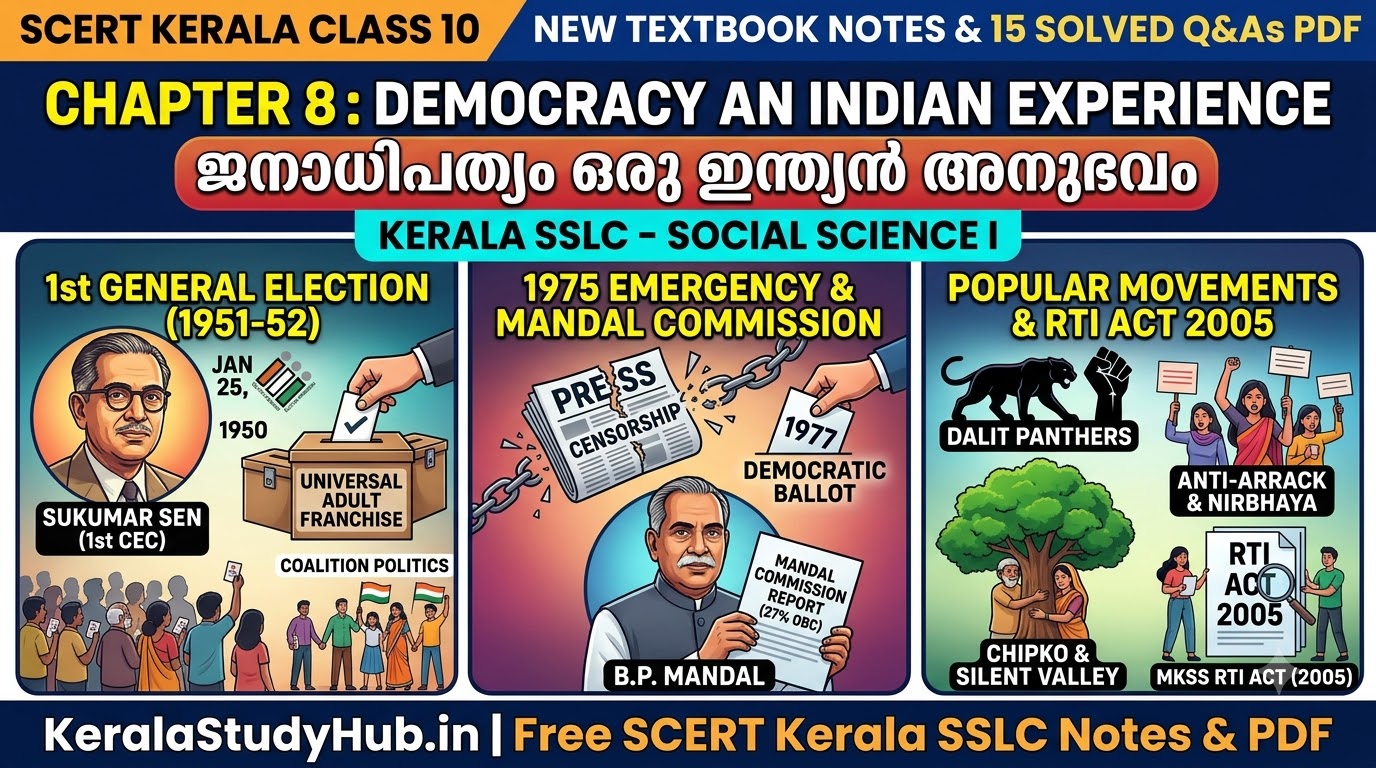
Kerala SSLC Social Science 1 Chapter 8 Notes on Democracy: An Indian Experience (Malayalam Medium: ജനാധിപത്യം ഒരു ഇന്ത്യൻ അനുഭവം) bring you the complete classroom study guide for the eighth unit of the newly revised Class 10 (Std 10) Social Science I textbook published by the State Council of Educational Research and Training (SCERT Kerala). Whenever I teach this chapter in Class 10, I tell my students that when India adopted Universal Adult Franchise in 1950, many Western observers doubted whether a newly independent nation with over 80% illiteracy could sustain democracy. Yet India not only held the world’s largest democratic election in 1951–52, but also overcame crises like the National Emergency of 1975 and deepened democracy through Coalition Politics, the Mandal Commission, Dalit/Women’s/Environmental Movements, and the Right to Information Act (2005).
- 1. First General Election (1951–52), Evolution of Party Politics & Coalition Era (ആദ്യ പൊതുതിരഞ്ഞെടുപ്പും മുന്നണി രാഷ്ട്രീയവും)
- 2. National Emergency of 1975, Mandal Commission (1979) & Dalit Movements (അടിയന്തരാവസ്ഥയും മണ്ഡൽ കമ്മീഷനും)
- 3. Popular Movements: Women, Environment, Farmers, Fishermen, RTI & Regional Autonomy
- 4. Complete SCERT Textbook “Let Us Assess” Solutions + 15 Extra Exam Questions & Answers
- Part A: SCERT Textbook “Let Us Assess” Questions and Answers (All Solved)
- Part B: Extra Sure-Shot Board Exam Questions and Answers (Q6 to Q15)
Designed for the Kerala Pareeksha Bhavan SSLC Public Examination, this complete classroom note includes detailed topic explanations, comparison tables, all solved SCERT Textbook Let Us Assess questions, and 15 Full Textbook + Extra Exam Questions and Answers so you can revise the entire chapter in one place.
Quick SSLC Social Science I Navigation: Revise Chapter 6: Mass Movement for Freedom | Chapter 7: The Glimpses of Free India | SSLC Physics All 7 Chapters Hub | SSLC Chemistry All 7 Chapters Hub | SSLC Biology All 6 Chapters Hub.
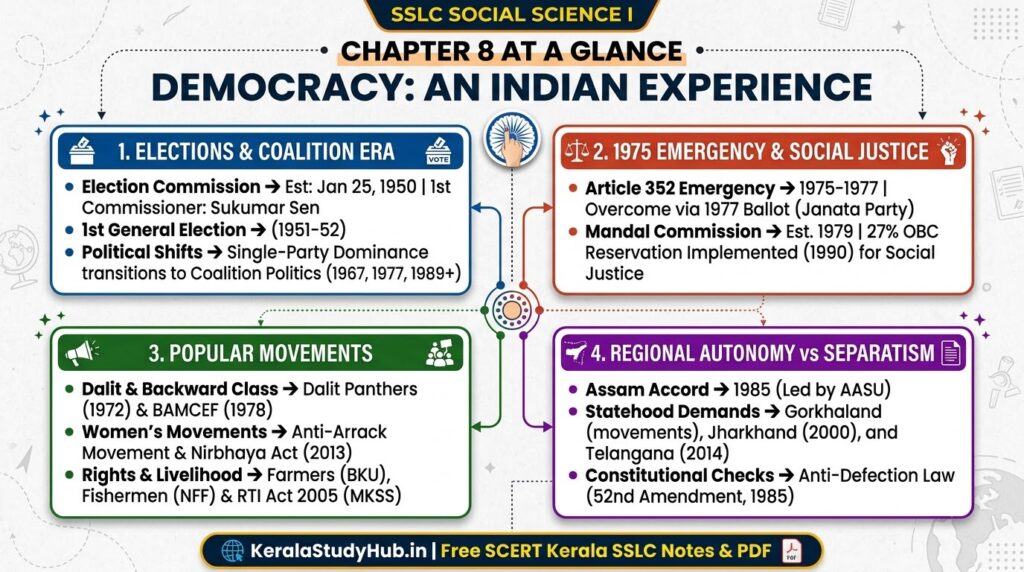
CHAPTER 8 AT A GLANCE: CLASS 10 SOCIAL SCIENCE I QUICK REVISION BLUEPRINT
- Election Commission & 1st General Election: Election Commission of India formed on January 25, 1950 (First Chief Election Commissioner: Sukumar Sen). First General Election held from October 1951 to February 1952 based on Universal Adult Franchise.
- National Emergency (June 25, 1975 – March 1977): Declared under Article 352 on grounds of “internal disturbance”. Froze Fundamental Rights, curtailed judicial review, imposed press censorship, and jailed opposition leaders. Overcome democratically in the 1977 General Election (First non-Congress government led by the Janata Party under PM Morarji Desai).
- Backward Classes & Dalit Empowerment: Kaka Kalelkar Commission (1953) → Second Backward Classes Commission / Mandal Commission (1979) headed by B.P. Mandal (recommended 27% reservation for OBCs; implemented in 1990 by PM V.P. Singh) | Dalit Panthers (1972, Maharashtra) & BAMCEF (1978, Kanshi Ram).
- Popular Social Movements: Women’s Movements (Anti-Arrack Movement in Andhra Pradesh, Nirbhaya Movement 2012 → Criminal Law Amendment Act 2013), Environmental Movements (Chipko, Silent Valley, Narmada Bachao Andolan), Farmers’ Movements (Bharatiya Kisan Union – BKU), Fishermen’s Movement, and RTI Campaign (MKSS in Rajasthan led by Aruna Roy → Right to Information Act, 2005).
- Regional Autonomy vs Separatist Movements: Assam Movement (AASU → 1985 Assam Accord), Gorkhaland, Creation of Jharkhand, Chhattisgarh & Uttarakhand (2000) and Telangana (2014) vs Khalistan separatist crisis (Operation Blue Star, 1984) and Mizo/Naga accords.
1. First General Election (1951–52), Evolution of Party Politics & Coalition Era (ആദ്യ പൊതുതിരഞ്ഞെടുപ്പും മുന്നണി രാഷ്ട്രീയവും)
To conduct free and fair elections across a vast and diverse nation, the Election Commission of India was established on January 25, 1950 (celebrated as National Voters’ Day), with Sukumar Sen as the first Chief Election Commissioner. The First General Election was held from October 1951 to February 1952.
- 5 Major Challenges in Conducting the First General Election (4-Mark Question):
- Delimiting Constituencies: Drawing boundaries of parliamentary and state assembly constituencies across newly integrated territories.
- Preparing Electoral Rolls: Registering over 17.3 crore eligible voters based on Universal Adult Franchise (nearly 40 lakh women were initially listed simply as “wife of…” or “daughter of…” and had to be re-registered by name).
- High Illiteracy (~85%): Educating a largely non-literate electorate about the secret ballot and introducing distinct election symbols on separate ballot boxes for each candidate.
- Training Election Personnel: Recruiting and training over 3 lakh polling officers and police personnel.
- Ensuring Transparency: Conducting impartial, peaceful polling across geographically difficult terrain.
| Phase / Period | Nature of Party System & Governance in India |
|---|---|
| 1. 1952 to 1967 (First Three Elections) | Dominance of the Indian National Congress at both the Union and State levels (with the historic exception of Kerala in 1957, where the CPI led by E.M.S. Namboodiripad formed the first non-Congress elected state government). |
| 2. 1967 General Election | Congress retained a reduced majority at the Centre, but lost power in 8 states, where non-Congress coalition governments (Samyukta Vidhayak Dal) were formed. |
| 3. 1977 General Election (Post-Emergency) | First non-Congress government at the Centre formed by the Janata Party with Morarji Desai as Prime Minister (1977–1979). Congress returned to power in 1980 and 1984. |
| 4. 1989 onwards (Era of Coalition Politics) | End of single-party dominance at the Centre: National Front (1989), Minority Congress Govt (1991), United Front (1996), NDA led by BJP (1998/1999–2004), UPA led by Congress (2004–2014), and NDA led by BJP (2014, 2019, 2024). |
3 Ways Coalition Governments Are Formed in India (3-Mark Question):
1. Pre-Poll Alliance: Political parties form an electoral front based on a Common Minimum Programme before the election.
2. Post-Poll Alliance: Different parties come together after the election results to reach the majority mark in the Lok Sabha.
3. Outside Support: Parties extend external issue-based support from outside without joining the Council of Ministers to help a minority government prove its majority.
2. National Emergency of 1975, Mandal Commission (1979) & Dalit Movements (അടിയന്തരാവസ്ഥയും മണ്ഡൽ കമ്മീഷനും)
- The National Emergency (June 25, 1975 – March 1977):
- Background Causes: Economic crisis of the early 1970s (food shortage, inflation, unemployment, oil crisis), the Gujarat (Navnirman) and Bihar student movements led by Jayaprakash Narayan (JP), the 1974 Railway Strike, and the Allahabad High Court verdict (June 12, 1975) invalidating Prime Minister Indira Gandhi’s 1971 Lok Sabha election.
- Declaration & Impacts (4-Mark Question): Declared on June 25, 1975 under Article 352 on the ground of “internal disturbance”: (1) Abolished the federal distribution of power and concentrated authority in the Union Government; (2) Froze Citizens’ Fundamental Rights; (3) Curtailed the Judiciary’s power of judicial review; (4) Imposed strict press censorship on newspapers; and (5) Imprisoned opposition leaders and activists without trial under preventive detention (MISA).
- Democratic Resilience (1977): When the Emergency was revoked in March 1977 and elections were called, the Indian electorate peacefully defeated the ruling party through the ballot box and elected the Janata Party government under Morarji Desai—proving the deep roots of Indian democracy.
- Backward Classes Commissions & The Mandal Commission Report:
- First Backward Classes Commission (1953): Chaired by Kaka Kalelkar (its recommendations were not implemented).
- Second Backward Classes Commission / Mandal Commission (1979): Appointed by the Janata Party government in 1979 and chaired by B.P. Mandal to study the educational and social backwardness of Other Backward Classes (OBCs). Submitted its report in 1980 recommending 27% reservation for OBCs in central government jobs and educational institutions, along with land reforms. Implemented in 1990 by the National Front government led by Prime Minister V.P. Singh, ushering in a new era of social justice and political empowerment of backward communities.
- Dalit Movements: (1) Dalit Panthers (1972, Maharashtra): Formed by educated urban Dalit youth and writers against caste atrocities and untouchability; (2) BAMCEF (1978): Backward and Minority Communities Employees Federation founded by Kanshi Ram for the political empowerment of SCs, STs, OBCs, and minorities (leading later to the formation of the Bahujan Samaj Party, BSP).
3. Popular Movements: Women, Environment, Farmers, Fishermen, RTI & Regional Autonomy
| Category of Movement | Major Movements, Leaders & Outcomes |
|---|---|
| 1. Women’s Movements (സ്ത്രീ മുന്നേറ്റങ്ങൾ) | • Anti-Arrack Movement (1990s, Nellore district, Andhra Pradesh): Rural women united against the sale of country liquor (arrack), which caused domestic violence and household poverty, forcing a state ban. • Nirbhaya Movement (2012, New Delhi): Massive nationwide protests demanding women’s safety following the brutal gang-rape and murder of a young paramedical student; led to the Criminal Law (Amendment) Act, 2013 (Nirbhaya Act) and fast-track courts. |
| 2. Environmental Movements (പരിസ്ഥിതി പ്രസ്ഥാനങ്ങൾ) | Emerged against unscientific development projects, deforestation, and displacement of tribals: • Chipko Movement (1973, Uttarakhand): Villagers (especially women) hugged trees to stop commercial logging (Sunderlal Bahuguna, Gaura Devi). • Silent Valley Movement (Kerala): Protected the tropical evergreen rainforest in Palakkad from a hydroelectric project. • Narmada Bachao Andolan (NBA): Led by Medha Patkar and Baba Amte for the rehabilitation of people displaced by the Sardar Sarovar Dam. |
| 3. Farmers’ & Fishermen’s Movements | • Bharatiya Kisan Union (BKU, 1980s, UP/Haryana) & Shetkari Sanghatana (Maharashtra): Mobilized farmers for fair minimum support prices (MSP), debt relief, and subsidized electricity; 2020–21 Samyukta Kisan Morcha protest. • National Fishworkers’ Forum (NFF): Started in Kerala by traditional coastal fishermen against mechanized bottom-trawling by deep-sea vessels that destroyed marine ecology and livelihoods. |
| 4. Right to Information (RTI) Movement | Initiated in 1990 at Bhim Tehsil, Rajasthan by the Mazdoor Kisan Shakti Sangathan (MKSS) led by Aruna Roy, demanding public hearings (Jan Sunwai) of village panchayat muster rolls and bills to expose corruption. Culminated in the historic Right to Information (RTI) Act of 2005. |
| 5. Regional Autonomy vs Separatist Movements | • Assam Movement (1979–1985): Led by the All Assam Students’ Union (AASU) against illegal cross-border immigration; resolved peacefully through the 1985 Assam Accord. • New States for Regional Autonomy: Gorkhaland movement (West Bengal); creation of Jharkhand, Chhattisgarh, and Uttarakhand (2000) and Telangana (2014). • Separatist Challenges Overcome: The Khalistan extremist movement in Punjab (Operation Blue Star in June 1984 at the Golden Temple, followed by the tragic assassination of PM Indira Gandhi on Oct 31, 1984 and the 1985 Rajiv-Longowal Punjab Accord), and the Mizo National Front (MNF — Laldenga, 1986 Mizo Peace Accord). |
4. Complete SCERT Textbook “Let Us Assess” Solutions + 15 Extra Exam Questions & Answers
Part A: SCERT Textbook “Let Us Assess” Questions and Answers (All Solved)
Q1. (Textbook) “Conducting the First General Election (1951–52) in a vast and diverse country like India was replete with numerous challenges.” Substantiate the statement.
Answer: Established on January 25, 1950 under First Chief Election Commissioner Sukumar Sen, the Election Commission faced unprecedented challenges during the 1951–52 General Election:
1. Delimitation of Constituencies: Drawing territorial boundaries for Lok Sabha and State Assembly seats across newly merged princely states and provinces.
2. Preparing Massive Electoral Rolls: Enrolling over 17.3 crore voters under Universal Adult Franchise (including correcting 40 lakh entries where women were recorded without their own names).
3. Overcoming Widespread Illiteracy (~85%): Designing pictorial election symbols and placing separate ballot boxes for each candidate so non-literate citizens could vote independently.
4. Training Officials & Logistics: Training over 3 lakh polling officers and setting up polling booths across deserts, mountains, and islands to ensure a transparent, fair election.
Q2. (Textbook) What were the major impacts of the National Emergency declared in India in 1975, and how did the people of India overcome this challenge through democratic means?
Answer: Declared on June 25, 1975 under Article 352, the National Emergency had severe impacts on Indian democracy:
• It suspended the federal structure of the Constitution and concentrated all powers in the Union Government.
• Citizens’ Fundamental Rights were frozen and the Judiciary’s power of judicial review was curtailed.
• Strict censorship was imposed on newspapers and media.
• Opposition leaders and thousands of political activists were imprisoned without trial.
How People Overcame It Democratically: When the Emergency was lifted in March 1977 and the Sixth General Election was held, Indian voters united peacefully at the ballot box, defeated the ruling Congress party, and elected the first non-Congress government led by the Janata Party under Prime Minister Morarji Desai. The subsequent 44th Constitutional Amendment (1978) added strict safeguards so that an Emergency could never again be misused lightly.
Q3. (Textbook) Evaluate the importance of the Mandal Commission Report and its implementation in Indian socio-political life.
Answer: Appointed in 1979 by the Janata Party government under the chairmanship of B.P. Mandal, the Second Backward Classes Commission investigated the social and educational backwardness of Other Backward Classes (OBCs). Its 1980 report recommended 27% reservation for OBCs in central government services and educational institutions. When Prime Minister V.P. Singh’s National Front government implemented the recommendation in 1990, it became a historic milestone in social justice, democratizing administrative power and empowering marginalized backward communities across India.
Q4. (Textbook) Explain the role of popular social movements (Women’s, Dalit, Environmental, Farmers’, and RTI movements) in strengthening Indian democracy.
Answer: Popular movements expand democracy beyond periodic elections by giving voice to marginalized citizens:
• Dalit Movements: The Dalit Panthers (1972) and BAMCEF (1978) fought caste oppression and ensured strict implementation of anti-atrocity laws.
• Women’s Movements: The Anti-Arrack Movement (Andhra Pradesh) fought domestic violence and liquor addiction, while the Nirbhaya Movement (2012) led to the stricter Criminal Law Amendment Act, 2013.
• Environmental Movements: Movements like Chipko, Silent Valley, and Narmada Bachao Andolan forced governments to balance industrial development with ecological conservation and tribal rights.
• RTI Movement: Led by MKSS (1990, Rajasthan), it resulted in the Right to Information Act, 2005, empowering every citizen to audit government files and fight corruption.
Q5. (Textbook) Distinguish between Regional Autonomy Movements and Separatist Movements in India with examples.
Answer: Regional Autonomy Movements operate within the framework of the Indian Constitution, demanding greater regional development, cultural protection, autonomous councils, or separate statehood within the Indian Union (e.g., the Gorkhaland movement leading to the Darjeeling Gorkha Hill Council/GTA, and movements that created Jharkhand, Chhattisgarh, Uttarakhand in 2000 and Telangana in 2014).
In contrast, Separatist Movements demand complete secession from India to form an independent country (e.g., the extremist Khalistan movement in Punjab in the 1980s). Indian democracy has successfully resolved regional grievances through dialogue, peace accords (such as the 1985 Assam Accord and 1986 Mizo Accord), and federal power-sharing.
Part B: Extra Sure-Shot Board Exam Questions and Answers (Q6 to Q15)
Q6. When was the Election Commission of India formed, and who was the first Chief Election Commissioner?
Answer: The Election Commission of India was formed on January 25, 1950, and Sukumar Sen served as the first Chief Election Commissioner of India.
Q7. What is meant by Defection (കൂറുമാറ്റം), and which Constitutional Amendment was passed to prevent it?
Answer: Defection refers to an elected legislator abandoning the political party on whose symbol they were elected and joining another party for personal office or monetary gain (popularly called “Aya Ram, Gaya Ram” after 1967). In 1985, Parliament passed the 52nd Constitutional Amendment Act (Anti-Defection Law — Tenth Schedule) to disqualify defecting legislators.
Q8. Write a short note on the Dalit Panthers movement.
Answer: Founded in Maharashtra in 1972 by educated first-generation Dalit youth and writers (such as Namdeo Dhasal and J.V. Pawar), the Dalit Panthers organized militant democratic resistance against caste oppression, untouchability, and atrocities against Dalits, while enriching Marathi protest literature.
Q9. What is BAMCEF, and when was it formed?
Answer: BAMCEF stands for the All India Backward and Minority Communities Employees Federation, formed in 1978 under the leadership of Kanshi Ram to politically organize and empower Scheduled Castes (SCs), Scheduled Tribes (STs), Other Backward Classes (OBCs), and minorities.
Q10. Explain the causes and outcome of the Anti-Arrack Movement in Andhra Pradesh.
Answer: Started in 1992 by rural women enrolled in adult literacy classes in Dubagunta village of Nellore district, Andhra Pradesh, the Anti-Arrack Movement protested against the government-backed sale of arrack (country liquor), which drained family wages and fueled domestic violence against women. The movement spread statewide and forced the government to ban arrack and address gender violence.
Q11. What led to the Nirbhaya Movement (2012), and what major legal reform did it bring?
Answer: The brutal gang-rape and murder of a 23-year-old paramedical student in New Delhi in December 2012 sparked the nationwide Nirbhaya Movement demanding women’s safety and swift justice. Based on the Justice J.S. Verma Committee report, Parliament enacted the Indian Criminal Law (Amendment) Act, 2013 (Nirbhaya Act), introducing stringent punishments for crimes against women and setting up Fast-Track Courts.
Q12. What were the major features and demands of the Fishermen’s Movement in India?
Answer: Originating in Kerala and spreading nationally through the National Fishworkers’ Forum (NFF), traditional artisanal fishermen protested against government policies allowing commercial deep-sea trawlers and mechanized bottom-trawling during the monsoon breeding season, which depleted fish stocks and destroyed coastal livelihoods.
Q13. Trace the origin of the Right to Information (RTI) Movement in India.
Answer: The movement for the Right to Information began in 1990 in Bhim Tehsil of Rajasthan, led by the Mazdoor Kisan Shakti Sangathan (MKSS) under social activist Aruna Roy. Demanding transparency in famine-relief wage records through public hearings (Jan Sunwai), the campaign grew nationwide and led Parliament to pass the Right to Information (RTI) Act in 2005.
Q14. What was the Assam Movement (1979–1985), and how was it resolved?
Answer: Led by the All Assam Students’ Union (AASU) from 1979 to 1985, the Assam Movement protested against large-scale illegal immigration from across the border, which locals feared would reduce the indigenous Assamese population to a minority and cause economic hardship. It was resolved peacefully in 1985 through the Assam Accord signed between the Rajiv Gandhi government and AASU leaders.
Q15. What was Operation Blue Star (1984)?
Answer: During the 1980s, a section of extremists in Punjab demanded a separate sovereign state called Khalistan and turned the Golden Temple in Amritsar into an armed fortress. In June 1984, the Government of India launched a military operation code-named Operation Blue Star to flush out the militants from the Golden Temple complex.
പത്താം ക്ലാസ് സാമൂഹ്യശാസ്ത്രം I അദ്ധ്യായം 8: ജനാധിപത്യം ഒരു ഇന്ത്യൻ അനുഭവം (മലയാളം മീഡിയം നോട്ടുകൾ)
- ആദ്യ പൊതുതിരഞ്ഞെടുപ്പ് (1951 ഒക്ടോബർ – 1952 ഫെബ്രുവരി): 1950 ജനുവരി 25-ന് ഇന്ത്യൻ തിരഞ്ഞെടുപ്പ് കമ്മീഷൻ രൂപീകൃതമായി (ആദ്യ മുഖ്യ തിരഞ്ഞെടുപ്പ് കമ്മീഷണർ: സുകുമാർ സെൻ). പ്രായപൂർത്തി വോട്ടവകാശത്തിന്റെ അടിസ്ഥാനത്തിലാണ് തിരഞ്ഞെടുപ്പ് നടന്നത്.
- 1975-ലെ ദേശീയ അടിയന്തരാവസ്ഥ (ജൂൺ 25, 1975 – മാർച്ച് 1977): ഭരണഘടനയുടെ 352-ാം അനുച്ഛേദപ്രകാരം ആഭ്യന്തര കലാപം ചൂണ്ടിക്കാട്ടി പ്രഖ്യാപിച്ച അടിയന്തരാവസ്ഥയിലൂടെ മൗലികാവകാശങ്ങൾ മരവിപ്പിക്കുകയും പത്രമാധ്യമങ്ങൾക്ക് സെൻസർഷിപ്പ് ഏർപ്പെടുത്തുകയും പ്രതിപക്ഷ നേതാക്കളെ ജയിലിലടക്കുകയും ചെയ്തു. 1977-ലെ തിരഞ്ഞെടുപ്പിൽ ജനങ്ങൾ ജനാധിപത്യപരമായി പ്രതികരിക്കുകയും മൊറാർജി ദേശായിയുടെ നേതൃത്വത്തിൽ ആദ്യത്തെ കോൺഗ്രസിതര സർക്കാർ (ജനതാ പാർട്ടി) അധികാരത്തിൽ വരികയും ചെയ്തു.
- മണ്ഡൽ കമ്മീഷനും (1979) ജനകീയ പ്രസ്ഥാനങ്ങളും: ബി.പി. മണ്ഡൽ അധ്യക്ഷനായ രണ്ടാം പിന്നാക്ക വിഭാഗ കമ്മീഷൻ (മണ്ഡൽ കമ്മീഷൻ) മറ്റു പിന്നാക്ക വിഭാഗങ്ങൾക്ക് (OBC) സർക്കാർ ജോലികളിലും വിദ്യാഭ്യാസ സ്ഥാപനങ്ങളിലും 27% സംവരണം ശുപാർശ ചെയ്തു (1990-ൽ വി.പി. സിംഗ് സർക്കാർ നടപ്പിലാക്കി). ദളിത് പാന്തേഴ്സ് (1972, മഹാരാഷ്ട്ര), ചാരായ വിരുദ്ധ സമരം (ആന്ധ്രാപ്രദേശ്), നിർഭയ പ്രസ്ഥാനം (2012), വിവരാവകാശ പ്രസ്ഥാനം (MKSS – 1990 രാജസ്ഥാൻ → വിവരാവകാശ നിയമം 2005), അസം പ്രസ്ഥാനം (AASU).
Teacher’s Classroom Note & Student Discussion Question:
Dear SSLC Students, I have included 15 complete textbook and extra exam questions above so you can prepare this chapter just like a classroom guidebook! Quick Question for You: Which organization in Rajasthan initiated the grassroots struggle that led to the Right to Information (RTI) Act of 2005, and who was India’s first Chief Election Commissioner? Write your answer in the comments below!


Latest SCERT & DHSE Kerala Study Notes
- Kerala Class 9 Physics Chapter 2 Notes: Equations of Motion (ചലനസമവാക്യങ്ങൾ) Std 9 Let Us Assess Questions and Answers PDF
- Kerala SSLC Christmas Exam Question Paper 2025-27: All Subjects Second Term & Model Question Papers with Solved Answer Keys PDF (New SCERT Syllabus)
- Kerala SSLC English Christmas Exam Question Paper 2025-27: Second Term & Model Solved 80-Mark Answer Key, Discourses & Grammar PDF
- Kerala SSLC Social Science Christmas Exam Question Paper 2025-27: Second Term & Model Solved 80-Mark Answer Key, Weightage & Map Study PDF
- Kerala SSLC Maths Christmas Exam Question Paper 2025-27: Second Term & Model Solved Answer Key, Weightage & Formula Sheet PDF (New SCERT Syllabus)
- Kerala SSLC Biology Christmas Exam Question Paper 2025-27: Second Term & Model Solved Answer Key, Weightage & Flowcharts PDF (New SCERT Syllabus)
- Kerala SSLC Chemistry Christmas Exam Question Paper 2025-27: Second Term & Model Solved Answer Key, Weightage & Sure A+ Questions PDF (New SCERT Syllabus)
- Kerala SSLC Physics Christmas Exam Question Paper 2025-27: Second Term & Model Solved Answer Key, Weightage & Formula Sheet PDF (New SCERT Syllabus)
