
Kerala SSLC Social Science 1 Chapter 7 Notes on The Glimpses of Free India (Malayalam Medium: സ്വതന്ത്ര ഇന്ത്യയുടെ വർത്തമാനം) welcome you to one of the most inspiring and high-scoring chapters of the newly revised Class 10 (Std 10) Social Science I textbook published by the State Council of Educational Research and Training (SCERT Kerala). In my classroom, when we finish studying the Freedom Struggle in Chapter 6, students always ask: “Sir, what happened the morning after August 15, 1947? How did a partitioned country with 565 princely states, millions of refugees, and severe food shortages unite and grow into a modern scientific republic?” That exact journey is what we study in Chapter 7 for the Kerala Pareeksha Bhavan SSLC Public Examination.
- 1. Post-Independence Challenges, Partition & Integration of Princely States (നാട്ടുരാജ്യങ്ങളുടെ സംയോജനം)
- 2. Linguistic Reorganisation of States in India (ഭാഷാടിസ്ഥാനത്തിലുള്ള സംസ്ഥാന പുനഃസംഘടന)
- 3. Economic Planning, Land Reforms, Agricultural Revolutions, Science & Foreign Policy
- 4. Complete SCERT Textbook “Let Us Assess” Solutions + 15 Extra Exam Questions & Answers
- Part A: SCERT Textbook “Let Us Assess” Questions and Answers (All Solved)
- Part B: Extra Sure-Shot Board Exam Questions and Answers (Q7 to Q15)
As your Social Science teacher, I have prepared this post as a complete, self-contained classroom notebook. Below you will find structured topic-wise revision notes, comparison tables, all solved SCERT Textbook Let Us Assess questions, and 15+ Extra Sure-Shot Board Exam Questions and Answers (1-Mark, 2-Mark, 3-Mark, 4-Mark, and 6-Mark Essays) so you do not need to look anywhere else to score an A+.
Quick SSLC Social Science I Navigation: Revise Chapter 5: Public Opinion in Democracy | Chapter 6: Mass Movement for Freedom | Next: Chapter 8: Democracy: An Indian Experience | SSLC Biology All 6 Chapters Hub.
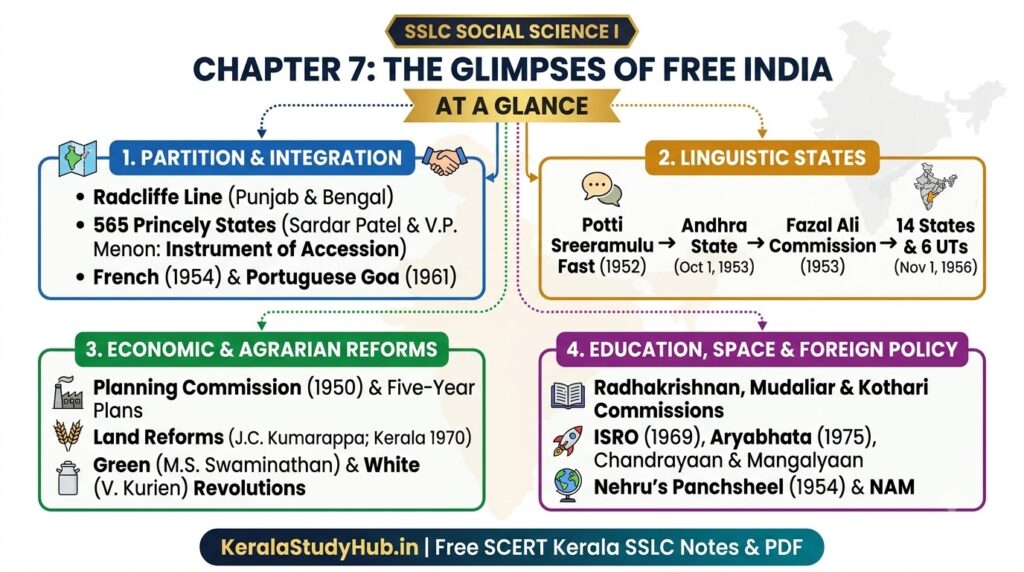
CHAPTER 7 AT A GLANCE: CLASS 10 SOCIAL SCIENCE I QUICK REVISION BLUEPRINT
- Partition & Boundary Line: Drawn by British lawyer Sir Cyril Radcliffe. Only two provinces were divided: Punjab (East Punjab to India; West Punjab to Pakistan) and Bengal (West Bengal to India; East Bengal to East Pakistan, which became Bangladesh in 1971), plus Sylhet in Assam joined East Pakistan via referendum.
- Martyrdom of Mahatma Gandhi: Assassinated on January 30, 1948 at Birla House, New Delhi, by communalist Nathuram Vinayak Godse.
- Integration of 565 Princely States: Led by Home Minister Sardar Vallabhbhai Patel and States Department Secretary V.P. Menon using the Instrument of Accession, Standstill Agreement, and Merger Agreement. Resisting states integrated: Junagadh, Hyderabad (Operation Polo), Kashmir, and Travancore/Manipur.
- Liberation of Foreign Enclaves: French territories (Pondicherry, Karaikal, Mahe, Yanam, Chandernagore) handed over in 1954; Portuguese territories liberated in 1954 (Dadra & Nagar Haveli) and December 1961 (Goa, Daman & Diu via Operation Vijay).
- Linguistic Reorganization of States: Martyrdom of Potti Sreeramulu (58-day fast, 1952) → Formation of Andhra State on October 1, 1953 → States Reorganisation Commission (1953) chaired by Justice Fazal Ali (with K.M. Panikkar & H.N. Kunzru) → 14 States & 6 Union Territories on November 1, 1956.
- Economic, Scientific & Kerala Model Achievements: Planning Commission (1950), Five-Year Plans, Land Reforms (J.C. Kumarappa Committee; Kerala Land Reforms 1963/1970 ending Janmi system), Green Revolution (Dr. M.S. Swaminathan), White Revolution (Dr. Verghese Kurien), Space Missions (Aryabhata 1975, Chandrayaan, Mangalyaan 2013), and Panchsheel (1954).
1. Post-Independence Challenges, Partition & Integration of Princely States (നാട്ടുരാജ്യങ്ങളുടെ സംയോജനം)
When India attained independence on August 15, 1947, the nation faced five immediate challenges: (1) Rehabilitation of millions of refugees displaced by Partition; (2) Integration of 565 Princely States into the Indian Union; (3) Incorporation of French and Portuguese colonial enclaves; (4) Reorganisation of states on a linguistic basis; and (5) Rebuilding the shattered colonial economy and achieving food self-sufficiency.
| Historical Milestone | Key Leaders / Officials | Key Facts for SSLC Exam |
|---|---|---|
| 1. Boundary Demarcation & Partition (1947) | Sir Cyril Radcliffe (British lawyer) | Only Bengal and Punjab were partitioned, while Sylhet in Assam joined East Pakistan after a referendum. Massive forced migration occurred in Punjab, whereas migration in Bengal was comparatively lower initially due to shared linguistic/cultural ties and Mahatma Gandhi’s peace mission in Noakhali/Calcutta. |
| 2. Integration of 565 Princely States | Sardar Vallabhbhai Patel (Home Minister) & V.P. Menon (Malayali Secretary of States Dept) | Used three legal agreements: Standstill Agreement, Instrument of Accession (handing over Defense, Foreign Affairs & Communications), and Merger Agreement. Rulers who joined were granted Privy Purses. Resistant states like Junagadh (plebiscite), Hyderabad (police action / Operation Polo in 1948), Kashmir (Instrument of Accession), and Travancore were successfully integrated. |
| 3. Liberation of French & Portuguese Territories | Government of India & Local Freedom Fighters | France handed over Pondicherry (Puducherry), Karaikal, Mahe, Yanam, and Chandernagore peacefully in 1954 following mass protests. Portugal refused to leave: Dadra and Nagar Haveli were liberated in 1954, and Goa, Daman, and Diu were liberated through military action (Operation Vijay) in 1961. |
2. Linguistic Reorganisation of States in India (ഭാഷാടിസ്ഥാനത്തിലുള്ള സംസ്ഥാന പുനഃസംഘടന)
- 1920 Nagpur Congress Session: Even during the freedom struggle, the Indian National Congress recognized the linguistic principle at its 1920 Nagpur session by organizing Provincial Congress Committees on the basis of language.
- S.K. Dhar Commission (1948) & J.V.P. Committee (1948): After independence, the Constituent Assembly appointed the S.K. Dhar Commission, and the Congress appointed the J.V.P. Committee (comprising Jawaharlal Nehru, Vallabhbhai Patel, and Pattabhi Sitaramayya) to examine the demand; both initially advised postponing linguistic division due to national security concerns.
- Martyrdom of Potti Sreeramulu & Birth of Andhra State (1952–1953): In 1952, veteran Gandhian freedom fighter Potti Sreeramulu undertook an indefinite hunger strike demanding a separate state of Andhra for Telugu-speaking people carved out of Madras Presidency. He died on the 58th day of his fast (December 15, 1952), triggering massive protests. Consequently, Andhra State came into existence on October 1, 1953 as the first linguistic state of independent India.
- States Reorganisation Commission (1953) & Act of 1956: In 1953, Prime Minister Jawaharlal Nehru appointed the three-member States Reorganisation Commission (SRC) chaired by Justice Fazal Ali, with K.M. Panikkar and H.N. Kunzru as members. Based on the Commission’s report, the Parliament passed the States Reorganisation Act in 1956, forming 14 Linguistic States (including Kerala State on November 1, 1956 by uniting Malabar, Cochin, and Travancore) and 6 Union Territories.
3. Economic Planning, Land Reforms, Agricultural Revolutions, Science & Foreign Policy
| Sector / Initiative | Key Architects / Commissions | Major Achievements & Exam Points |
|---|---|---|
| 1. Mixed Economy & Five-Year Plans | Jawaharlal Nehru (Planning Commission formed on March 15, 1950) | Adopted a Mixed Economy combining public and private sectors. 1st Five-Year Plan (1951–56): Agriculture & multipurpose river valley dams (Bhakra Nangal, Hirakud, Damodar Valley — called “Temples of Modern India” by Nehru). 2nd Five-Year Plan (1956–61): Rapid Heavy Industrialization (Iron & Steel plants at Bhilai, Rourkela, Durgapur). |
| 2. Land Reforms in India & Kerala | J.C. Kumarappa (Agrarian Reforms Committee) | Kerala Land Reforms Act (1963/1970) | Abolished the Zamindari / Janmi landlord system, fixed a ceiling on land holdings, distributed surplus land to landless peasants, and granted permanent ownership rights to tenants (Kudikidappukar). |
| 3. Agricultural Revolutions | Dr. M.S. Swaminathan (Father of Indian Green Revolution) | Dr. Verghese Kurien (White Revolution) | Green Revolution: High-Yielding Variety (HYV) seeds, irrigation, chemical fertilizers → self-sufficiency in food grains. White Revolution (Operation Flood): Increased milk production. Blue Revolution: Improved fish production. |
| 4. Education Commissions in Free India | Dr. S. Radhakrishnan (1948), Dr. Lakshmanaswami Mudaliar (1952), Dr. D.S. Kothari (1964) | Radhakrishnan Commission (University Education, 1948); Mudaliar Commission (Secondary Education, 1952); Kothari Commission (1964 — recommended the 10+2+3 national pattern). National Education Policies: 1968, 1986, and 2020. |
| 5. Science, Space & Nuclear Progress | Homi J. Bhabha, Vikram Sarabhai, Dr. A.P.J. Abdul Kalam | CSIR, Atomic Energy Commission (1948), ISRO (1969). First Indian artificial satellite: Aryabhata (launched on April 19, 1975); Lunar missions: Chandrayaan-1, 2, and 3; Mars Orbiter Mission: Mangalyaan (2013); Solar mission: Aditya-L1. |
| 6. India’s Foreign Policy & Panchsheel (1954) | Jawaharlal Nehru (Chief Architect of Indian Foreign Policy) & Zhou Enlai (China) | Core principles: Peaceful coexistence, Non-Alignment (NAM), anti-colonialism, and anti-racism (anti-apartheid). Panchsheel Agreement (1954) signed between Nehru and Chinese Premier Zhou Enlai based on 5 principles of mutual respect and non-aggression. |
4. Complete SCERT Textbook “Let Us Assess” Solutions + 15 Extra Exam Questions & Answers
Part A: SCERT Textbook “Let Us Assess” Questions and Answers (All Solved)
Q1. (Textbook) How did the integration of Princely States after India’s independence address the issue of national unity? What strategies were employed?
Answer: At the time of independence in 1947, there were around 565 Princely States ruled by Maharajas and Nawabs who were given the option by the Indian Independence Act to join India, join Pakistan, or remain independent. If left independent, India would have fragmented into hundreds of pieces. Home Minister Sardar Vallabhbhai Patel and States Department Secretary V.P. Menon unified the nation using three diplomatic treaties:
1. Standstill Agreement: Maintained existing administrative arrangements.
2. Instrument of Accession: Princely states transferred control over Defense, External Affairs, and Communications to the Indian Union.
3. Merger Agreement: Merged smaller states into neighbouring provinces.
Rulers were granted Privy Purses. Resistant states like Junagadh (integrated via plebiscite), Hyderabad (integrated via police action / Operation Polo in 1948), Kashmir (signed Instrument of Accession after Pakistani tribal invasion), and Travancore were brought into the Indian Union, ensuring territorial integrity and political stability.
Q2. (Textbook) Discuss the motivations and outcomes of the Linguistic Reorganisation of States in post-independence India.
Answer: British Indian provinces had been drawn haphazardly for military and administrative convenience, grouping people speaking different languages together. Linguistic reorganization was motivated by the need to ensure administrative convenience, preserve regional cultures, and allow ordinary citizens to participate in democratic governance in their mother tongue. Following the martyrdom of Potti Sreeramulu in 1952 and the creation of Andhra State on October 1, 1953, the Government of India appointed the States Reorganisation Commission (1953) chaired by Justice Fazal Ali (with K.M. Panikkar and H.N. Kunzru). Based on its report, the States Reorganisation Act of 1956 created 14 linguistic states and 6 Union Territories on November 1, 1956, strengthening Indian federalism and national unity.
Q3. (Textbook) Analyse the socio-economic impacts of Land Reform Laws in India and specifically in Kerala.
Answer: Based on the recommendations of the Agrarian Reforms Committee chaired by J.C. Kumarappa, independent India enacted land reform laws with three primary objectives: (1) Abolishing intermediaries like the Zamindari and Janmi systems; (2) Tenancy reforms providing security of tenure and fair rent; and (3) Imposing a ceiling on land holdings and redistributing surplus land to landless agricultural labourers.
In Kerala (Kerala Land Reforms Act, 1963 / implemented 1970): The centuries-old feudal Janmi system was completely abolished; tenants and homestead dwellers (Kudikidappukar) gained permanent ownership rights over their land; caste-based agrarian exploitation ended; and rural poverty and inequality declined sharply.
Q4. (Textbook) In what ways did Kerala’s approach to Education and Healthcare set it apart from other Indian states and earn it the reputation of the “Kerala Model of Development”?
Answer: Historically supported by social reform movements, Christian missionaries, visionary rulers of Travancore and Cochin, and post-1956 elected governments, Kerala invested heavily in universal, free public school education, mid-day meal programmes, library movements, and a strong three-tier Primary Health Centre (PHC) public healthcare network alongside effective land reforms and public distribution (ration shops). As a result, Kerala achieved near-100% literacy, high life expectancy, low infant mortality, and high human development indicators comparable to developed countries despite having a moderate per-capita income—earning global recognition as the “Kerala Model of Development”.
Q5. (Textbook) “There is no visible limit to the advance of science, if it is given the chance to advance.” — Jawaharlal Nehru. Evaluate India’s achievements in Science and Space Exploration in light of this statement.
Answer: Prime Minister Jawaharlal Nehru championed Scientific Temper as the foundation of nation-building. Under his leadership and the guidance of scientists like Homi J. Bhabha, Vikram Sarabhai, and C.V. Raman, India established the Council of Scientific and Industrial Research (CSIR), the Atomic Energy Commission (1948), IITs, and the Indian Space Research Organisation (ISRO, 1969). Major space milestones include:
• Launching India’s first artificial satellite, Aryabhata, on April 19, 1975.
• Developing indigenous satellite launch vehicles (SLV-3, PSLV, GSLV/LVM3) and INSAT/GSAT communication and IRS remote-sensing satellites.
• Historic planetary missions: Chandrayaan-1 (2008), Chandrayaan-2 (2019), and Chandrayaan-3 (2023 — first country to soft-land near the Lunar South Pole), the Mangalyaan (Mars Orbiter Mission, 2013), and the Aditya-L1 solar mission.
Q6. (Textbook) What were the fundamental principles of India’s Foreign Policy and the Panchsheel Agreement (1954)?
Answer: Shaped by Jawaharlal Nehru, India’s foreign policy is based on Non-Alignment (NAM), peaceful coexistence, opposition to colonialism, imperialism, and racial discrimination (apartheid), and support for the United Nations and world peace.
In 1954, Prime Minister Jawaharlal Nehru and Chinese Premier Zhou Enlai signed the Panchsheel Agreement (Five Principles of Peaceful Coexistence):
1. Mutual respect for each other’s territorial integrity and sovereignty.
2. Mutual non-aggression.
3. Mutual non-interference in each other’s internal affairs.
4. Equality and mutual benefit.
5. Peaceful coexistence.
Part B: Extra Sure-Shot Board Exam Questions and Answers (Q7 to Q15)
Q7. Who prepared the boundary line between India and Pakistan in 1947, and which provinces were divided?
Answer: British lawyer Sir Cyril Radcliffe chaired the Boundary Commissions that drew the border (the Radcliffe Line). The provinces of Punjab (West Punjab to Pakistan, East Punjab to India) and Bengal (East Bengal to East Pakistan, West Bengal to India) were divided, while Sylhet district in Assam joined East Pakistan through a referendum.
Q8. Why was the post-partition migration and violence comparatively lower in Bengal than in Punjab?
Answer: Unlike Punjab, where a sudden, complete exchange of populations took place amid intense communal violence, Bengal shared a strong common linguistic and cultural bond (Bengali language and secular heritage), and Mahatma Gandhi’s personal presence and fasts for communal harmony in Calcutta and Noakhali calmed tensions and prevented an immediate total exodus.
Q9. Compare how India liberated territories held by France and Portugal after 1947.
Answer: Following popular mass movements in French Indian settlements (Pondicherry, Karaikal, Mahe, Yanam, Chandernagore), France respected public sentiment and handed over its territories to India through a diplomatic treaty in 1954. In contrast, Portugal refused to negotiate; volunteers liberated Dadra and Nagar Haveli in 1954, and the Indian Armed Forces liberated Goa, Daman, and Diu in December 1961 (Operation Vijay).
Q10. Distinguish between the Standstill Agreement, Instrument of Accession, and Merger Agreement.
Answer: (1) Standstill Agreement: Ensured that existing administrative and economic arrangements between British India and the princely states continued unchanged to prevent an administrative vacuum and stop states from joining Pakistan.
(2) Instrument of Accession: Agreement by which princely states acceded to the Indian Union by handing over three subjects—Defense, External Affairs, and Communications—while retaining internal autonomy.
(3) Merger Agreement: Agreement by which princely rulers surrendered full governance rights so their states merged completely into the Indian Union’s democratic administrative framework.
Q11. Name the three major Education Commissions appointed in independent India and their chairpersons.
Answer: (1) University Education Commission (1948) — chaired by Dr. S. Radhakrishnan; (2) Secondary Education Commission (1952) — chaired by Dr. A. Lakshmanaswami Mudaliar; and (3) Indian Education Commission (1964–66) — chaired by Dr. D.S. Kothari.
Q12. Distinguish between the Green Revolution, White Revolution, and Blue Revolution in India.
Answer: (1) Green Revolution (led by Dr. M.S. Swaminathan): Use of High-Yielding Variety (HYV) seeds, irrigation, and fertilizers to achieve self-sufficiency in food grains (wheat and rice).
(2) White Revolution / Operation Flood (led by Dr. Verghese Kurien): Dairy cooperative movement that made India the world’s largest producer of milk.
(3) Blue Revolution: Scientific modernization of marine and inland fisheries to increase fish production.
Q13. Who were the members of the J.V.P. Committee (1948) and the States Reorganisation Commission (1953)?
Answer: The J.V.P. Committee (1948) consisted of Jawaharlal Nehru, Vallabhbhai Patel, and Pattabhi Sitaramayya. The States Reorganisation Commission (1953) consisted of Justice Fazal Ali (Chairman), K.M. Panikkar, and H.N. Kunzru.
Q14. What were the focal areas of the First and Second Five-Year Plans in India?
Answer: The First Five-Year Plan (1951–1956) prioritized Agriculture, Irrigation, and Power (constructing multipurpose river valley dams like Bhakra Nangal, Hirakud, and Damodar Valley). The Second Five-Year Plan (1956–1961), based on the P.C. Mahalanobis model, prioritized Rapid Heavy Industrialization (setting up public-sector steel plants at Bhilai, Rourkela, and Durgapur).
Q15. When and where was Mahatma Gandhi assassinated, and why was India’s first Independence Day a blend of joy and sorrow?
Answer: India’s independence on August 15, 1947 was accompanied by the tragic trauma of Partition, communal riots, and the displacement of millions of refugees. Mahatma Gandhi, who worked tirelessly to restore Hindu-Muslim unity, was assassinated on January 30, 1948 in the courtyard of Birla House, New Delhi, by communalist Nathuram Vinayak Godse.
പത്താം ക്ലാസ് സാമൂഹ്യശാസ്ത്രം I അദ്ധ്യായം 7: സ്വതന്ത്ര ഇന്ത്യയുടെ വർത്തമാനം (മലയാളം മീഡിയം നോട്ടുകൾ)
- വിഭജനവും നാട്ടുരാജ്യങ്ങളുടെ സംയോജനവും: ഇന്ത്യയുടെയും പാകിസ്താന്റെയും അതിർത്തി നിർണ്ണയിച്ചത് ബ്രിട്ടീഷ് അഭിഭാഷകനായ സിറിൽ റാഡ്ക്ലിഫ് ആണ് (പഞ്ചാബും ബംഗാളും വിഭജിക്കപ്പെട്ടു). 565 നാട്ടുരാജ്യങ്ങളെ ഇന്ത്യൻ യൂണിയനിൽ ലയിപ്പിക്കുന്നതിന് നേതൃത്വം നൽകിയത് ആഭ്യന്തര മന്ത്രി സർദാർ വല്ലഭായ് പട്ടേലും സ്റ്റേറ്റ്സ് ഡിപ്പാർട്ട്മെന്റ് സെക്രട്ടറിയായിരുന്ന മലയാളി വി.പി. മേനോനുമാണ് (ജുനഗഢ്, ഹൈദരാബാദ്, കാശ്മീർ, തിരുവിതാംകൂർ എന്നിവ ലയിപ്പിച്ചു). 1954-ൽ ഫ്രഞ്ച് പ്രദേശങ്ങളും (പോണ്ടിച്ചേരി, മാഹി), 1961-ൽ പോർച്ചുഗീസ് പ്രദേശങ്ങളും (ഗോവ, ദാമൻ, ദിയു) മോചിപ്പിക്കപ്പെട്ടു.
- ഭാഷാടിസ്ഥാനത്തിലുള്ള സംസ്ഥാന പുനഃസംഘടന: തെലുങ്ക് സംസാരിക്കുന്നവർക്കായി പ്രത്യേക ആന്ധ്രാ സംസ്ഥാനം രൂപീകരിക്കണമെന്നാവശ്യപ്പെട്ട് നിരാഹാര സമരം അനുഷ്ഠിച്ച പോട്ടി ശ്രീരാമുലുവിന്റെ മരണത്തെ (1952) തുടർന്ന് 1953 ഒക്ടോബർ 1-ന് ആന്ധ്രാ സംസ്ഥാനം നിലവിൽ വന്നു. തുടർന്ന് 1953-ൽ രൂപീകരിച്ച സംസ്ഥാന പുനഃസംഘടനാ കമ്മീഷന്റെ (ഫസൽ അലി, കെ.എം. പണിക്കർ, എച്ച്.എൻ. കുൻസ്രു) ശുപാർശപ്രകാരം 1956 നവംബർ 1-ന് 14 സംസ്ഥാനങ്ങളും 6 കേന്ദ്രഭരണ പ്രദേശങ്ങളും രൂപീകരിച്ചു.
- സാമ്പത്തിക-ശാസ്ത്ര പുരോഗതി: ഭൂപരിഷ്കരണം (ജെ.സി. കുമരപ്പ കമ്മിറ്റി), ഹരിതവിപ്ലവം (ഡോ. എം.എസ്. സ്വാമിനാഥൻ), ധവളവിപ്ലവം (ഡോ. വർഗീസ് കുര്യൻ), ബഹിരാകാശ നേട്ടങ്ങൾ (ആര്യഭട്ട – 1975 ഏപ്രിൽ 19, ചന്ദ്രയാൻ, മംഗൾയാൻ – 2013), ജവഹർലാൽ നെഹ്റുവും ചൗ എൻ ലായിയും തമ്മിൽ ഒപ്പുവെച്ച പഞ്ചശീല തത്വങ്ങൾ (1954).
Teacher’s Classroom Note & Student Discussion Question:
Dear SSLC Students, make sure you revise all 15 questions and answers above before your examination — especially the questions on Integration of Princely States, Linguistic Reorganization of States (1956), and Land Reforms! Quick Question for You: On what exact date was India’s first artificial satellite Aryabhata launched, and who is known as the Father of the Green Revolution in India? Write your answer in the comments below!


Latest SCERT & DHSE Kerala Study Notes
- Kerala Class 9 Physics Chapter 2 Notes: Equations of Motion (ചലനസമവാക്യങ്ങൾ) Std 9 Let Us Assess Questions and Answers PDF
- Kerala SSLC Christmas Exam Question Paper 2025-27: All Subjects Second Term & Model Question Papers with Solved Answer Keys PDF (New SCERT Syllabus)
- Kerala SSLC English Christmas Exam Question Paper 2025-27: Second Term & Model Solved 80-Mark Answer Key, Discourses & Grammar PDF
- Kerala SSLC Social Science Christmas Exam Question Paper 2025-27: Second Term & Model Solved 80-Mark Answer Key, Weightage & Map Study PDF
- Kerala SSLC Maths Christmas Exam Question Paper 2025-27: Second Term & Model Solved Answer Key, Weightage & Formula Sheet PDF (New SCERT Syllabus)
- Kerala SSLC Biology Christmas Exam Question Paper 2025-27: Second Term & Model Solved Answer Key, Weightage & Flowcharts PDF (New SCERT Syllabus)
- Kerala SSLC Chemistry Christmas Exam Question Paper 2025-27: Second Term & Model Solved Answer Key, Weightage & Sure A+ Questions PDF (New SCERT Syllabus)
- Kerala SSLC Physics Christmas Exam Question Paper 2025-27: Second Term & Model Solved Answer Key, Weightage & Formula Sheet PDF (New SCERT Syllabus)
