
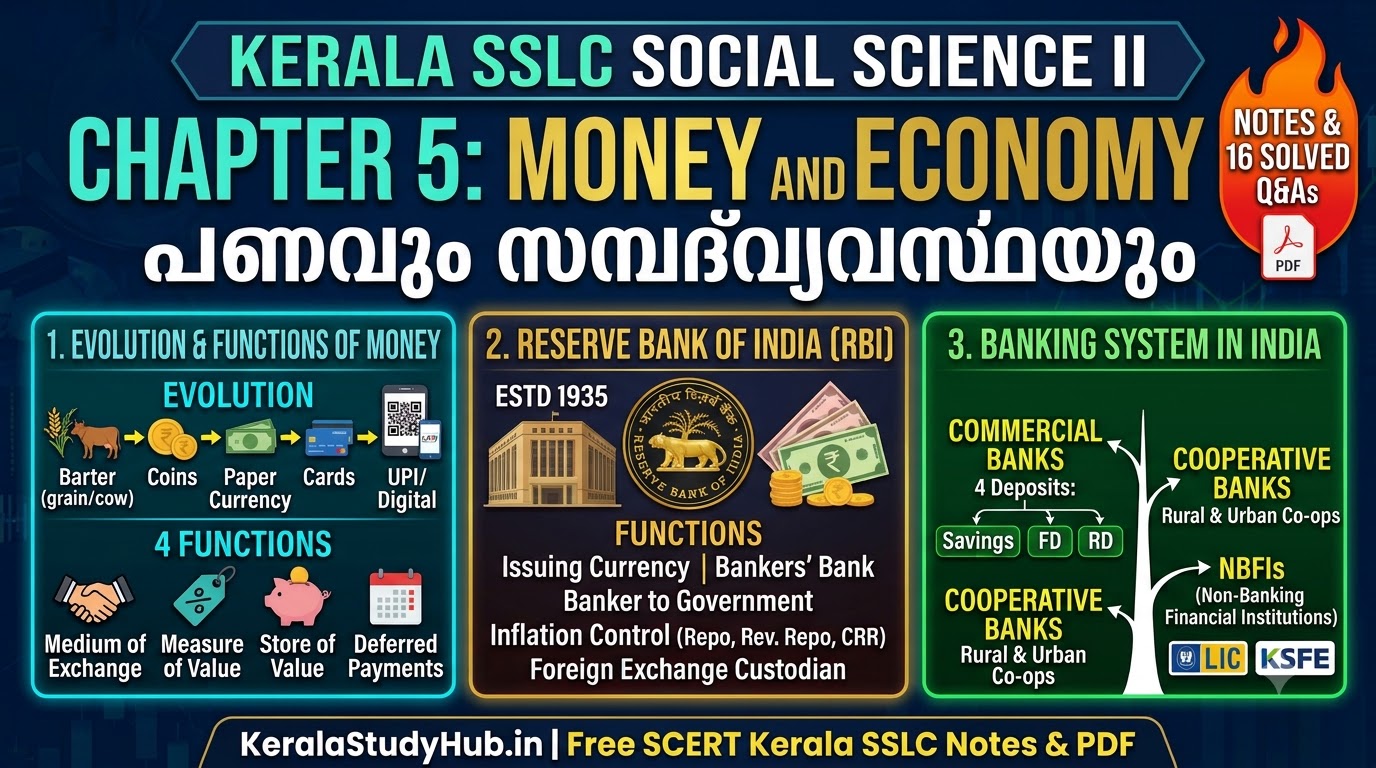
Kerala SSLC Social Science 2 Chapter 5 Notes on Money and Economy (Malayalam Medium: പണവും സമ്പദ്വ്യവസ്ഥയും) welcome you to the fifth unit of the newly revised Class 10 (Std 10) Social Science II (Economics) textbook published by the State Council of Educational Research and Training (SCERT Kerala). In my classroom, when we begin this chapter, I take out a Rs. 100 note and ask my students to read the promise printed on it signed by the Governor of the Reserve Bank of India (RBI), and then ask: “Why does the RBI raise the Repo Rate when prices of vegetables and fuel go up? And how do Commercial Banks, Cooperative Banks, and UPI digital payments keep our economy moving?”
- 1. Evolution of Money, Velocity of Circulation & The 4 Functions of Money (പണത്തിന്റെ ധർമ്മങ്ങൾ)
- 2. Reserve Bank of India (RBI): Functions, Inflation & Monetary vs Fiscal Policy (റിസർവ് ബാങ്കിന്റെ ധർമ്മങ്ങളും നാണയപ്പെരുപ്പവും)
- 2.1 What Is Inflation & How Does the RBI Control It? (4-Mark / 6-Mark Question)
- 3. Commercial Banks, Cooperative Banks, NBFIs & Financial Inclusion (ബാങ്കിങ് സംവിധാനവും സാമ്പത്തിക ഉൾച്ചേർക്കലും)
- 4. Complete SCERT Textbook “Let Us Assess” Solutions + 16 Extra Exam Questions & Answers
- Part A: SCERT Textbook “Let Us Assess” Questions and Answers (All Solved)
- Part B: Extra Sure-Shot Board Exam Questions and Answers (Q7 to Q16)
Designed strictly for the Kerala Pareeksha Bhavan SSLC Public Examination (and Kerala PSC examinations), this complete classroom guide covers the 4 Functions of Money, the 6 Functions of the Reserve Bank of India (RBI), Inflation & Credit Control (Repo Rate, Reverse Repo Rate, CRR), Commercial vs Cooperative Banks vs NBFIs, and 16 Full Solved Textbook + Extra Exam Questions and Answers.
Quick SSLC Social Science II Navigation: Revise Chapter 3: Rainy Forests to Permafrost | Chapter 4: Consumer: Rights and Protection | Next: Chapter 6: The Changing Earth | SSLC Social Science I (History) All 9 Chapters Hub.
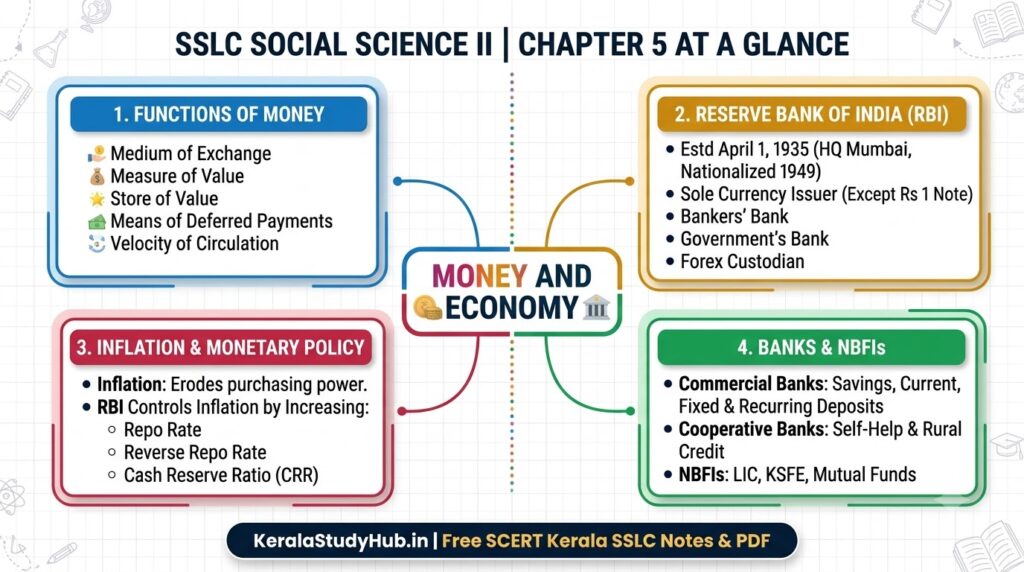
CHAPTER 5 AT A GLANCE: CLASS 10 SOCIAL SCIENCE II (MONEY & BANKING) BLUEPRINT
- 4 Functions of Money: (1) Medium of Exchange, (2) Measure of Value, (3) Store of Value, and (4) Means of Deferred Payments (lending and borrowing).
- Reserve Bank of India (RBI — Central Bank): Established on April 1, 1935 in Kolkata; headquarters shifted to Mumbai in 1937; nationalized in 1949; headed by the RBI Governor. Prints all currency notes except Rs. 1 notes and coins (issued by the Ministry of Finance).
- Controlling Inflation (Monetary Policy): During inflation, RBI reduces money supply by increasing Repo Rate, Reverse Repo Rate, and Cash Reserve Ratio (CRR).
- Financial Institutions: Commercial Banks (accept 4 types of deposits & lend money), Cooperative Banks (cooperation, self-help & mutual assistance for rural farmers), and Non-Banking Financial Institutions (NBFIs) (LIC, KSFE, Mutual Funds — cannot accept savings deposits).
1. Evolution of Money, Velocity of Circulation & The 4 Functions of Money (പണത്തിന്റെ ധർമ്മങ്ങൾ)
Before the invention of money, goods were exchanged directly for goods under the Barter System. Due to the difficulties of the Barter System (lack of double coincidence of wants, inability to store perishable goods, and lack of a common measure of value), money evolved through five stages: Commodity Money (cattle, leather, grains) → Metallic Money (gold, silver, copper coins) → Paper Currency → Plastic Money (Debit & Credit Cards) → Electronic/Digital Money (UPI, Net Banking, Mobile Wallets).
| Function of Money | How It Facilitates Economic Activity (4-Mark Exam Question!) |
|---|---|
| 1. Medium of Exchange (വിനിമയ മാധ്യമം) | Goods and services can be bought and sold effortlessly using money, eliminating the need for double coincidence of wants in countless daily transactions. |
| 2. Measure of Value (മൂല്യത്തിന്റെ അളവുകോൽ) | Just as weight is measured in kilograms and length in metres, the value of every good and service is expressed in terms of money (Price), making it easy to compare the values of different goods. |
| 3. Store of Value (മൂല്യത്തിന്റെ ശേഖരം) | Allows individuals to convert the value of any asset or perishable agricultural produce into money and store it safely as savings for future use. |
| 4. Means of Deferred Payments (ഭാവിയിലെ കൊടുക്കൽ വാങ്ങലുകൾ) | Serves as a reliable standard for lending, borrowing, credit purchases, and repaying loans at a future date. |
Velocity of Circulation of Money (പണത്തിന്റെ പര്യായവേഗത): The number of times a unit of currency changes hands for transactions within a specific period is called its velocity of circulation. An increase in the velocity of circulation of money accelerates trade, production, and economic growth, whereas a slowdown leads to economic stagnation.
2. Reserve Bank of India (RBI): Functions, Inflation & Monetary vs Fiscal Policy (റിസർവ് ബാങ്കിന്റെ ധർമ്മങ്ങളും നാണയപ്പെരുപ്പവും)
The Reserve Bank of India (RBI) is the apex Central Bank of India. It was established on April 1, 1935 in Kolkata, shifted its permanent headquarters to Mumbai in 1937, and was nationalized in 1949. It is headed by the RBI Governor.
- Printing and Issuing Currency: The RBI has the sole monopoly to print and issue all currency notes in India (Rs. 2, 5, 10, 20, 50, 100, 200, 500), except One-Rupee notes and all coins, which are issued by the Ministry of Finance, Government of India.
- Bankers’ Bank (ബാങ്കുകളുടെ ബാങ്ക്): Acts as the regulator, supervisor, clearing house, and “Lender of Last Resort” for all scheduled commercial and cooperative banks in India.
- Controls Money Supply and Credit: Regulates the volume of money and bank credit in the economy using interest rates (Repo, Reverse Repo) and reserve ratios (CRR, SLR) to control inflation and deflation.
- Government’s Bank (സർക്കാരിന്റെ ബാങ്ക്): Accepts deposits, makes payments, manages public debt, issues bonds/treasury bills, and advises both the Central and State Governments on financial matters.
- Custodian of Foreign Exchange Reserves: Holds and manages India’s foreign currency and gold reserves and maintains stability in the foreign exchange rate of the Rupee.
- Publication of Reports: Publishes authentic economic and banking data, surveys, and monetary policy reports.
2.1 What Is Inflation & How Does the RBI Control It? (4-Mark / 6-Mark Question)
Inflation (നാണയപ്പെരുപ്പം) is an economic condition characterized by a continuous, general rise in the prices of goods and services accompanied by a decline in the purchasing power (value) of money. When unchecked money supply increases total demand without a corresponding increase in the production of goods, inflation occurs.
| RBI Credit Control Tool | Meaning | Action Taken by RBI to Control Inflation |
|---|---|---|
| 1. Repo Rate (റിപ്പോ നിരക്ക്) | The rate of interest charged by the RBI when it lends short-term funds to commercial banks. | Increased: Makes borrowing from RBI costlier; commercial banks raise loan interest rates, reducing public borrowing and money supply. |
| 2. Reverse Repo Rate (റിവേഴ്സ് റിപ്പോ നിരക്ക്) | The rate of interest paid by the RBI to commercial banks when banks deposit their surplus funds with the RBI. | Increased: Encourages commercial banks to park surplus money safely with the RBI rather than lending it out, reducing money in circulation. |
| 3. Cash Reserve Ratio (CRR — കരുതൽ ധന അനുപാതം) | The minimum percentage of total deposits that every commercial bank must keep as cash reserves with the RBI. | Increased: Locks up a larger share of bank deposits with the RBI, leaving banks with less money to give out as loans. |
3. Commercial Banks, Cooperative Banks, NBFIs & Financial Inclusion (ബാങ്കിങ് സംവിധാനവും സാമ്പത്തിക ഉൾച്ചേർക്കലും)
- Commercial Banks & 4 Types of Deposits: Commercial banks accept deposits from the public and lend money for agriculture, industry, housing, and education:
1. Savings Deposit (സേവിംഗ്സ് നിക്ഷേപം): Encourages saving habit among households; offers low interest and allows withdrawals with minor restrictions.
2. Current Deposit (കറന്റ് നിക്ഷേപം): Meant for businessmen and traders; allows unlimited deposits and withdrawals daily; carries no interest and provides an Overdraft facility.
3. Fixed / Term Deposit (സ്ഥിര നിക്ഷേപം): Money deposited for a fixed period (e.g., 1 to 5 years); earns the highest rate of interest.
4. Recurring Deposit (ആവർത്തന നിക്ഷേപം): Fixed amount deposited every month for a specific period (ideal for salaried persons and small savers). - Cooperative Banks (സഹകരണ ബാങ്കുകൾ): Work on the principles of cooperation, self-help, and mutual assistance. Their main objectives are to provide low-cost agricultural and rural loans, rescue villagers and ordinary farmers from the exploitation of private moneylenders, inculcate saving habits, and distribute credit equitably.
- Non-Banking Financial Institutions (NBFIs — ബാങ്കിംഗ് ഇതര ധനകാര്യ സ്ഥാപനങ്ങൾ): Institutions like LIC (Life Insurance Corporation), GIC, Mutual Funds (UTI), and KSFE (Kerala State Financial Enterprises — Chitty & Gold Loans) provide specialized financial, investment, and risk-management services. Unlike banks, NBFIs cannot accept demand/savings deposits withdrawable by cheque.
4. Complete SCERT Textbook “Let Us Assess” Solutions + 16 Extra Exam Questions & Answers
Part A: SCERT Textbook “Let Us Assess” Questions and Answers (All Solved)
Q1. (Textbook) Explain the four major functions of Money in an economy.
Answer: (1) Medium of Exchange: Facilitates the buying and selling of goods and services smoothly without the hurdles of barter.
(2) Measure of Value: Expresses the value of every commodity and service in monetary terms (price), making comparison of values easy.
(3) Store of Value: Enables people to save wealth and purchasing power in liquid form for future needs.
(4) Means of Deferred Payments: Acts as the standard medium for borrowing, lending, and settling future credit obligations.
Q2. (Textbook) What are the major functions of the Reserve Bank of India (RBI)?
Answer: Established on April 1, 1935 and nationalized in 1949, the RBI performs six primary functions:
1. Printing and Issuing Currency: Issues all currency notes in India except One-Rupee notes and coins.
2. Bankers’ Bank: Regulates and supervises all commercial banks and acts as the lender of last resort.
3. Controller of Money Supply and Credit: Uses Repo Rate, Reverse Repo Rate, and CRR to control inflation and stabilize the economy.
4. Government’s Bank: Handles banking transactions, public debt, and financial advisory for the Central and State Governments.
5. Custodian of Foreign Exchange Reserves: Protects forex reserves and stabilizes the exchange value of the Rupee.
6. Publication of Economic Reports.
Q3. (Textbook) Elaborate on how Inflation affects purchasing power and economic growth in India, and the measures used by the RBI to control it.
Answer: Inflation is a sustained rise in general prices that erodes the value of money—meaning each Rupee buys fewer goods and services, reducing consumers’ purchasing power and hurting fixed-income families. Unchecked inflation discourages savings, creates business uncertainty, and slows down production.
Measures to Control Inflation: The RBI increases the Repo Rate (making bank loans costlier), increases the Reverse Repo Rate (absorbing surplus cash from banks), and raises the Cash Reserve Ratio (CRR) (reducing the lendable funds with commercial banks), thereby contracting excess money supply and bringing prices down.
Q4. (Textbook) Evaluate the relationship between Fiscal Policy and Monetary Policy in managing the Indian economy.
Answer: Fiscal Policy is formulated by the Government using taxation, public expenditure, and public borrowing to influence aggregate demand and development. Monetary Policy is formulated by the Reserve Bank of India (RBI) using interest rates (Repo/Reverse Repo) and credit-control ratios (CRR/SLR) to regulate money supply and price stability. Both policies must work in close coordination: for instance, during inflation, the RBI tightens credit while the government curbs unnecessary expenditure; during a recession, the government increases public infrastructure spending while the RBI lowers interest rates to stimulate investment and employment.
Q5. (Textbook) Discuss the role of the Cooperative Banking System in enhancing financial inclusion in rural areas.
Answer: Operating on the principles of cooperation, self-help, and mutual assistance, Cooperative Banks play a vital role in rural financial inclusion: (1) They provide low-interest loans to small farmers, artisans, and self-help groups; (2) They rescue villagers from the debt-trap of private moneylenders charging exorbitant interest; (3) They inculcate the habit of thrift and savings among rural households; and (4) They ensure equitable distribution of credit at the grassroots level.
Q6. (Textbook) Analyze how Non-Banking Financial Institutions (NBFIs) complement the banking sector in India.
Answer: Non-Banking Financial Institutions (such as insurance companies like LIC and GIC, mutual funds like UTI, microfinance bodies, and chit/loan enterprises like KSFE) cannot accept demand/savings bank deposits checkable by cheque, but they mobilize public savings through specialized financial products. They complement commercial banks by providing life/general insurance, risk management, long-term capital investment, gold loans, and chit funds to underserved segments, broadening financial inclusion.
Part B: Extra Sure-Shot Board Exam Questions and Answers (Q7 to Q16)
Q7. When and where was the Reserve Bank of India (RBI) established, when was its headquarters shifted to Mumbai, and when was it nationalized?
Answer: The RBI was established on April 1, 1935 in Kolkata; its headquarters was shifted to Mumbai in 1937; and it was nationalized by the Government of India in 1949.
Q8. Who issues One-Rupee notes and coins in India, and whose signature appears on a One-Rupee note?
Answer: One-Rupee notes and all coins are issued by the Ministry of Finance, Government of India, and the One-Rupee note bears the signature of the Finance Secretary (whereas all higher denomination currency notes are issued by the RBI and bear the signature of the RBI Governor).
Q9. Distinguish between Repo Rate and Reverse Repo Rate.
Answer: Repo Rate is the interest rate at which the Reserve Bank of India lends short-term money to commercial banks. Reverse Repo Rate is the interest rate at which the RBI borrows money from commercial banks (or the rate commercial banks earn when they park surplus funds with the RBI).
Q10. Compare the four types of deposits accepted by Commercial Banks.
Answer: (1) Savings Deposit: Helps individuals save money with moderate interest and withdrawal facility; (2) Current Deposit: For traders/firms with unlimited daily transactions, Overdraft facility, and zero interest; (3) Fixed Deposit: Lump sum deposited for a fixed tenure earning the highest interest rate; (4) Recurring Deposit: Fixed monthly instalments deposited over a chosen tenure.
Q11. What is meant by an “Overdraft” facility, and to which bank account holders is it granted?
Answer: An Overdraft (OD) is a credit facility granted by commercial banks to reliable Current Account holders (businessmen/traders), allowing them to withdraw more money from their account than the actual balance available up to a specified limit.
Q12. Distinguish between NEFT, RTGS, and UPI in modern digital banking.
Answer: (1) NEFT (National Electronic Funds Transfer): Electronic transfer of funds between bank accounts settled in half-hourly batches with no minimum limit; (2) RTGS (Real Time Gross Settlement): Instant, real-time transfer of large-value funds (minimum Rs. 2 Lakh); (3) UPI (Unified Payments Interface): Instant 24×7 mobile-based payment system allowing real-time bank-to-bank transfers using a Virtual Payment Address or QR code.
Q13. What were the major drawbacks of the Barter System that led to the invention of Money?
Answer: (1) Lack of Double Coincidence of Wants (both parties had to simultaneously want what the other offered); (2) Absence of a common measure of value; (3) Difficulty in dividing indivisible goods (like livestock); and (4) Difficulty in storing perishable wealth for future use.
Q14. What is Financial Inclusion, and how does the Pradhan Mantri Jan Dhan Yojana (PMJDY) promote it?
Answer: Financial Inclusion is the delivery of formal banking, credit, insurance, and payment services at an affordable cost to disadvantaged and low-income groups. PMJDY promotes financial inclusion by enabling every unbanked citizen to open a zero-balance bank account with a RuPay debit card, accidental insurance cover, and Direct Benefit Transfer (DBT) of government subsidies.
Q15. How do Self-Help Groups (SHGs) and Microfinance (such as Kudumbashree in Kerala) empower rural households?
Answer: Microfinance institutions and Neighbourhood Groups (NHGs) under Kudumbashree collect small weekly thrift savings from women, link them with banks for collateral-free micro-loans, promote micro-enterprises, and eradicate rural poverty while empowering women economically.
Q16. Why is the Reserve Bank of India called the “Bankers’ Bank”?
Answer: Just as ordinary citizens keep accounts with commercial banks and borrow from them in times of need, all commercial banks maintain cash reserves (CRR) with the RBI, settle inter-bank claims through the RBI, follow RBI regulations, and borrow emergency funds from the RBI as the “Lender of Last Resort”.
പത്താം ക്ലാസ് സാമൂഹ്യശാസ്ത്രം II അദ്ധ്യായം 5: പണവും സമ്പദ്വ്യവസ്ഥയും (മലയാളം മീഡിയം നോട്ടുകൾ)
- പണത്തിന്റെ 4 പ്രധാന ധർമ്മങ്ങൾ: (1) വിനിമയ മാധ്യമം (Medium of Exchange), (2) മൂല്യത്തിന്റെ അളവുകോൽ (Measure of Value), (3) മൂല്യത്തിന്റെ ശേഖരം (Store of Value), (4) ഭാവിയിലെ കൊടുക്കൽ വാങ്ങലുകൾ (Means of Deferred Payments).
- റിസർവ് ബാങ്ക് ഓഫ് ഇന്ത്യ (RBI): ഇന്ത്യയുടെ കേന്ദ്ര ബാങ്ക്. 1935 ഏപ്രിൽ 1-ന് കൊൽക്കത്തയിൽ സ്ഥാപിതമായി; 1937-ൽ ആസ്ഥാനം മുംബൈയിലേക്ക് മാറ്റി; 1949-ൽ ദേശസാൽക്കരിച്ചു. ധർമ്മങ്ങൾ: കറൻസി നോട്ടുകൾ അച്ചടിച്ചിറക്കൽ (ഒരു രൂപ നോട്ടും നാണയങ്ങളും ഒഴികെ — അവ കേന്ദ്ര ധനകാര്യ മന്ത്രാലയമാണ് പുറത്തിറക്കുന്നത്), ബാങ്കുകളുടെ ബാങ്ക്, വായ്പാ നിയന്ത്രണം, സർക്കാരിന്റെ ബാങ്ക്, വിദേശനാണ്യ ശേഖരത്തിന്റെ സൂക്ഷിപ്പുകാരൻ.
- നാണയപ്പെരുപ്പവും (Inflation) നിയന്ത്രണവും: സാധനങ്ങളുടെയും സേവനങ്ങളുടെയും വില അനിയന്ത്രിതമായി ഉയരുകയും പണത്തിന്റെ മൂല്യം (വാങ്ങൽ ശേഷി) കുറയുകയും ചെയ്യുന്ന അവസ്ഥയാണ് നാണയപ്പെരുപ്പം. ഇത് നിയന്ത്രിക്കാൻ ആർ.ബി.ഐ റിപ്പോ നിരക്ക് (Repo Rate), റിവേഴ്സ് റിപ്പോ നിരക്ക് (Reverse Repo Rate), കരുതൽ ധന അനുപാതം (CRR) എന്നിവ വർദ്ധിപ്പിക്കുന്നു.
Teacher’s Classroom Note & Student Discussion Question:
Dear SSLC Students, “Functions of the Reserve Bank of India (RBI) and How RBI Controls Inflation” is one of the most repeated 6-Mark Essay Questions in SSLC Social Science II! Quick Question for You: Which authority issues One-Rupee notes and coins in India, and what does the RBI do to the Repo Rate and CRR during inflation? Write your answer in the comments below!




Latest SCERT & DHSE Kerala Study Notes
- Kerala Class 9 Physics Chapter 2 Notes: Equations of Motion (ചലനസമവാക്യങ്ങൾ) Std 9 Let Us Assess Questions and Answers PDF
- Kerala SSLC Christmas Exam Question Paper 2025-27: All Subjects Second Term & Model Question Papers with Solved Answer Keys PDF (New SCERT Syllabus)
- Kerala SSLC English Christmas Exam Question Paper 2025-27: Second Term & Model Solved 80-Mark Answer Key, Discourses & Grammar PDF
- Kerala SSLC Social Science Christmas Exam Question Paper 2025-27: Second Term & Model Solved 80-Mark Answer Key, Weightage & Map Study PDF
- Kerala SSLC Maths Christmas Exam Question Paper 2025-27: Second Term & Model Solved Answer Key, Weightage & Formula Sheet PDF (New SCERT Syllabus)
- Kerala SSLC Biology Christmas Exam Question Paper 2025-27: Second Term & Model Solved Answer Key, Weightage & Flowcharts PDF (New SCERT Syllabus)
- Kerala SSLC Chemistry Christmas Exam Question Paper 2025-27: Second Term & Model Solved Answer Key, Weightage & Sure A+ Questions PDF (New SCERT Syllabus)
- Kerala SSLC Physics Christmas Exam Question Paper 2025-27: Second Term & Model Solved Answer Key, Weightage & Formula Sheet PDF (New SCERT Syllabus)